Telephone/WhatsApp:+86 156 2656 0610

Telephone/WhatsApp:+86 156 2656 0610
Email:info@seekmach.com

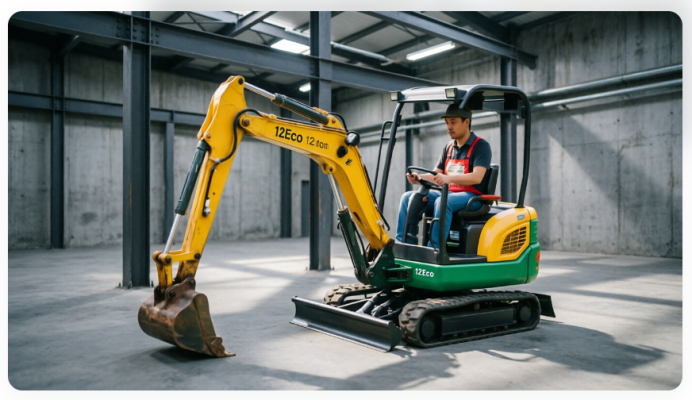
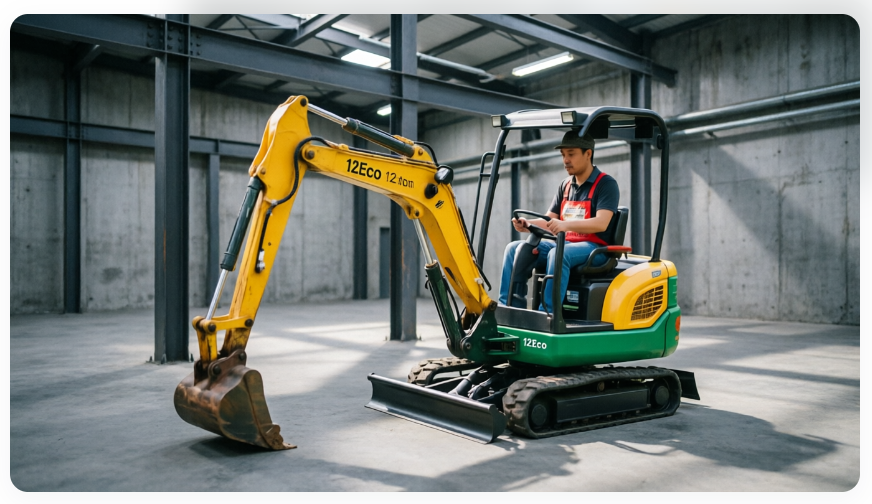
You know the scenario. The client wants a multi-tiered water feature, a sunken fire pit, and extensive French drains. The budget is phenomenal, but there’s a catch: the only access is a 38-inch side gate, the lawn is pristine, and you are working right next to a century-old oak tree.
Bringing in heavy iron is out of the question. Trying to do it with wheelbarrows and spades will destroy your profit margin in labor costs alone. This is exactly where the 1.2 Ton Mini Excavator stops being just a piece of rental equipment and becomes the most critical surgical tool in your fleet.
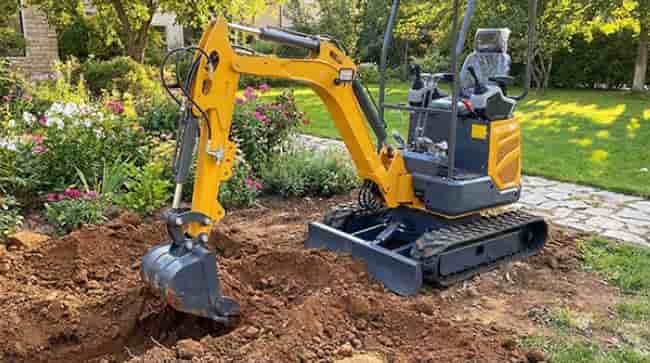
Specifically, we need to talk about the 1.2 Ton Mini Excavator -12Eco. Operating this machine in established, high-value gardens isn’t just about digging holes; it is an exercise in applied physics, soil mechanics, and hydraulic finesse. If you are running this machine on a delicate residential site, here is the deep-dive technical briefing you need to avoid catastrophic site damage and maximize your operational efficiency.
Every brochure tells you a Mini Excavator has “low ground pressure.” But what does that actually mean when you are tracking over an irrigated, aerated residential lawn?
Let’s look at the math. The ground bearing pressure is determined by the weight of the machine distributed over the contact area of the tracks.
When you track a 1200 kg machine across a lawn, the static force $F$ exerted by gravity $g$ ($9.81 \text{ m/s}^2$) is:
$$F = m \cdot g = 1200 \text{ kg} \cdot 9.81 \text{ m/s}^2 = 11772 \text{ N}$$
If your tracks have a combined ground contact area $A$ of approximately $0.6 \text{ m}^2$, the pressure $P$ is:
$$P = \frac{F}{A} = \frac{11772}{0.6} = 19620 \text{ Pa} \approx 2.8 \text{ PSI}$$
At roughly 2.8 PSI, the static footprint is lighter than a grown man’s footstep. However, gardens are rarely static. The moment you initiate a zero-turn radius spin (slewing the tracks in opposite directions), you introduce rotational shear forces. The rubber tracks of the -12Eco will grip the turf, and the torque will literally rip the sod from its root bed.
The Expert Playbook:
One of the fastest ways to get sued on a high-end landscaping job is killing a heritage tree. When you bring a machine into a garden, you are entering the Critical Root Zone (CRZ).
According to arborist standards often cited by the International Society of Arboriculture, the CRZ is calculated as 1 foot of radius for every 1 inch of trunk diameter at breast height (DBH). If you are trenching for irrigation within this zone, a standard bucket will sever anchor roots, destabilizing the tree and inviting fungal infections.
This is where the precision of the 1.2 Ton Mini Excavator -12Eco shines.
Modern garden designs love terracing. Operating on slopes introduces the risk of dynamic rollover. The -12Eco is built with a low center of gravity (CG), but the moment you boom up with a bucket full of dense topsoil (which can weigh up to 100 kg), your CG shifts dramatically upward and outward.
| Operation State | CG Shift | Rollover Risk Level | Mitigation Strategy |
| Tracking Up Slope (Empty) | Shifts Rearward | Low | Keep boom low, bucket pointing uphill. |
| Tracking Cross-Slope | Shifts Laterally | Critical | Avoid. If necessary, build a level bench to track across. |
| Swinging Loaded Bucket Downhill | Shifts Forward/Down | High | Keep dozer blade planted downhill. Keep load 10 inches off the ground. |
The Dozer Blade as an Anchor: The front dozer blade isn’t just for backfilling. When you are positioned on a 15-degree slope in a backyard, plunge that blade into the downhill soil. It acts as a mechanical stabilizer. If you need to break through compacted hardpan, the blade prevents the machine from pushing itself backward.
Let’s talk about setting a 300 kg limestone boulder next to a glass pool fence. You don’t need raw power here; you need surgical flow control.
Many operators make the mistake of running the engine at full throttle (rabbit mode) to get maximum hydraulic pressure. In precision hardscaping, this is a recipe for disaster. The auxiliary hydraulic lines on the -12Eco can be metered perfectly. By running at half-throttle (turtle mode), you “micro-dose” the hydraulic fluid to the boom and stick cylinders.
This allows you to lower that limestone boulder at a rate of centimeters per second. You can find comprehensive specs on its hydraulic displacement on the main SeekMach equipment portal.
“In residential work, speed is a liability. The mark of a professional is how slow and smooth they can make the machine move when the tolerances are measured in millimeters.”
Backyards are a wild west of undocumented utilities. While major gas and power lines are usually marked, homeowners notoriously bury PVC irrigation pipes, low-voltage lighting wires, and pool filter lines just inches below the surface.
The breakout force of the -12Eco’s arm is immense—easily enough to snap a 2-inch PVC main without the engine even bogging down.
Working in gardens means dealing with mud, mulch, and abrasive sand. If you neglect daily checks, the machine will fail when you need it most.
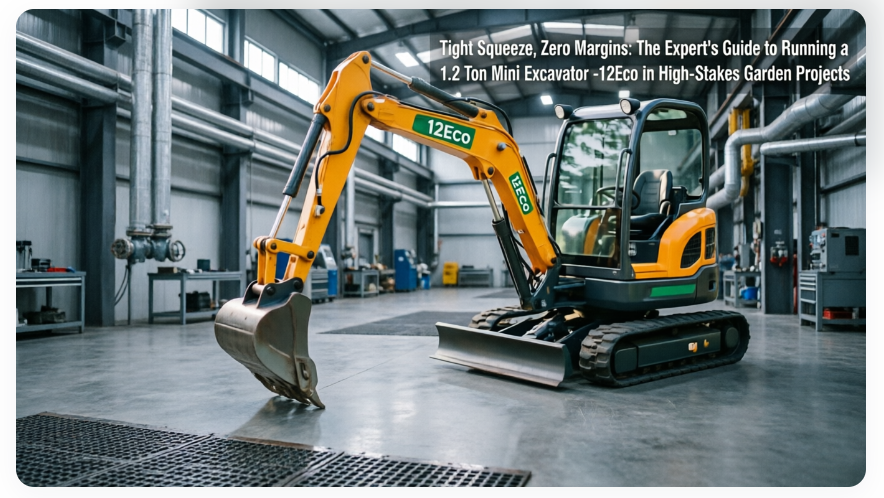
For a visual breakdown of how fluid these compact machines can operate in confined spaces, check out this excellent industry overview:
Ultimately, high-end landscaping is about managing risk while maximizing output. You cannot afford to tear down a client’s fence, ruin their driveway, or crush their drainage system just to dig a hole.
The 1.2 Ton Mini Excavator -12Eco provides the exact balance of hydraulic breakout force and microscopic control needed for these high-stress environments. It allows you to bid on complex, tight-access jobs that your competitors have to walk away from. It’s not just an excavator; in the right hands, it’s a competitive advantage.
Explore our full range of solutions designed for challenging environments at our Mini Excavators category page.
Q1: What happens if I strike an unexpected concrete footing in the garden?
Immediately stop curling the bucket. The -12Eco has pressure relief valves, but continuously trying to rip out a solid concrete block will strain the boom cylinder. Dig around the object to determine its size. If it’s too large, switch to an auxiliary hydraulic breaker attachment, which the -12Eco can easily run.
Q2: Can the -12Eco track over an asphalt driveway in the middle of summer?
You must exercise extreme caution. In 90°F+ (32°C+) weather, asphalt softens. Even with rubber tracks, a zero-turn pivot will tear the asphalt, leaving permanent scars. Always lay down heavy-duty conveyor belting or plywood over asphalt in hot weather, and make wide, gradual turns.
Q3: The soil is purely saturated clay. How do I prevent the tracks from spinning and digging a trench?
Saturated clay fills the treads of rubber tracks, turning them into slick slicks. Do not try to power through. Use your boom and stick to push/pull the machine. Plant the bucket teeth into solid ground ahead of you, and use the hydraulic arm to drag the machine forward, rather than relying solely on the track drive motors.
Q4: How do I manage the exhaust fumes and heat when working in a highly enclosed courtyard garden?
While the -12Eco meets stringent emissions standards (hence the ‘Eco’ designation), enclosed courtyards with high walls trap heat and carbon monoxide. You must ensure cross-ventilation. If the air is stagnant, bring in industrial fans. Furthermore, be aware that the machine’s cooling fan blows hot air out the back; don’t park the rear of the machine inches away from a client’s expensive exotic plants, or you will scorch them.
Q5: Is it safe to lift root balls and trees using the bucket eyelet?
Yes, but you must calculate the dynamic load. A root ball that weighs 300 kg dry can weigh 600 kg after a rainstorm. Always use certified lifting slings attached to the designated lifting point on the linkage, never just loop a chain around the bucket teeth. Keep the load low to the ground and avoid sudden hydraulic jerks.
References & Further Reading: