Telephone/WhatsApp:+86 156 2656 0610
Telephone/WhatsApp:+86 156 2656 0610
Email:info@seekmach.com

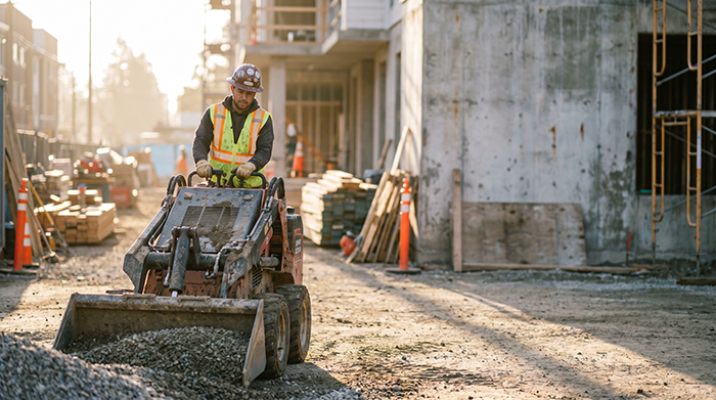
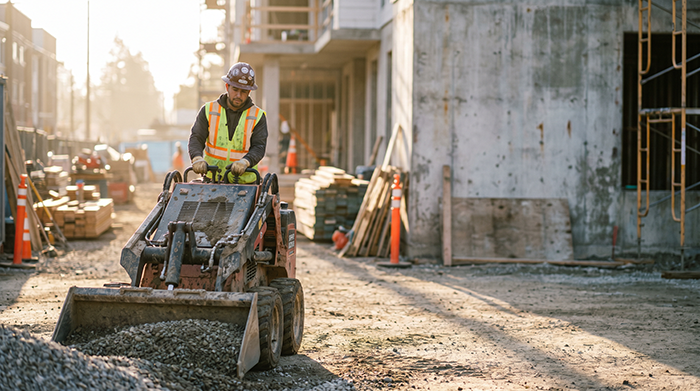
The modern job site has a space problem, a labor problem, and a deadline problem — and they’re all getting worse at the same time. Crews are shrinking, project footprints are tightening, and the days of throwing bodies and bulldozers at every challenge are firmly behind us. The answer isn’t a bigger machine. It’s a smarter one.
“The biggest trend in the landscaping industry is the move toward small-platform sub-compact loaders. Contractors are struggling with labor shortages, and these machines allow one operator to do the work of five people.” — Landscape Management Magazine
That shift is real, and it’s accelerating. Across landscaping, construction, and site prep, professionals are moving away from oversized equipment that creates as many headaches as it solves. The demand for the right mini skid steer for sale has never been higher — and the market is responding.
The SM-460W sits squarely at the intersection of raw capability and practical portability. It’s purpose-built for the reality contractors actually face: tight access points, lean crews, and unforgiving schedules. This machine doesn’t ask you to compromise between power and maneuverability — it delivers both.
The 460-series represents a genuine sweet spot. Powerful enough to move serious material, compact enough to work where larger machines simply can’t go. Before diving into what makes it stand out, it helps to understand exactly what a mini skid steer is — and why the mechanics behind it matter so much on a real job site.
Before diving deeper into what makes the SM-460W a standout machine, it helps to understand the category it belongs to — and why that category exists in the first place.
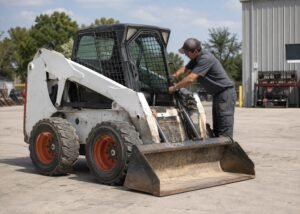
A skid steer loader is a small, rigid-frame, engine-powered machine with lift arms designed to accept a wide variety of labor-saving tools and attachments. The “skid” in the name isn’t just branding — it’s a description of how the machine actually moves. Unlike conventional vehicles that steer by turning their front wheels, a skid steer achieves direction by varying the speed or rotation of its wheels on opposing sides. The wheels on one side skid — or drag — across the ground, forcing the machine to pivot. The result? A zero-radius turn that lets the operator spin the machine completely within its own footprint.
That capability is more than a party trick. On confined job sites, it’s the difference between getting work done and getting stuck.
Most people picture rubber tires when they think of skid steers, but wheel-tracked models — which ride on continuous rubber tracks instead — offer a distinct advantage in muddy, uneven, or soft terrain. Tracks distribute the machine’s weight over a larger surface area, dramatically reducing ground pressure and improving traction where tires would spin out or sink.
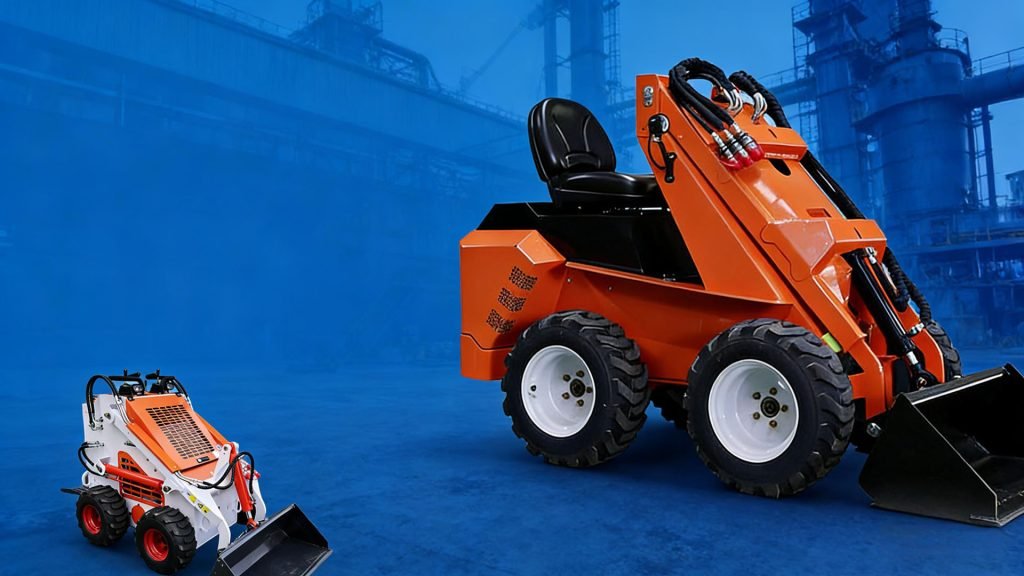
The heavy duty mini skid steer designation signals something counterintuitive: serious power in a deliberately small package. Compact dimensions open up access to interior demolition sites, narrow alleyways, landscaped residential properties, and crowded urban construction zones where full-size equipment simply cannot operate.
The smallest machine on a job site is often the one doing the most critical work. Mini skid steers fill gaps that no other equipment category can.
Keeping your compact equipment performing at its best matters just as much as choosing the right machine — check out our related guide on Compact Equipment Maintenance for practical tips. And as you’ll see in the next section, the SM-460W’s engineering raises the bar for what “heavy-duty” truly means at this scale.
Understanding what makes the SM-460W different starts with the machine itself — not its marketing. Now that we’ve established what a mini skid steer loader actually does and why the skid-steer drive system matters, it’s time to look at the engineering decisions that separate this machine from lighter-duty alternatives in its class.
The “460” designation isn’t arbitrary. It signals a chassis engineered to a heavier-duty specification than entry-level compact loaders, with a reinforced frame designed to handle sustained stress — not just occasional light landscaping work. Where standard compact machines prioritize low weight above all else, the 460-series chassis balances portability with structural integrity. That’s a meaningful distinction on a job site where equipment failure isn’t just an inconvenience; it’s a schedule-killer.
Small footprint does not mean small capability — the SM-460W proves that compact dimensions and heavy-duty performance aren’t mutually exclusive.
In practice, heavy-duty build quality at the compact scale comes down to component selection and weld integrity. Thicker boom arms, reinforced pivot points, and robust hydraulic fittings are the differences you don’t see in a spec sheet until something goes wrong in the field. According to Construction Equipment Magazine, compact loaders can reduce project timelines by up to 30% in urban environments — but only when the machine is reliable enough to sustain that pace without downtime.
The SM-460W’s wheel-tracked design delivers a critical advantage over standard rubber tires on challenging terrain. On muddy, uneven, or soft ground — exactly the conditions that slow a project down — tracked stability distributes machine weight more evenly, reducing sinkage and improving traction. This isn’t a minor comfort feature; it’s a productivity factor on real-world job sites.
Engine torque delivery complements this stability. Consistent low-end torque means the machine doesn’t bog down under load, which matters most when you’re pushing into compacted soil or lifting near rated capacity.
All of that power, though, is only as useful as what you attach to it — which is exactly where the SM-460W’s hydraulic system becomes the real story.
What separates a capable machine from a genuinely transformative one? In the world of compact equipment, the answer is almost always hydraulics. As Wikipedia notes, modern mini skid steers are defined by their auxiliary hydraulic systems, which allow a single power unit to operate dozens of specialized tools. The SM-460W’s hydraulic output is engineered to handle high-torque, demanding attachments — the kind that lesser machines simply stall out on.
The right attachment doesn’t just expand what you can do. It multiplies what one crew member can accomplish in a single shift.
This is the real ROI argument for the SM-460W. Instead of renting a dedicated auger unit for Monday, a trencher for Wednesday, and a debris grapple for Friday, one machine handles all three. The savings across a single season — in rental fees, transportation costs, and lost time — can easily offset the investment.
[YouTube Video Embed Placeholder — SM-460W attachment changeover and auger demonstration]
The breadth of compatible mini skid steer attachments is exactly what makes this machine a practical fleet replacement rather than just another piece of iron. In the next section, we’ll look at how these capabilities translate across specific industries — from horse stalls to urban demolition sites.
The hydraulic versatility covered in the previous section only tells half the story. The other half plays out on job sites — in muddy stalls, tight alleyways, and overgrown lots where compact power isn’t a luxury, it’s the only practical option. The SM-460W, often compared favorably to a capable t460 mini track skid steer configuration, earns its reputation across three distinctly different work environments.
In farm settings, the SM-460W handles the unglamorous but essential daily grind. Stall cleaning, hay bale repositioning, and fence post installation all become significantly faster with the right loader attachment swapped in under a minute. A mid-sized operation running livestock can realistically replace two to three hours of manual labor per day with a single machine pass.
A common pattern in agricultural operations: farms report cutting daily maintenance time by up to 40% after integrating a compact track loader into routine chores.
Grading uneven terrain, laying sod across large residential lots, and transporting mature trees — these tasks demand both delicacy and raw muscle. The SM-460W’s tight turning radius and low ground pressure make it ideal for finished lawns where wheel-based machines would leave ruts. One practical approach is pairing it with a pallet fork attachment for balled-and-burlapped tree transport, eliminating the need for a second vehicle entirely.
Landscaping crews using compact track loaders typically complete sod installation projects 30–50% faster than hand-laid alternatives.
Urban job sites rarely offer the luxury of open access. Indoor demolition work and material handling in tight alleyways are exactly where full-size equipment fails and the SM-460W thrives. Its compact footprint moves debris, concrete rubble, and palletized materials through standard doorways without structural risk to surrounding walls.
Construction teams report that compact loaders reduce material handling labor costs by an average of 25% on confined-site projects.
For a complete breakdown of compatible tools, the SM-460W Attachment Guide outlines every supported implement by application category. As the Allied Market Research projection of a $22.3 billion compact equipment market by 2030 suggests, demand for machines that do more with less space is accelerating fast — which raises an obvious question: does the SM-460W deliver that kind of value relative to its price point?
The compact equipment market has undergone a quiet revolution. Manufacturing quality in the loader sector has risen sharply over the past decade, closing the gap between budget-friendly machines and premium workhorses. What once required a major capital commitment is now accessible — and the mini skid steer loader model 460 wheel tracked small form factor sits squarely at the center of that shift.
Total Cost of Ownership (TCO) tells a smarter story than sticker price. When crews factor in attachment compatibility, fuel efficiency, reduced labor hours, and minimal downtime, the SM-460W consistently outperforms its initial investment. One versatile machine replacing two or three specialized rentals is a calculation that resonates with any project manager running a tight budget in 2026.
Increasing urbanization is also reshaping procurement decisions. Allied Market Research notes that demand for compact machinery capable of operating in confined spaces is accelerating — and versatile, space-conscious equipment isn’t a luxury anymore; it’s a project requirement.
The SM-460W is purpose-built for exactly this environment. It’s not just a purchase — it’s a long-term investment in operational flexibility.
Ready to run your own numbers? Request a Quote and see how the SM-460W fits your 2026 project planning. You might be surprised how many questions come up — which is exactly what the next section is here to answer.
What’s the difference between the SM-460W and a standard skid steer? The SM-460W combines the lifting capacity of a full-size skid steer with a compact, wheeled footprint designed for tight-space maneuvering. Where standard skid steers can feel oversized and unwieldy in confined areas, the SM-460W’s zero-radius turning allows it to navigate narrow alleyways and indoor sites that would be completely inaccessible to conventional machines, according to Construction Equipment Magazine.
Can the SM-460W be used for indoor demolition? Absolutely — and it’s one of the machine’s standout use cases. Its compact dimensions and zero-turn capability make it well-suited for warehouse gutting, interior strip-outs, and renovation clearance where ceiling height and floor integrity are concerns. In practice, operators pair it with hydraulic breaker attachments for efficient interior concrete removal without bringing in larger, impractical equipment.
What are the most popular attachments for the T460 series? The most commonly spec’d attachments include hydraulic augers, pallet forks, bucket grapples, and rotary tillers. The T460 platform’s universal quick-attach system means operators can swap tools in minutes, keeping job-site downtime minimal across agriculture, landscaping, and demolition applications.
How does the wheel-tracked system perform on soft turf? The SM-460W’s wheeled design distributes ground pressure effectively, minimizing turf damage compared to standard tracked alternatives. However, on extremely saturated or muddy terrain, operators should exercise caution — adding turf tires further reduces surface impact in sensitive landscaping environments.
The bottom line: The SM-460W isn’t just a loader — it’s the kind of force multiplier that reshapes what a small crew can accomplish in a single day. If your operation is still working around equipment limitations rather than through them, it’s time to rethink the toolbox.