Telephone/WhatsApp:+86 156 2656 0610

Telephone/WhatsApp:+86 156 2656 0610
Email:info@seekmach.com

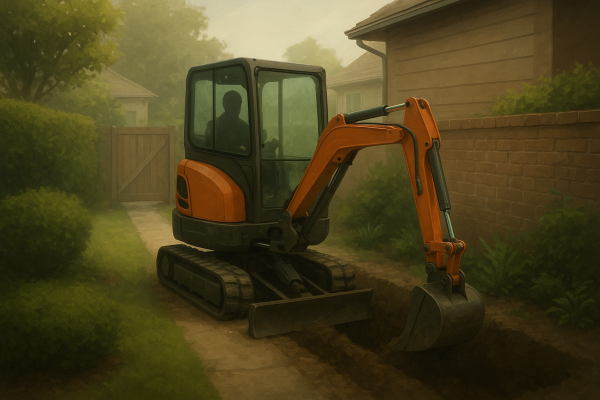
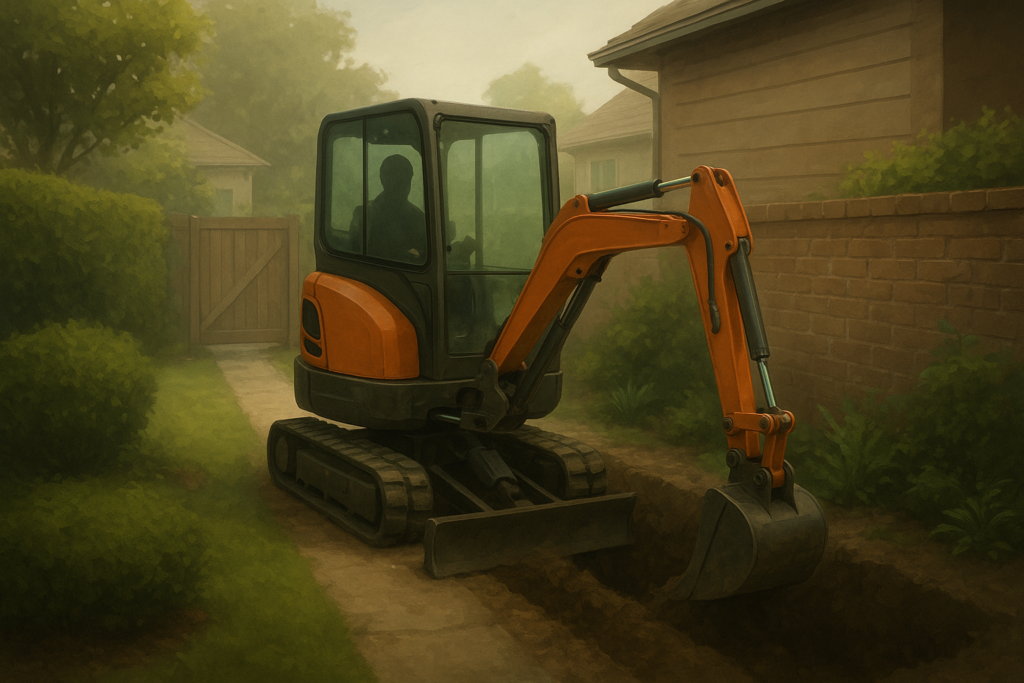
A lot of U.S. buyers aren’t just shopping for “a mini excavator.” They’re shopping for capability per inch—machines that can fit through gates, work in tight backyards, and still run real attachments.
Table of Contents
ToggleIn other words, the demand spike isn’t only about budgets. It’s about jobsite reality:
This guide is built for the consideration stage: you already know what an excavator is. What you need now is a framework that helps you compare a China mini Excavato against your job requirements without getting lost in spec sheets.
Before you compare models, lock down these inputs. You’ll use them as your non-negotiables.
Pro Tip: If you have “one tight gate” that shows up on 20% of jobs, size to that gate. The best machine is the one that gets used.
Trade guidance consistently starts with transport, dig depth, and lift needs because they drive everything else—from productivity to safety to whether you’ll rent a bigger unit later. A practical reference is Compact Equipment’s mini excavator buying/renting guide (2024).
Be brutally honest:
If transport is frequent, you’ll often prioritize compactness and simplicity over maximum size.
Here’s the matrix I’d use to compare any China mini Excavato shortlist.
| Criteria | What to check | Why it matters | Score (0–3) |
|---|---|---|---|
| Access width | Min width / retractable undercarriage | Determines what jobs you can physically enter | |
| Dig depth | Max digging depth + reach | Determines trench/foundation capability | |
| Tail swing | Zero/reduced/conventional | Controls safety and clearance in tight spaces | |
| Hydraulic capability | Aux flow, pressure, circuits, return line | Determines attachment performance | |
| Attachment readiness | Quick coupler, auxiliary lines to stick | Reduces downtime when swapping tools | |
| Stability | Track width, ground pressure, dozer blade | Keeps work safe and predictable | |
| Serviceability | Access panels, daily checks, filter access | Lowers downtime and “mystery failures” | |
| Emissions/aftertreatment | Engine standard, filtration, duty-cycle fit | Impacts compliance and maintenance routine | |
| Noise / neighborhood friendliness | Rated noise if available, muffling design | Matters for residential work (and callbacks) | |
| Operator controls | Ergonomics, smoothness, visibility | Fatigue and precision are cost drivers | |
| Documentation | Manual, parts book, hydraulic schematics | Protects you when you need parts fast | |
| Support plan | Spare parts, response time, consumables | Keeps the machine earning |
Key Takeaway: A comparison matrix does one valuable thing—it forces every seller to answer the same questions.
If you’re evaluating any “eco” mini Excavato option, you don’t need buzzwords—you need clarity.
The U.S. Environmental Protection Agency explains that Tier 4 standards were finalized for nonroad diesel engines to dramatically reduce harmful emissions; see the U.S. EPA page on the Tier 4 nonroad diesel final rule.
For buyers, the practical point is this:
EPA has a clear technical overview of diesel particulate filters (DPFs) and their implications; see the U.S. EPA bulletin “Diesel Particulate Filter General Information”.
Use that bulletin as your question list:
⚠️ Warning: Never assume “eco” means “maintenance-free.” Emissions systems can be reliable—but only when they match the work pattern.
Below are example specs (not industry averages) pulled from SeekMach product pages so you can see how a mini Excavator-ECO shortlist comparison works.
| Model | Operating weight | Engine power (listed options) | Max digging depth | Chassis width | Bucket capacity |
|---|---|---|---|---|---|
| SeekMach 08Eco | 800 kg | 7.6 kW | 1300 mm | 780 mm | 0.02 m³ |
| SeekMach 12Eco | 1200 kg | 7.6 kW / 8.6 kW / 13.5 HP / 10.2 kW | 1626 mm | 800–950 mm | 0.03 m³ |
Spec sources: SeekMach product pages for SeekMach 08Eco and SeekMach 12Eco.
Key Takeaway: Even a small jump in operating weight can bring meaningful reach/depth gains—but you need to make sure access width and transport still work.
If you want to see the broader ECO lineup and how it’s positioned, SeekMach’s category page frames the ECO series as designed to reduce emissions, noise, and fuel use: see SeekMach ECO Series mini excavators.
For a broader view of excavator options and attachments, browse the SeekMach category page (linked later in this guide).
Most mini excavator regret happens here.
Trade buyers’ guides regularly call out auxiliary hydraulics, flow control, and attachment circuits as deciding factors because attachments are what turn a mini excavator into a profit center. A useful overview is the Equipment World Mini Excavator Buyer’s Guide (2026).
If you plan to use attachments, ask these before you buy:
Here’s a practical attachment planning table (brand-neutral):
| Attachment | What it’s for | What to verify before purchase |
|---|---|---|
| Trenching bucket | Utility trenches, irrigation | Bucket pin size, width options |
| Grading/ditching bucket | Backfill, finish work | Tilt function support, edge durability |
| Hydraulic auger | Post holes, planting, footings | Aux flow/pressure, torque needs |
| Hydraulic breaker | Light demo, rock | Aux flow, return line, vibration considerations |
| Thumb | Handling brush/rocks/debris | Mount style, hydraulics for thumb control |
| Grapple | Brush, logs, debris | Aux circuits and control smoothness |
If your shortlist includes a China mini Excavato supplier, the goal isn’t to “trust harder.” It’s to de-risk the purchase with documentation and systems.
Pro Tip: Ask for a “first-year spares kit” recommendation. Even a great machine becomes a headache if a simple consumable stops your week.
If you’re buying at a distance—or importing—your biggest risks usually aren’t “does it dig.” They’re fit, support, and documentation.
Don’t stop at “overall width.” Ask for (and verify):
If your core work is tight-access, one inch matters. A China mini Excavato that can’t pass the gate becomes a yard ornament.
If you plan to run an auger, breaker, or hydraulic thumb, you need more than “it supports attachments.” Get clear answers on:
If the supplier can’t explain the hydraulic setup cleanly, you’re likely signing up for trial-and-error.
For U.S. projects, use the EPA Tier 4 framework as your baseline reference and ask how the engine configuration and aftertreatment are maintained for your work pattern.
What to confirm:
At minimum, you want:
Without these, downtime turns into guesswork—and parts ordering becomes slow and expensive.
Ask for a first-year consumables list (filters, seals, hoses, wear parts) and recommended spares. If the seller won’t provide a parts plan, you’ll build it yourself later—under pressure.
This is a simple way to catch issues early and start your mini Excavato ownership with a clean baseline.
Key Takeaway: Your goal in week one is not maximum production—it’s confirming reliability, leak-free hydraulics, and attachment readiness.
Use one real-world video to validate what “compact work” looks like: control smoothness, swing clearance, and how attachments change the workflow.
If you want a shortlist recommendation, here’s the fastest way to get a clean answer:
Then compare against the mini Excavator-ECO options and request configuration guidance directly from SeekMach:
In everyday use, people often use the terms interchangeably. A compact excavator is generally a smaller class of excavator designed for tight spaces and lighter earthmoving. For a high-level definition, see Wikipedia’s Excavator overview.
Start with your constraints: access width, transport, and required digging depth. If any one of those is a hard limit, it overrides everything else. Then compare machines with a simple scoring matrix so every option answers the same questions.
It can be—especially when your work involves tight access and neighborhood sensitivity (noise, fumes, scheduling). But the key is verifying the engine/aftertreatment configuration and making sure your duty cycle matches the system’s maintenance needs.
Understand the nonroad engine regulatory context and how modern emissions systems affect maintenance. The U.S. EPA Tier 4 page (linked above) is a solid starting point.
Buying for “max specs” instead of actual jobs. A machine that’s too wide for gates, too heavy to transport easily, or underpowered for your attachments will cost you productivity.
Auxiliary hydraulics (flow/pressure), number of aux circuits, and whether the machine is quick-coupler ready. Trade buyer guides emphasize hydraulics and attachment readiness for a reason.
Ask how the system handles regeneration and what monitoring indicators mean in daily operation. EPA’s technical bulletin on particulate filters (linked above) is a useful reference.
SeekMach lists the ECO series as a category with multiple models on its site (linked above).
SeekMach is a professional manufacturer and exporter dedicated to the R&D and production of excavators, loaders and tractors. We guarantee to provide you with the best quality service.