Telephone/WhatsApp:+86 156 2656 0610

Telephone/WhatsApp:+86 156 2656 0610
Email:info@seekmach.com

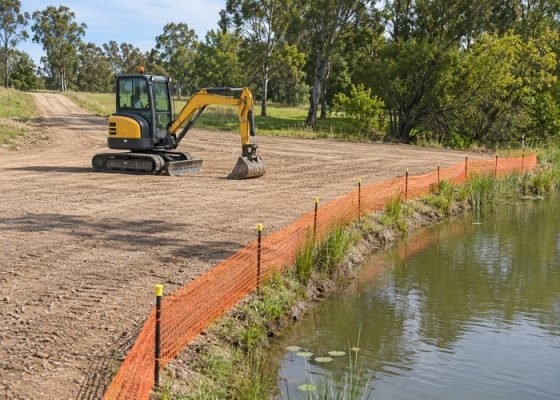
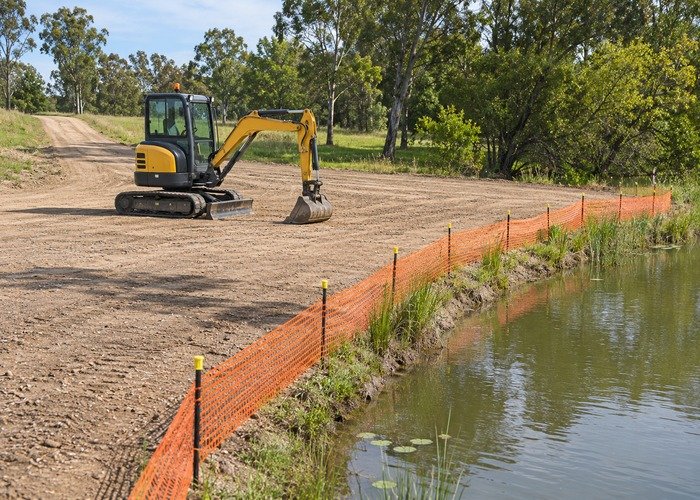
A mini excavator can reach the edge of a pond, ditch, canal, stream, or flooded work area with little room to spare. Its compact size does not remove the risk: tracks can load or break a bank, hidden ground conditions can fail without warning, and a slide or tip into water can become a life-threatening emergency. Plan the work around ground stability and a credible emergency response before moving the machine near water.
Treat the water’s edge as a changing ground and access problem, not simply a place to position the excavator. Assess the bank and the complete travel path, establish an exclusion zone, choose equipment suited to the ground and task, and plan escape and rescue. No single safe setback applies to every bank, machine, and work method.
“Working near water” can describe different jobs. They call for related precautions, but hazards and controls are not interchangeable.
These categories may overlap. A pond-shaping job may include a trench that fills with water; assess each condition separately and apply the relevant controls.
A bank can look firm at the surface while concealing soft fill, saturated soil, erosion, voids, seepage, or a weak layer beneath the tracks. Recent rain, changing water levels, nearby drainage, and previous excavation can alter conditions. A narrow machine may fit beside the water and still impose loads the edge cannot support.
Before mobilizing, inspect the proposed work area and complete approach route. Consider bank height and shape, visible cracks or slumping, erosion and seepage, soil and fill history, water-level changes, and whether people or vehicles have disturbed the ground. Look for a route that keeps the machine away from unsupported edges and allows it to turn, work, and leave without crossing questionable ground.
Where stability is uncertain, stop and obtain an assessment from a competent person with appropriate knowledge of the site and ground conditions. The assessment should consider machine weight and track pressures, boom and bucket reach, direction of travel and work, ground slope, attachments, and loads from spoil or other equipment. Reassess if conditions change: a bank that was acceptable earlier may be unsafe after rainfall, seepage, excavation, or a water-level change.
Do not use a fixed distance from water as a universal rule. The safe operating area depends on ground, bank geometry, machine, and task. Mark the approved boundary on site and keep the machine and personnel within it. If the boundary cannot be established confidently, do not position the excavator at the edge.
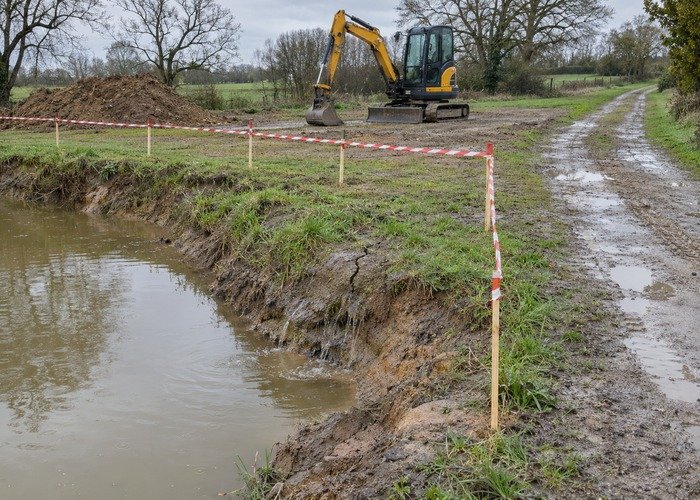
Keep people out of the machine’s operating area and away from the bank edge. Establish an exclusion zone that accounts for excavator swing, bucket and load, travel route, and areas that could be affected if the bank moves. Use barriers, signs, or a spotter where needed to prevent unauthorized entry and help the operator maintain separation.
A spotter can support communication and watch for changing conditions, but should not stand at the edge or where a slide could trap them. Agree on clear signals and stop-work instructions before operation. The operator should stop if communication is lost, someone enters the exclusion zone, the ground changes, or the machine cannot maintain its approved route.
Do not place spoil, materials, parked vehicles, or other equipment where added load could destabilize the bank. Control drainage and water discharge so they do not erode the edge or soften the machine’s route. If mats or other ground-protection measures are proposed, confirm they are suitable and approved as part of the ground-control plan; mats do not make an unstable bank safe by themselves. See Mini Excavator Ground Protection Mats: Route and Ground Approval.
Select equipment for the assessed conditions and work. Consider operating weight, stability, track contact, reach, attachment, and space to turn and retreat. Follow the manufacturer’s operating instructions and machine limits. A smaller excavator is not automatically suitable for a weak bank; size alone does not establish stability.
Keep the machine on the approved route and operating area. Avoid abrupt turns, sudden braking, unnecessary travel near the edge, and positioning that puts weight on an unsupported lip. Work from a stable position and avoid reaching or carrying loads in a way that could shift balance toward water. If the task requires a position that the assessment has not approved, change the method or use equipment better suited to it.
Before starting, identify a clear escape route for the machine and operator. The route should lead away from the bank and remain usable throughout the task. Do not let spoil, hoses, barriers, parked vehicles, or other work block the exit. If safe retreat is unavailable, revise the setup before work begins.
Rescue planning must be in place before the excavator approaches open water. Identify how to raise the alarm, who will call emergency services, how responders will find and reach the site, and what rescue equipment is appropriate and immediately available. Account for depth, current, visibility, temperature, access, and other hazards that affect a rescue.
Workers should know how to summon help and where to go if someone enters the water. Keep rescue equipment accessible from a stable location, and assign trained people to the roles in the plan. Do not improvise a rescue by entering the water without the training and equipment required for conditions: a rescuer can become another casualty. Plan for an injured or unconscious person as well as for someone who can respond and assist. Ensure there is a reliable way to communicate from the work area and that emergency access is not blocked by the machine or spoil.
Personal flotation equipment may be required by applicable rules or the site assessment. It can support a person in water, but does not prevent an excavator from tipping, stop drowning in every circumstance, or make machine submersion safe. It is no substitute for stable ground, separation from the edge, suitable equipment, a safe escape route, or a practiced rescue plan. Check that workers understand how and when their equipment should be used.
If an excavator enters water or becomes unstable, people should follow the site emergency plan and call emergency services. Do not approach or enter the water to reach a machine unless the rescue plan, training, and conditions support that action. Do not assume a submerged machine can be exited or recovered safely; recovery requires a planned method and competent personnel.
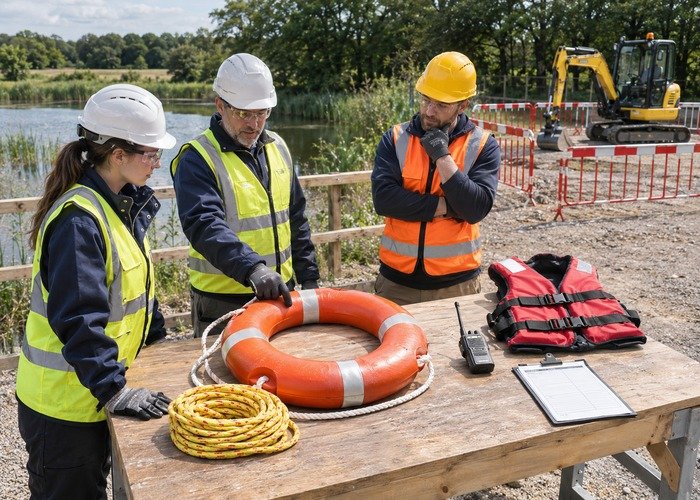
Requirements vary by jurisdiction and type of work. In the United States, OSHA’s construction rule at 29 CFR 1926.106, Working over or near water addresses approved personal flotation devices, lifesaving equipment, and emergency arrangements for employees working over or near water where drowning danger exists. OSHA’s excavation standard at 29 CFR 1926.651 includes requirements concerning water accumulation and other excavation hazards. Apply the provisions relevant to the specific work and employer obligations; these references do not establish a universal bank setback.
For work in Victoria, Australia, WorkSafe Victoria’s safety alert on operating mobile plant on or near water bodies discusses the risk of mobile plant entering water and describes controls such as exclusion zones, maintaining suitable working surfaces, task-suitable plant, and rescue planning. HSE’s general excavator guidance calls for risk assessment of the site, terrain, weather, machine operation and emergency procedures. These are jurisdiction-specific references; check the rules and guidance applicable to the project rather than assuming one country’s requirements apply everywhere.
Before work, brief the operator and ground crew on the approved machine position and route, exclusion zone, communication signals, stop-work triggers, escape route, and emergency roles. Confirm that everyone knows where rescue equipment is stored and how to raise the alarm. Keep the briefing practical and specific to the site, and ensure new or replacement workers receive it before entering the work area.
Stop and reassess if the edge cracks, settles, slumps, or becomes saturated; water begins seeping or rising; tracks sink or slip; visibility or communication worsens; or the planned route becomes blocked. Do not continue on the assumption that the bank will hold. Reposition only after the ground and method have been reassessed and approved. Record significant changes and the revised controls so the crew follows one current plan.
At the end of a shift or after a pause, check whether rain, water-level changes, new excavation, spoil movement, or equipment traffic altered the bank or route. Conditions can change while no one is operating. Repeat the relevant checks before restarting and restore barriers or signs that were moved.
There is no single setback safe for every machine and bank. The approved distance depends on bank geometry, soil and fill, saturation, erosion, water level, machine loads, and work method. Have the ground assessed and mark the site-specific operating boundary. If stability is uncertain, keep the excavator away from the edge until a competent assessment defines a safe method.
No. Flotation equipment may be required for workers in particular circumstances, but it cannot prevent bank collapse or machine submersion, and it does not make a submerged excavator safe. Use it as required within the applicable safety plan, alongside ground assessment, exclusion controls, suitable equipment, escape planning, and rescue arrangements.
No. A spotter can help control access, maintain communication, and watch for changing conditions, but cannot stabilize weak ground. Establish the approved working area through a suitable ground assessment and keep the spotter in a safe position outside the hazard area.
Stop and reassess the trench, ground stability, water source, and dewatering method. Trench water introduces excavation-specific hazards and may affect nearby ground. Follow applicable excavation requirements and a competent person’s assessment; open-water precautions or a pond-layout plan alone are insufficient.
This article provides general safety information. The site-specific risk assessment, competent ground assessment, manufacturer instructions, and applicable local requirements govern the work.