Telephone/WhatsApp:+86 156 2656 0610

Telephone/WhatsApp:+86 156 2656 0610
Email:info@seekmach.com

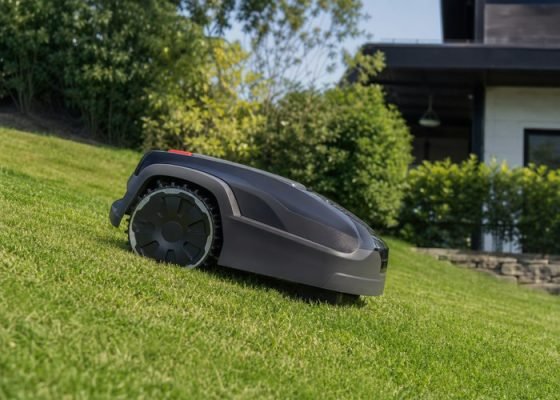
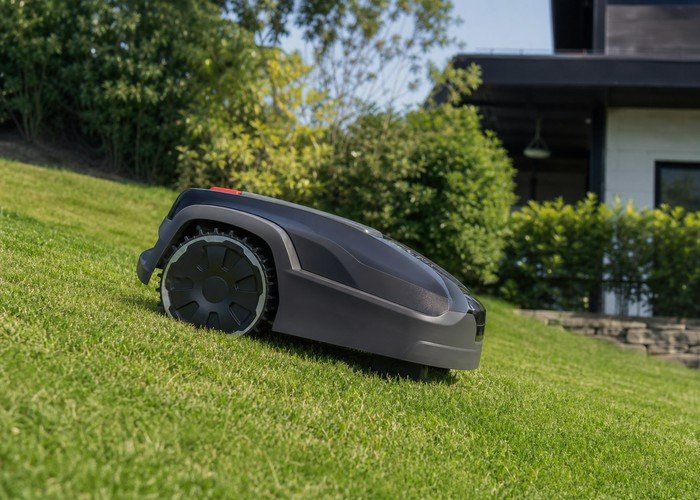
Robot Lawn Mower Slope Guide: Percentage, Degrees, Traction, and Yard-Fit Test gives buyers and operators a structured way to verify condition, fit, and safety before money or machinery moves.
Continue through the SeekMach equipment range, compare the tractor range, review pelles compactes, see chargeuses compactes, and browse lawn mowers.
Start with records, ratings, and the exact machine: Convert manufacturer slope limits carefully: percent grade equals rise divided by horizontal run times 100, while degrees use a different scale. Never treat 20 percent as 20 degrees. Use the exact model manual and apply the lower limit when traction, boundary or navigation conditions are worse.
Start with records, ratings, and the exact machine: Measure several lines across the steepest mowing area using a straight board and inclinometer or a measured rise and run. Check cross-slope as well as uphill travel, transitions at the top and bottom, holes, edging, drop-offs and wet zones.
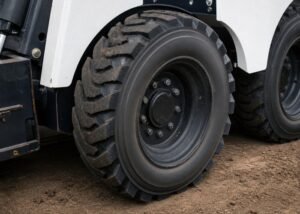
Start with records, ratings, and the exact machine: Drive-wheel tread, mower weight distribution and grass condition control traction. A mower that climbs dry turf may slide downhill when wet, turn poorly across the slope or scalp at a sharp transition. Test under conservative conditions before expanding the mapped area.
Start with records, ratings, and the exact machine: Boundary-wire, RTK and vision systems can all fail for reasons unrelated to drive power. Confirm satellite view, tree and building obstruction, wire placement, camera visibility, narrow passages, charging route and safe setbacks from water, walls and public paths.
Start with records, ratings, and the exact machine: Use exclusion zones or conventional mowing where the slope exceeds the manual, the mower can reach a drop-off, wheels spin repeatedly, braking is inconsistent or retrieval would expose a person to a fall. A successful one-time climb is not proof of reliable unattended operation.
Safety-first walk-around before operation: Convert manufacturer slope limits carefully: percent grade equals rise divided by horizontal run times 100, while degrees use a different scale. Never treat 20 percent as 20 degrees. Use the exact model manual and apply the lower limit when traction, boundary or navigation conditions are worse.
Safety-first walk-around before operation: Measure several lines across the steepest mowing area using a straight board and inclinometer or a measured rise and run. Check cross-slope as well as uphill travel, transitions at the top and bottom, holes, edging, drop-offs and wet zones.
Safety-first walk-around before operation: Drive-wheel tread, mower weight distribution and grass condition control traction. A mower that climbs dry turf may slide downhill when wet, turn poorly across the slope or scalp at a sharp transition. Test under conservative conditions before expanding the mapped area.
Safety-first walk-around before operation: Boundary-wire, RTK and vision systems can all fail for reasons unrelated to drive power. Confirm satellite view, tree and building obstruction, wire placement, camera visibility, narrow passages, charging route and safe setbacks from water, walls and public paths.
Safety-first walk-around before operation: Use exclusion zones or conventional mowing where the slope exceeds the manual, the mower can reach a drop-off, wheels spin repeatedly, braking is inconsistent or retrieval would expose a person to a fall. A successful one-time climb is not proof of reliable unattended operation.
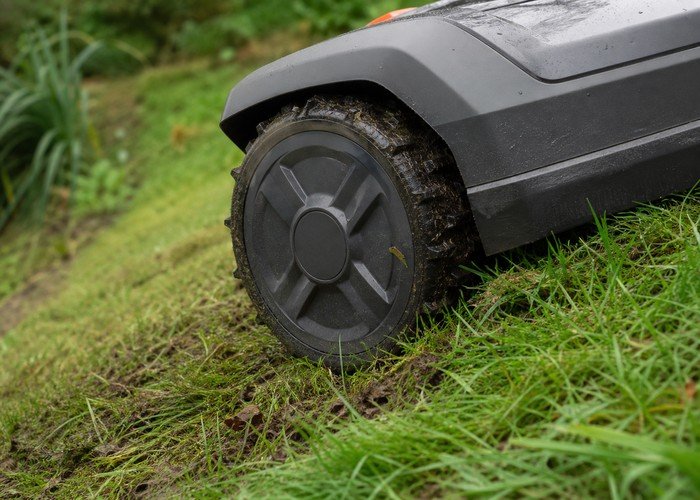
Engine, fluids, cooling, and leak checks: Convert manufacturer slope limits carefully: percent grade equals rise divided by horizontal run times 100, while degrees use a different scale. Never treat 20 percent as 20 degrees. Use the exact model manual and apply the lower limit when traction, boundary or navigation conditions are worse.
Engine, fluids, cooling, and leak checks: Measure several lines across the steepest mowing area using a straight board and inclinometer or a measured rise and run. Check cross-slope as well as uphill travel, transitions at the top and bottom, holes, edging, drop-offs and wet zones.
Engine, fluids, cooling, and leak checks: Drive-wheel tread, mower weight distribution and grass condition control traction. A mower that climbs dry turf may slide downhill when wet, turn poorly across the slope or scalp at a sharp transition. Test under conservative conditions before expanding the mapped area.
Engine, fluids, cooling, and leak checks: Boundary-wire, RTK and vision systems can all fail for reasons unrelated to drive power. Confirm satellite view, tree and building obstruction, wire placement, camera visibility, narrow passages, charging route and safe setbacks from water, walls and public paths.
Engine, fluids, cooling, and leak checks: Use exclusion zones or conventional mowing where the slope exceeds the manual, the mower can reach a drop-off, wheels spin repeatedly, braking is inconsistent or retrieval would expose a person to a fall. A successful one-time climb is not proof of reliable unattended operation.
Hydraulics, structure, and working components: Convert manufacturer slope limits carefully: percent grade equals rise divided by horizontal run times 100, while degrees use a different scale. Never treat 20 percent as 20 degrees. Use the exact model manual and apply the lower limit when traction, boundary or navigation conditions are worse.
Hydraulics, structure, and working components: Measure several lines across the steepest mowing area using a straight board and inclinometer or a measured rise and run. Check cross-slope as well as uphill travel, transitions at the top and bottom, holes, edging, drop-offs and wet zones.
Hydraulics, structure, and working components: Drive-wheel tread, mower weight distribution and grass condition control traction. A mower that climbs dry turf may slide downhill when wet, turn poorly across the slope or scalp at a sharp transition. Test under conservative conditions before expanding the mapped area.
Hydraulics, structure, and working components: Boundary-wire, RTK and vision systems can all fail for reasons unrelated to drive power. Confirm satellite view, tree and building obstruction, wire placement, camera visibility, narrow passages, charging route and safe setbacks from water, walls and public paths.
Hydraulics, structure, and working components: Use exclusion zones or conventional mowing where the slope exceeds the manual, the mower can reach a drop-off, wheels spin repeatedly, braking is inconsistent or retrieval would expose a person to a fall. A successful one-time climb is not proof of reliable unattended operation.
Functional test under realistic load: Convert manufacturer slope limits carefully: percent grade equals rise divided by horizontal run times 100, while degrees use a different scale. Never treat 20 percent as 20 degrees. Use the exact model manual and apply the lower limit when traction, boundary or navigation conditions are worse.
Functional test under realistic load: Measure several lines across the steepest mowing area using a straight board and inclinometer or a measured rise and run. Check cross-slope as well as uphill travel, transitions at the top and bottom, holes, edging, drop-offs and wet zones.
Functional test under realistic load: Drive-wheel tread, mower weight distribution and grass condition control traction. A mower that climbs dry turf may slide downhill when wet, turn poorly across the slope or scalp at a sharp transition. Test under conservative conditions before expanding the mapped area.
Functional test under realistic load: Boundary-wire, RTK and vision systems can all fail for reasons unrelated to drive power. Confirm satellite view, tree and building obstruction, wire placement, camera visibility, narrow passages, charging route and safe setbacks from water, walls and public paths.
Functional test under realistic load: Use exclusion zones or conventional mowing where the slope exceeds the manual, the mower can reach a drop-off, wheels spin repeatedly, braking is inconsistent or retrieval would expose a person to a fall. A successful one-time climb is not proof of reliable unattended operation.
Decision table: pass, negotiate, or stop: Convert manufacturer slope limits carefully: percent grade equals rise divided by horizontal run times 100, while degrees use a different scale. Never treat 20 percent as 20 degrees. Use the exact model manual and apply the lower limit when traction, boundary or navigation conditions are worse.
Decision table: pass, negotiate, or stop: Measure several lines across the steepest mowing area using a straight board and inclinometer or a measured rise and run. Check cross-slope as well as uphill travel, transitions at the top and bottom, holes, edging, drop-offs and wet zones.
Decision table: pass, negotiate, or stop: Drive-wheel tread, mower weight distribution and grass condition control traction. A mower that climbs dry turf may slide downhill when wet, turn poorly across the slope or scalp at a sharp transition. Test under conservative conditions before expanding the mapped area.
Decision table: pass, negotiate, or stop: Boundary-wire, RTK and vision systems can all fail for reasons unrelated to drive power. Confirm satellite view, tree and building obstruction, wire placement, camera visibility, narrow passages, charging route and safe setbacks from water, walls and public paths.
Decision table: pass, negotiate, or stop: Use exclusion zones or conventional mowing where the slope exceeds the manual, the mower can reach a drop-off, wheels spin repeatedly, braking is inconsistent or retrieval would expose a person to a fall. A successful one-time climb is not proof of reliable unattended operation.
Questions to ask the seller or operator: Convert manufacturer slope limits carefully: percent grade equals rise divided by horizontal run times 100, while degrees use a different scale. Never treat 20 percent as 20 degrees. Use the exact model manual and apply the lower limit when traction, boundary or navigation conditions are worse.
Questions to ask the seller or operator: Measure several lines across the steepest mowing area using a straight board and inclinometer or a measured rise and run. Check cross-slope as well as uphill travel, transitions at the top and bottom, holes, edging, drop-offs and wet zones.
Questions to ask the seller or operator: Drive-wheel tread, mower weight distribution and grass condition control traction. A mower that climbs dry turf may slide downhill when wet, turn poorly across the slope or scalp at a sharp transition. Test under conservative conditions before expanding the mapped area.
Questions to ask the seller or operator: Boundary-wire, RTK and vision systems can all fail for reasons unrelated to drive power. Confirm satellite view, tree and building obstruction, wire placement, camera visibility, narrow passages, charging route and safe setbacks from water, walls and public paths.
Questions to ask the seller or operator: Use exclusion zones or conventional mowing where the slope exceeds the manual, the mower can reach a drop-off, wheels spin repeatedly, braking is inconsistent or retrieval would expose a person to a fall. A successful one-time climb is not proof of reliable unattended operation.
A repeatable field checklist: Convert manufacturer slope limits carefully: percent grade equals rise divided by horizontal run times 100, while degrees use a different scale. Never treat 20 percent as 20 degrees. Use the exact model manual and apply the lower limit when traction, boundary or navigation conditions are worse.
A repeatable field checklist: Measure several lines across the steepest mowing area using a straight board and inclinometer or a measured rise and run. Check cross-slope as well as uphill travel, transitions at the top and bottom, holes, edging, drop-offs and wet zones.
A repeatable field checklist: Drive-wheel tread, mower weight distribution and grass condition control traction. A mower that climbs dry turf may slide downhill when wet, turn poorly across the slope or scalp at a sharp transition. Test under conservative conditions before expanding the mapped area.
A repeatable field checklist: Boundary-wire, RTK and vision systems can all fail for reasons unrelated to drive power. Confirm satellite view, tree and building obstruction, wire placement, camera visibility, narrow passages, charging route and safe setbacks from water, walls and public paths.
A repeatable field checklist: Use exclusion zones or conventional mowing where the slope exceeds the manual, the mower can reach a drop-off, wheels spin repeatedly, braking is inconsistent or retrieval would expose a person to a fall. A successful one-time climb is not proof of reliable unattended operation.
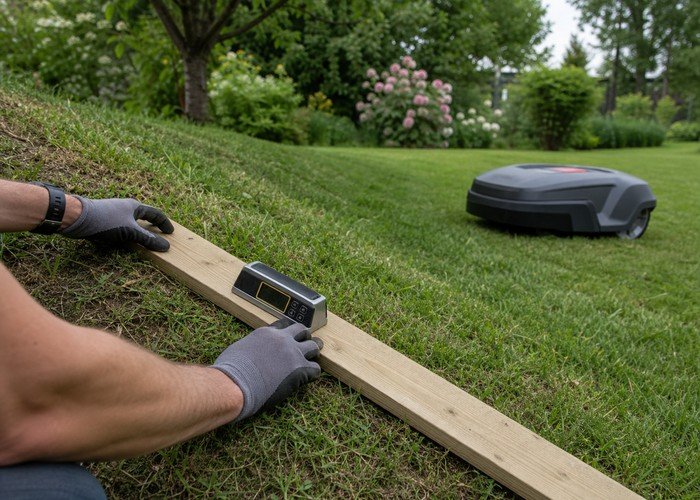
Common mistakes that create expensive surprises: Convert manufacturer slope limits carefully: percent grade equals rise divided by horizontal run times 100, while degrees use a different scale. Never treat 20 percent as 20 degrees. Use the exact model manual and apply the lower limit when traction, boundary or navigation conditions are worse.
Common mistakes that create expensive surprises: Measure several lines across the steepest mowing area using a straight board and inclinometer or a measured rise and run. Check cross-slope as well as uphill travel, transitions at the top and bottom, holes, edging, drop-offs and wet zones.
Common mistakes that create expensive surprises: Drive-wheel tread, mower weight distribution and grass condition control traction. A mower that climbs dry turf may slide downhill when wet, turn poorly across the slope or scalp at a sharp transition. Test under conservative conditions before expanding the mapped area.
Common mistakes that create expensive surprises: Boundary-wire, RTK and vision systems can all fail for reasons unrelated to drive power. Confirm satellite view, tree and building obstruction, wire placement, camera visibility, narrow passages, charging route and safe setbacks from water, walls and public paths.
Common mistakes that create expensive surprises: Use exclusion zones or conventional mowing where the slope exceeds the manual, the mower can reach a drop-off, wheels spin repeatedly, braking is inconsistent or retrieval would expose a person to a fall. A successful one-time climb is not proof of reliable unattended operation.
Final verification before transport or purchase: Convert manufacturer slope limits carefully: percent grade equals rise divided by horizontal run times 100, while degrees use a different scale. Never treat 20 percent as 20 degrees. Use the exact model manual and apply the lower limit when traction, boundary or navigation conditions are worse.
Final verification before transport or purchase: Measure several lines across the steepest mowing area using a straight board and inclinometer or a measured rise and run. Check cross-slope as well as uphill travel, transitions at the top and bottom, holes, edging, drop-offs and wet zones.
Final verification before transport or purchase: Drive-wheel tread, mower weight distribution and grass condition control traction. A mower that climbs dry turf may slide downhill when wet, turn poorly across the slope or scalp at a sharp transition. Test under conservative conditions before expanding the mapped area.
Final verification before transport or purchase: Boundary-wire, RTK and vision systems can all fail for reasons unrelated to drive power. Confirm satellite view, tree and building obstruction, wire placement, camera visibility, narrow passages, charging route and safe setbacks from water, walls and public paths.
Final verification before transport or purchase: Use exclusion zones or conventional mowing where the slope exceeds the manual, the mower can reach a drop-off, wheels spin repeatedly, braking is inconsistent or retrieval would expose a person to a fall. A successful one-time climb is not proof of reliable unattended operation.
No. Use this workflow to organize the inspection, then apply the exact limits and procedures in the model manual.
Use a qualified technician when records are incomplete, safety structures are altered, fluids are contaminated, structural cracks appear, or the functional test is inconsistent.
Record serial number, hours, cold-start condition, leaks, wear, measured settings, attachments, faults, photographs, and the person who performed the check.