Telephone/WhatsApp:+86 156 2656 0610

Telephone/WhatsApp:+86 156 2656 0610
Email:info@seekmach.com

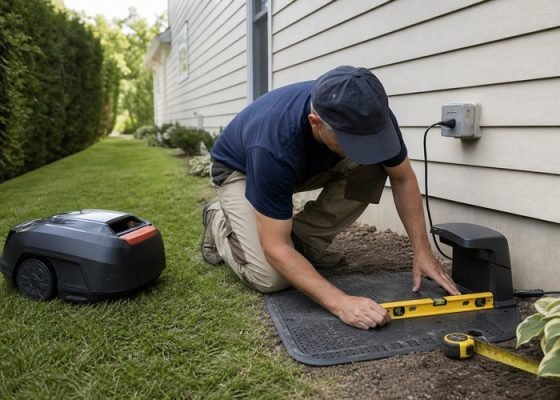
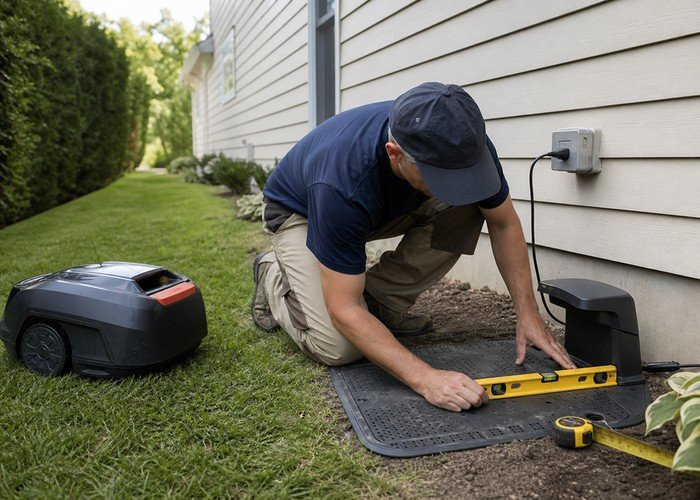
Robot Mower Charging Station Placement: Power, Slope, Shade, and Docking Access gives buyers and operators a structured way to verify condition, fit, and safety before money or machinery moves.
Continue through the SeekMach equipment range, compare the tractor range, review pelles compactes, see chargeuses compactes, and browse lawn mowers.
Start with records, ratings, and the exact machine: Choose the station location from the exact model manual before laying wire or mapping. A dependable site is level, stable, well drained, close to an approved power supply, and has the manufacturer-specified clear approach. Boundary-wire, camera, RTK, and hybrid mowers can require different open-space and sky-view conditions.
Start with records, ratings, and the exact machine: Check the full day, not one moment. Direct sun can heat the mower and lengthen charging, while a deep roof, metal wall, tree canopy, or narrow passage can interfere with some positioning systems. Shade and weather protection are helpful only when ventilation, wireless signals, and docking clearance remain within the manual.
Start with records, ratings, and the exact machine: Keep the baseplate straight and supported so it cannot twist, sink, or rock. Avoid low spots, irrigation spray, roof runoff, steep cross-slope, loose gravel, steps, and high-traffic paths. Plan cable protection and use an outdoor-rated supply installed in accordance with local electrical rules.
Start with records, ratings, and the exact machine: For wired systems, route the boundary and guide wires exactly as specified around and in front of the dock, avoiding sharp bends and confusing parallel runs. For virtual-boundary systems, confirm the mower and any reference station maintain the required view and communication throughout docking and departure.
Start with records, ratings, and the exact machine: Before fixing the station permanently, run repeated home-and-start tests from several parts of the lawn, including after charging and at the edge of operating hours. Watch approach alignment, wheel slip, contact engagement, water movement, signal status, and any map relocation requirement when the dock is moved.
Safety-first walk-around before operation: Choose the station location from the exact model manual before laying wire or mapping. A dependable site is level, stable, well drained, close to an approved power supply, and has the manufacturer-specified clear approach. Boundary-wire, camera, RTK, and hybrid mowers can require different open-space and sky-view conditions.
Safety-first walk-around before operation: Check the full day, not one moment. Direct sun can heat the mower and lengthen charging, while a deep roof, metal wall, tree canopy, or narrow passage can interfere with some positioning systems. Shade and weather protection are helpful only when ventilation, wireless signals, and docking clearance remain within the manual.
Safety-first walk-around before operation: Keep the baseplate straight and supported so it cannot twist, sink, or rock. Avoid low spots, irrigation spray, roof runoff, steep cross-slope, loose gravel, steps, and high-traffic paths. Plan cable protection and use an outdoor-rated supply installed in accordance with local electrical rules.
Safety-first walk-around before operation: For wired systems, route the boundary and guide wires exactly as specified around and in front of the dock, avoiding sharp bends and confusing parallel runs. For virtual-boundary systems, confirm the mower and any reference station maintain the required view and communication throughout docking and departure.
Safety-first walk-around before operation: Before fixing the station permanently, run repeated home-and-start tests from several parts of the lawn, including after charging and at the edge of operating hours. Watch approach alignment, wheel slip, contact engagement, water movement, signal status, and any map relocation requirement when the dock is moved.

Engine, fluids, cooling, and leak checks: Choose the station location from the exact model manual before laying wire or mapping. A dependable site is level, stable, well drained, close to an approved power supply, and has the manufacturer-specified clear approach. Boundary-wire, camera, RTK, and hybrid mowers can require different open-space and sky-view conditions.
Engine, fluids, cooling, and leak checks: Check the full day, not one moment. Direct sun can heat the mower and lengthen charging, while a deep roof, metal wall, tree canopy, or narrow passage can interfere with some positioning systems. Shade and weather protection are helpful only when ventilation, wireless signals, and docking clearance remain within the manual.
Engine, fluids, cooling, and leak checks: Keep the baseplate straight and supported so it cannot twist, sink, or rock. Avoid low spots, irrigation spray, roof runoff, steep cross-slope, loose gravel, steps, and high-traffic paths. Plan cable protection and use an outdoor-rated supply installed in accordance with local electrical rules.
Engine, fluids, cooling, and leak checks: For wired systems, route the boundary and guide wires exactly as specified around and in front of the dock, avoiding sharp bends and confusing parallel runs. For virtual-boundary systems, confirm the mower and any reference station maintain the required view and communication throughout docking and departure.
Engine, fluids, cooling, and leak checks: Before fixing the station permanently, run repeated home-and-start tests from several parts of the lawn, including after charging and at the edge of operating hours. Watch approach alignment, wheel slip, contact engagement, water movement, signal status, and any map relocation requirement when the dock is moved.
Hydraulics, structure, and working components: Choose the station location from the exact model manual before laying wire or mapping. A dependable site is level, stable, well drained, close to an approved power supply, and has the manufacturer-specified clear approach. Boundary-wire, camera, RTK, and hybrid mowers can require different open-space and sky-view conditions.
Hydraulics, structure, and working components: Check the full day, not one moment. Direct sun can heat the mower and lengthen charging, while a deep roof, metal wall, tree canopy, or narrow passage can interfere with some positioning systems. Shade and weather protection are helpful only when ventilation, wireless signals, and docking clearance remain within the manual.
Hydraulics, structure, and working components: Keep the baseplate straight and supported so it cannot twist, sink, or rock. Avoid low spots, irrigation spray, roof runoff, steep cross-slope, loose gravel, steps, and high-traffic paths. Plan cable protection and use an outdoor-rated supply installed in accordance with local electrical rules.
Hydraulics, structure, and working components: For wired systems, route the boundary and guide wires exactly as specified around and in front of the dock, avoiding sharp bends and confusing parallel runs. For virtual-boundary systems, confirm the mower and any reference station maintain the required view and communication throughout docking and departure.
Hydraulics, structure, and working components: Before fixing the station permanently, run repeated home-and-start tests from several parts of the lawn, including after charging and at the edge of operating hours. Watch approach alignment, wheel slip, contact engagement, water movement, signal status, and any map relocation requirement when the dock is moved.
Functional test under realistic load: Choose the station location from the exact model manual before laying wire or mapping. A dependable site is level, stable, well drained, close to an approved power supply, and has the manufacturer-specified clear approach. Boundary-wire, camera, RTK, and hybrid mowers can require different open-space and sky-view conditions.
Functional test under realistic load: Check the full day, not one moment. Direct sun can heat the mower and lengthen charging, while a deep roof, metal wall, tree canopy, or narrow passage can interfere with some positioning systems. Shade and weather protection are helpful only when ventilation, wireless signals, and docking clearance remain within the manual.
Functional test under realistic load: Keep the baseplate straight and supported so it cannot twist, sink, or rock. Avoid low spots, irrigation spray, roof runoff, steep cross-slope, loose gravel, steps, and high-traffic paths. Plan cable protection and use an outdoor-rated supply installed in accordance with local electrical rules.
Functional test under realistic load: For wired systems, route the boundary and guide wires exactly as specified around and in front of the dock, avoiding sharp bends and confusing parallel runs. For virtual-boundary systems, confirm the mower and any reference station maintain the required view and communication throughout docking and departure.
Functional test under realistic load: Before fixing the station permanently, run repeated home-and-start tests from several parts of the lawn, including after charging and at the edge of operating hours. Watch approach alignment, wheel slip, contact engagement, water movement, signal status, and any map relocation requirement when the dock is moved.
Decision table: pass, negotiate, or stop: Choose the station location from the exact model manual before laying wire or mapping. A dependable site is level, stable, well drained, close to an approved power supply, and has the manufacturer-specified clear approach. Boundary-wire, camera, RTK, and hybrid mowers can require different open-space and sky-view conditions.
Decision table: pass, negotiate, or stop: Check the full day, not one moment. Direct sun can heat the mower and lengthen charging, while a deep roof, metal wall, tree canopy, or narrow passage can interfere with some positioning systems. Shade and weather protection are helpful only when ventilation, wireless signals, and docking clearance remain within the manual.
Decision table: pass, negotiate, or stop: Keep the baseplate straight and supported so it cannot twist, sink, or rock. Avoid low spots, irrigation spray, roof runoff, steep cross-slope, loose gravel, steps, and high-traffic paths. Plan cable protection and use an outdoor-rated supply installed in accordance with local electrical rules.
Decision table: pass, negotiate, or stop: For wired systems, route the boundary and guide wires exactly as specified around and in front of the dock, avoiding sharp bends and confusing parallel runs. For virtual-boundary systems, confirm the mower and any reference station maintain the required view and communication throughout docking and departure.
Decision table: pass, negotiate, or stop: Before fixing the station permanently, run repeated home-and-start tests from several parts of the lawn, including after charging and at the edge of operating hours. Watch approach alignment, wheel slip, contact engagement, water movement, signal status, and any map relocation requirement when the dock is moved.
Questions to ask the seller or operator: Choose the station location from the exact model manual before laying wire or mapping. A dependable site is level, stable, well drained, close to an approved power supply, and has the manufacturer-specified clear approach. Boundary-wire, camera, RTK, and hybrid mowers can require different open-space and sky-view conditions.
Questions to ask the seller or operator: Check the full day, not one moment. Direct sun can heat the mower and lengthen charging, while a deep roof, metal wall, tree canopy, or narrow passage can interfere with some positioning systems. Shade and weather protection are helpful only when ventilation, wireless signals, and docking clearance remain within the manual.
Questions to ask the seller or operator: Keep the baseplate straight and supported so it cannot twist, sink, or rock. Avoid low spots, irrigation spray, roof runoff, steep cross-slope, loose gravel, steps, and high-traffic paths. Plan cable protection and use an outdoor-rated supply installed in accordance with local electrical rules.
Questions to ask the seller or operator: For wired systems, route the boundary and guide wires exactly as specified around and in front of the dock, avoiding sharp bends and confusing parallel runs. For virtual-boundary systems, confirm the mower and any reference station maintain the required view and communication throughout docking and departure.
Questions to ask the seller or operator: Before fixing the station permanently, run repeated home-and-start tests from several parts of the lawn, including after charging and at the edge of operating hours. Watch approach alignment, wheel slip, contact engagement, water movement, signal status, and any map relocation requirement when the dock is moved.
A repeatable field checklist: Choose the station location from the exact model manual before laying wire or mapping. A dependable site is level, stable, well drained, close to an approved power supply, and has the manufacturer-specified clear approach. Boundary-wire, camera, RTK, and hybrid mowers can require different open-space and sky-view conditions.
A repeatable field checklist: Check the full day, not one moment. Direct sun can heat the mower and lengthen charging, while a deep roof, metal wall, tree canopy, or narrow passage can interfere with some positioning systems. Shade and weather protection are helpful only when ventilation, wireless signals, and docking clearance remain within the manual.
A repeatable field checklist: Keep the baseplate straight and supported so it cannot twist, sink, or rock. Avoid low spots, irrigation spray, roof runoff, steep cross-slope, loose gravel, steps, and high-traffic paths. Plan cable protection and use an outdoor-rated supply installed in accordance with local electrical rules.
A repeatable field checklist: For wired systems, route the boundary and guide wires exactly as specified around and in front of the dock, avoiding sharp bends and confusing parallel runs. For virtual-boundary systems, confirm the mower and any reference station maintain the required view and communication throughout docking and departure.
A repeatable field checklist: Before fixing the station permanently, run repeated home-and-start tests from several parts of the lawn, including after charging and at the edge of operating hours. Watch approach alignment, wheel slip, contact engagement, water movement, signal status, and any map relocation requirement when the dock is moved.
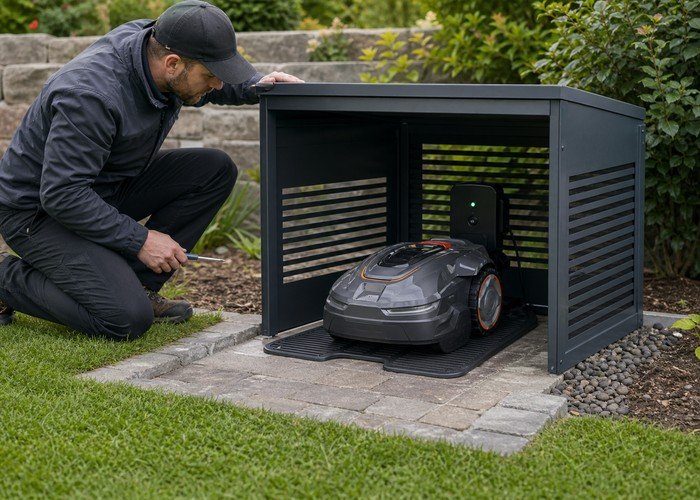
Common mistakes that create expensive surprises: Choose the station location from the exact model manual before laying wire or mapping. A dependable site is level, stable, well drained, close to an approved power supply, and has the manufacturer-specified clear approach. Boundary-wire, camera, RTK, and hybrid mowers can require different open-space and sky-view conditions.
Common mistakes that create expensive surprises: Check the full day, not one moment. Direct sun can heat the mower and lengthen charging, while a deep roof, metal wall, tree canopy, or narrow passage can interfere with some positioning systems. Shade and weather protection are helpful only when ventilation, wireless signals, and docking clearance remain within the manual.
Common mistakes that create expensive surprises: Keep the baseplate straight and supported so it cannot twist, sink, or rock. Avoid low spots, irrigation spray, roof runoff, steep cross-slope, loose gravel, steps, and high-traffic paths. Plan cable protection and use an outdoor-rated supply installed in accordance with local electrical rules.
Common mistakes that create expensive surprises: For wired systems, route the boundary and guide wires exactly as specified around and in front of the dock, avoiding sharp bends and confusing parallel runs. For virtual-boundary systems, confirm the mower and any reference station maintain the required view and communication throughout docking and departure.
Common mistakes that create expensive surprises: Before fixing the station permanently, run repeated home-and-start tests from several parts of the lawn, including after charging and at the edge of operating hours. Watch approach alignment, wheel slip, contact engagement, water movement, signal status, and any map relocation requirement when the dock is moved.
Final verification before transport or purchase: Choose the station location from the exact model manual before laying wire or mapping. A dependable site is level, stable, well drained, close to an approved power supply, and has the manufacturer-specified clear approach. Boundary-wire, camera, RTK, and hybrid mowers can require different open-space and sky-view conditions.
Final verification before transport or purchase: Check the full day, not one moment. Direct sun can heat the mower and lengthen charging, while a deep roof, metal wall, tree canopy, or narrow passage can interfere with some positioning systems. Shade and weather protection are helpful only when ventilation, wireless signals, and docking clearance remain within the manual.
Final verification before transport or purchase: Keep the baseplate straight and supported so it cannot twist, sink, or rock. Avoid low spots, irrigation spray, roof runoff, steep cross-slope, loose gravel, steps, and high-traffic paths. Plan cable protection and use an outdoor-rated supply installed in accordance with local electrical rules.
Final verification before transport or purchase: For wired systems, route the boundary and guide wires exactly as specified around and in front of the dock, avoiding sharp bends and confusing parallel runs. For virtual-boundary systems, confirm the mower and any reference station maintain the required view and communication throughout docking and departure.
Final verification before transport or purchase: Before fixing the station permanently, run repeated home-and-start tests from several parts of the lawn, including after charging and at the edge of operating hours. Watch approach alignment, wheel slip, contact engagement, water movement, signal status, and any map relocation requirement when the dock is moved.
No. Use this workflow to organize the inspection, then apply the exact limits and procedures in the model manual.
Use a qualified technician when records are incomplete, safety structures are altered, fluids are contaminated, structural cracks appear, or the functional test is inconsistent.
Record serial number, hours, cold-start condition, leaks, wear, measured settings, attachments, faults, photographs, and the person who performed the check.