














































Key takeaways (for busy buyers)
- Start with constraints, not marketing: access width, transport limits, and required digging depth decide your size class.
- Hydraulics are your “attachment budget”: auxiliary flow/circuits and coupler readiness determine whether augers, thumbs, and breakers feel effortless—or painful.
- ECO isn’t a label; it’s a question set: for U.S. projects, ask how the machine’s engine/aftertreatment aligns with the regulatory environment and what maintenance it implies (use the EPA Tier 4 nonroad rule as your baseline).
- Compare apples to apples: use one scoring matrix and force every candidate to answer the same 12 questions.
- Use real specs when you can: below, example specs are pulled directly from the SeekMach product pages for SeekMach 08Eco and SeekMach 12Eco—no guessing.
Why “China mini Excavato” is trending with U.S. buyers right now
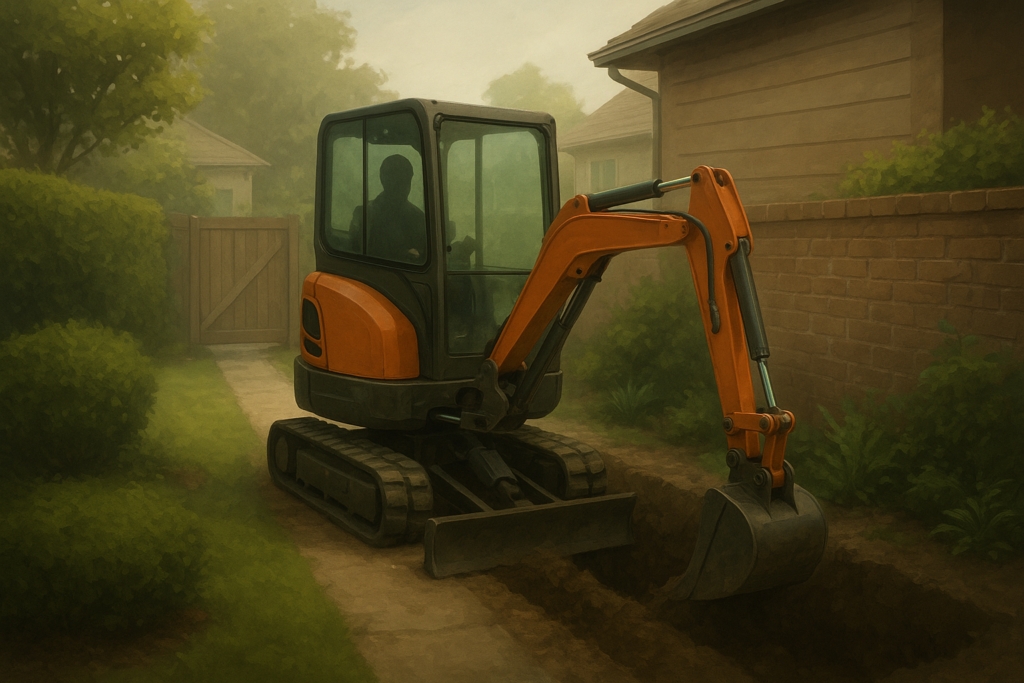
A lot of U.S. buyers aren’t just shopping for “a mini excavator.” They’re shopping for capability per inch—machines that can fit through gates, work in tight backyards, and still run real attachments.
In other words, the demand spike isn’t only about budgets. It’s about jobsite reality:
- More tight-access work (residential landscaping, drainage, trenching, light utility).
- More need for one-machine versatility—because labor is tight and schedules are tighter.
- More pressure to think about emissions and maintenance (especially if equipment will be used on regulated or sensitive sites).
This guide is built for the consideration stage: you already know what an excavator is. What you need now is a framework that helps you compare a China mini Excavato against your job requirements without getting lost in spec sheets.
Step 1 — Needs assessment: define the job your China mini Excavato must win
Before you compare models, lock down these inputs. You’ll use them as your non-negotiables.
A. Access and working envelope
- Minimum gate width / passage width (inches or mm)
- Tightest swing zone (fences, walls, sidewalks)
- Ground conditions (soft turf vs. gravel vs. hardpack)
Pro Tip: If you have “one tight gate” that shows up on 20% of jobs, size to that gate. The best machine is the one that gets used.
B. Digging and lifting requirements
- Typical trench depth (and maximum “worst case”)
- Whether you need lift work (pipes, boulders, small slabs)
Trade guidance consistently starts with transport, dig depth, and lift needs because they drive everything else—from productivity to safety to whether you’ll rent a bigger unit later. A practical reference is Compact Equipment’s mini excavator buying/renting guide (2024).
C. Transport reality
Be brutally honest:
- What trailer do you already have?
- What tow vehicle do you already have?
- How often will you move the machine between jobsites?
If transport is frequent, you’ll often prioritize compactness and simplicity over maximum size.
Step 2 — The 12-point comparison matrix (score every candidate the same way)
Here’s the matrix I’d use to compare any China mini Excavato shortlist.
Scoring method
- 0 = deal-breaker
- 1 = workable but compromises
- 2 = good fit
- 3 = ideal fit
The matrix
| Критерии | What to check | Why it matters | Score (0–3) |
|---|---|---|---|
| Access width | Min width / retractable undercarriage | Determines what jobs you can physically enter | |
| Dig depth | Max digging depth + reach | Determines trench/foundation capability | |
| Tail swing | Zero/reduced/conventional | Controls safety and clearance in tight spaces | |
| Hydraulic capability | Aux flow, pressure, circuits, return line | Determines attachment performance | |
| Attachment readiness | Quick coupler, auxiliary lines to stick | Reduces downtime when swapping tools | |
| Стабильность | Track width, ground pressure, dozer blade | Keeps work safe and predictable | |
| Serviceability | Access panels, daily checks, filter access | Lowers downtime and “mystery failures” | |
| Emissions/aftertreatment | Engine standard, filtration, duty-cycle fit | Impacts compliance and maintenance routine | |
| Noise / neighborhood friendliness | Rated noise if available, muffling design | Matters for residential work (and callbacks) | |
| Operator controls | Ergonomics, smoothness, visibility | Fatigue and precision are cost drivers | |
| Documentation | Manual, parts book, hydraulic schematics | Protects you when you need parts fast | |
| Support plan | Spare parts, response time, consumables | Keeps the machine earning |
Key Takeaway: A comparison matrix does one valuable thing—it forces every seller to answer the same questions.
Step 3 — ECO, emissions, and the U.S. reality: what buyers should ask (without guessing)
If you’re evaluating any “eco” mini Excavato option, you don’t need buzzwords—you need clarity.
A quick, non-technical baseline
The U.S. Environmental Protection Agency explains that Tier 4 standards were finalized for nonroad diesel engines to dramatically reduce harmful emissions; see the U.S. EPA page on the Tier 4 nonroad diesel final rule.
For buyers, the practical point is this:
- Emissions compliance is a system (engine + aftertreatment + maintenance + duty cycle).
- If the aftertreatment doesn’t match how you work, you’ll feel it in downtime, not in marketing.
What to ask about particulate filtration (DPF) and maintenance
EPA has a clear technical overview of diesel particulate filters (DPFs) and their implications; see the U.S. EPA bulletin “Diesel Particulate Filter General Information”.
Use that bulletin as your question list:
- Does this configuration use particulate filtration?
- What is the recommended regeneration/maintenance approach for your duty cycle?
- What are the monitoring indicators (backpressure/temperature) and what are the operator actions when they trigger?
⚠️ Warning: Never assume “eco” means “maintenance-free.” Emissions systems can be reliable—but only when they match the work pattern.
Step 4 — Spec-first examples: mini Excavator-ECO comparisons using SeekMach pages
Below are example specs (not industry averages) pulled from SeekMach product pages so you can see how a mini Excavator-ECO shortlist comparison works.
Quick spec table (from SeekMach)
| Модель | Эксплуатационная масса | Engine power (listed options) | Max digging depth | Ширина шасси | Емкость ковша |
|---|---|---|---|---|---|
| SeekMach 08Eco | 800 кг | 7,6 кВт | 1300 мм | 780 mm | 0.02 m³ |
| SeekMach 12Eco | 1200 кг | 7.6 kW / 8.6 kW / 13.5 HP / 10.2 kW | 1626 mm | 800–950 mm | 0,03 м³ |
Spec sources: SeekMach product pages for SeekMach 08Eco and SeekMach 12Eco.
Key Takeaway: Even a small jump in operating weight can bring meaningful reach/depth gains—but you need to make sure access width and transport still work.
Visual snapshot chart
How to interpret these numbers (what matters in the field)
- Эксплуатационная масса often correlates with stability and how confidently you can work the bucket without “chattering” or feeling light.
- Глубина копания is your trenching ceiling. Don’t buy a machine that’s almost deep enough.
- Ширина шасси is access. If you can’t enter, you can’t bill.
- Емкость ковша matters, but it’s only one part of production—hydraulics and cycle time matter too.
If you want to see the broader ECO lineup and how it’s positioned, SeekMach’s category page frames the ECO series as designed to reduce emissions, noise, and fuel use: see SeekMach ECO Series mini excavators.
For a broader view of excavator options and attachments, browse the SeekMach category page (linked later in this guide).
Step 5 — Hydraulics and attachments: the questions that separate “works” from “works well”
Most mini excavator regret happens here.
Trade buyers’ guides regularly call out auxiliary hydraulics, flow control, and attachment circuits as deciding factors because attachments are what turn a mini excavator into a profit center. A useful overview is the Equipment World Mini Excavator Buyer’s Guide (2026).
Attachment-driven checklist (copy/paste)
If you plan to use attachments, ask these before you buy:
- Что auxiliary hydraulic flow and pressure are available?
- How many aux circuits are available (and are they switchable)?
- Is there a hydraulic quick coupler option?
- Is the machine plumbed to the end of the stick for quick coupler/tilt tools?
- Is there an appropriate return line (when required by certain tools)?
- Can the operator adjust hydraulic flow from the controls?
Common mini excavator attachments to plan for
Here’s a practical attachment planning table (brand-neutral):
| Вложение | What it’s for | What to verify before purchase |
|---|---|---|
| Trenching bucket | Utility trenches, irrigation | Bucket pin size, width options |
| Grading/ditching bucket | Backfill, finish work | Tilt function support, edge durability |
| Hydraulic auger | Post holes, planting, footings | Aux flow/pressure, torque needs |
| Hydraulic breaker | Light demo, rock | Aux flow, return line, vibration considerations |
| Большой палец | Handling brush/rocks/debris | Mount style, hydraulics for thumb control |
| Грейфер | Brush, logs, debris | Aux circuits and control smoothness |
Step 6 — Risk control for importing or buying from a distance: the “no surprises” checklist
If your shortlist includes a China mini Excavato supplier, the goal isn’t to “trust harder.” It’s to de-risk the purchase with documentation and systems.
Documentation you should request
- Operator manual
- Maintenance schedule
- Parts list / exploded diagrams
- Hydraulic schematic
- Engine documentation for the specific configuration
Parts & support questions
- What are the fast-wear parts (filters, seals, hoses, bucket teeth) and typical lead times?
- What spare parts are recommended for the first 6–12 months?
- What is the support process (ticketing, response time, troubleshooting steps)?
Pro Tip: Ask for a “first-year spares kit” recommendation. Even a great machine becomes a headache if a simple consumable stops your week.
Step 7 — Red flags & deal-breakers (save yourself a bad surprise)
If you’re buying at a distance—or importing—your biggest risks usually aren’t “does it dig.” They’re fit, support, и documentation.
Red flag 1: The machine fits on paper, but not in your real access path
Don’t stop at “overall width.” Ask for (and verify):
- minimum undercarriage width (if retractable)
- blade width (some blades are wider than the tracks)
- tail swing clearance needed to rotate safely
If your core work is tight-access, one inch matters. A China mini Excavato that can’t pass the gate becomes a yard ornament.
Red flag 2: Attachment plans are vague
If you plan to run an auger, breaker, or hydraulic thumb, you need more than “it supports attachments.” Get clear answers on:
- auxiliary hydraulic flow/pressure
- number of auxiliary circuits
- whether flow is adjustable from the operator controls
If the supplier can’t explain the hydraulic setup cleanly, you’re likely signing up for trial-and-error.
Red flag 3: Emissions/aftertreatment isn’t matched to your duty cycle
For U.S. projects, use the EPA Tier 4 framework as your baseline reference and ask how the engine configuration and aftertreatment are maintained for your work pattern.
What to confirm:
- what the operator does when the system requests regeneration/maintenance
- what indicators mean (and whether they’re easy to see)
- how the machine behaves if the work cycle is low temperature / light load for long periods
Red flag 4: No real documentation set
At minimum, you want:
- operator manual
- maintenance schedule
- parts book / exploded diagrams
- hydraulic schematic
Without these, downtime turns into guesswork—and parts ordering becomes slow and expensive.
Red flag 5: No practical parts plan
Ask for a first-year consumables list (filters, seals, hoses, wear parts) and recommended spares. If the seller won’t provide a parts plan, you’ll build it yourself later—under pressure.
Step 8 — Receiving & first-week inspection checklist (especially for imported units)
This is a simple way to catch issues early and start your mini Excavato ownership with a clean baseline.
Before you start the engine
- Walkaround: check for shipping damage, bent guards, cracked housings
- Hose routing: look for rubbing points and sharp bends
- Fasteners: spot-check critical bolts (tracks/undercarriage guards)
- Fluids: verify levels (engine oil, hydraulic oil, coolant if applicable)
First start + warm-up
- Idle stability: listen for hunting or uneven idle
- Hydraulics: cycle boom/stick/bucket slowly and check for leaks
- Track drive: slow forward/reverse, check for binding or unusual noise
First hour of work
- Temperature: watch for overheating under typical load
- Controls: confirm smooth, predictable response
- Attachments: if you’ll run an auger/breaker/thumb, test auxiliary lines and flow control early
Key Takeaway: Your goal in week one is not maximum production—it’s confirming reliability, leak-free hydraulics, and attachment readiness.
YouTube: a practical walk-through to calibrate your expectations
Use one real-world video to validate what “compact work” looks like: control smoothness, swing clearance, and how attachments change the workflow.
Next steps (helpful, not pushy)
If you want a shortlist recommendation, here’s the fastest way to get a clean answer:
- Your minimum access width (gate/path)
- Your target dig depth (typical + max)
- The top 2 attachments you’ll actually use
- How often you’ll transport the machine
Then compare against the mini Excavator-ECO options and request configuration guidance directly from SeekMach:
- Start with the product pages: SeekMach 08Eco and SeekMach 12Eco (linked above)
- Or browse the full lineup in the SeekMach excavator supplier category
Вопросы-Ответы
1) What’s the difference between a “mini excavator” and a “compact excavator”?
In everyday use, people often use the terms interchangeably. A compact excavator is generally a smaller class of excavator designed for tight spaces and lighter earthmoving. For a high-level definition, see Wikipedia’s Excavator overview.
2) How do I choose the right size class for a China mini Excavato?
Start with your constraints: access width, transport, and required digging depth. If any one of those is a hard limit, it overrides everything else. Then compare machines with a simple scoring matrix so every option answers the same questions.
3) Is “mini Excavator-ECO” worth it for residential work?
It can be—especially when your work involves tight access and neighborhood sensitivity (noise, fumes, scheduling). But the key is verifying the engine/aftertreatment configuration and making sure your duty cycle matches the system’s maintenance needs.
4) What EPA emissions topic should I understand before buying?
Understand the nonroad engine regulatory context and how modern emissions systems affect maintenance. The U.S. EPA Tier 4 page (linked above) is a solid starting point.
5) What’s the biggest mistake buyers make when choosing a mini Excavato?
Buying for “max specs” instead of actual jobs. A machine that’s too wide for gates, too heavy to transport easily, or underpowered for your attachments will cost you productivity.
6) Which specs matter most for attachments?
Auxiliary hydraulics (flow/pressure), number of aux circuits, and whether the machine is quick-coupler ready. Trade buyer guides emphasize hydraulics and attachment readiness for a reason.
7) What maintenance questions should I ask about DPF?
Ask how the system handles regeneration and what monitoring indicators mean in daily operation. EPA’s technical bulletin on particulate filters (linked above) is a useful reference.
8) Where can I see the ECO lineup quickly?
SeekMach lists the ECO series as a category with multiple models on its site (linked above).