Telephone/WhatsApp:+86 156 2656 0610

Telephone/WhatsApp:+86 156 2656 0610
Email:info@seekmach.com



Verify a mini excavator cab’s emergency exit from the instructions and labels for that actual cab, then confirm that the designated route and any specified escape equipment remain available. Do not assume every window is an exit or every pane can be broken by the same tool. Familiarisation should happen before the machine is accepted for work, under safe arrangements and the manufacturer’s instructions.
This guide helps an owner identify documentation gaps, obstructions and service questions. It is not a rescue procedure or a glass-breaking tutorial. In an actual emergency, follow the applicable emergency arrangements and seek the appropriate assistance. Do not use this article to improvise an escape method for an unidentified machine.
Record the machine model and serial information and identify whether it has the original cab, an approved replacement or an altered enclosure. A canopy and a closed cab do not have identical access arrangements. An attachment guard or aftermarket enclosure may also change the questions that need to be answered.
Find the operator manual and any cab-specific information applicable to the installed arrangement. Retain the relevant document references and readable label photographs obtained safely. If the manual and the machine appear different, refer the mismatch to the manufacturer or authorized service provider before treating either as a complete answer.
IL SeekMach excavator category helps start a product inquiry, but the final answer must identify the supplied cab and configuration. A general product image cannot establish which opening is designated for emergency egress or what equipment is required.
A door, sliding window and opening windshield may have ordinary ventilation or access functions. Their presence does not establish that each is the approved emergency route. Ask the supplier to identify the relevant manual section and markings rather than relying on the largest visible pane.
A useful limited example is the 2017 Kubota U27-4 operator manual, which gives model-specific emergency-hammer information. The example demonstrates that escape provisions can be expressly defined in a manual. It does not establish the glass, tool, route or actions for a SeekMach machine or another cab.
Keep the distinction visible on the familiarisation record. Write the document’s actual description of the designated provision and where the supporting information is kept. Avoid a vague entry such as windows checked, which does not tell the next operator what was identified or which uncertainty remains.
| Question | Evidence to confirm | Assumption to avoid |
|---|---|---|
| Which cab is installed? | Actual machine and cab identification | A model photograph proves the current arrangement |
| Which route is designated? | Applicable manual and labels | Every opening window is an emergency exit |
| What equipment is specified? | Exact tool and retention provisions | Any hammer works with every type of glass |
| Is the route available? | Inspection and familiarisation under safe arrangements | A route remains usable after accessories are fitted |
Ask what the applicable instructions say about the designated opening, its glazing and any specified escape equipment. Do not infer glass type from tint, thickness by eye or a generic replacement listing. An unverified description such as safety glass does not resolve every question about the intended emergency provision.
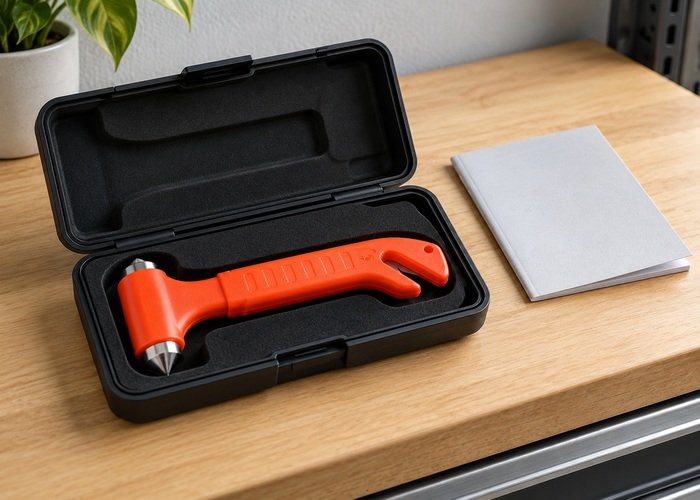
Where a tool is specified, identify the approved type, its storage or retention arrangement and the required condition checks. A tool supplied loose in a box is not automatically installed where the manufacturer intended. Equally, a missing holder or unknown substitute should remain an open service question rather than being accepted because the item looks familiar.
Do not practise striking a window, remove a retaining arrangement or modify a tool to demonstrate the route. The manufacturer and responsible qualified person should determine the appropriate familiarisation and inspection method. Damage created during an improvised demonstration can introduce the very defect the check was intended to prevent.
Review accessories, guards, storage and personal items through the applicable inspection process. A location that was clear at delivery may later hold clothing, tools or an added monitor. A guard outside the cab can also raise a compatibility question that cannot be resolved simply by looking from the seat.
Record what has changed and refer it to the supplier where it could affect the documented route or equipment. Do not remove a protective guard as an informal solution to an egress concern. The complete arrangement needs an approved answer that addresses both functions, rather than trading one safety question for another.
The Hong Kong Labour Department’s Code of Practice on Safe Use of Excavators, first issued in January 2005, provides a dated jurisdiction-specific context for machine safety and emergency planning. Use it as contextual guidance, not as a claim that a particular cab meets current requirements in every country.
Identify who will explain the cab’s access and emergency provisions and how understanding will be checked. Provide the applicable instructions in a form the operator can understand. A quick statement that the tool is behind the seat does not establish that the operator has identified the designated provision or understands its limitations.
Conduct familiarisation with the machine secured and hazards controlled under the manufacturer’s procedure. Do not create a trapped-person exercise or place someone in an unstable machine to make the training feel realistic. The responsible qualified person should decide what non-destructive demonstration is appropriate.
IL mini excavator seat-belt inspection guide addresses a separate part of the operator’s protection. Familiarisation should make the relationship between equipment and instructions clear without encouraging an improvised escape sequence or weakening normal restraint requirements.
Report a missing tool, unreadable marking, damaged latch or obstructed provision through the site’s equipment-defect arrangements. Describe the observed condition and affected cab precisely. Do not simply mark the entire machine checked when an important question has been deferred to a future service visit.
UK HSE inspection guidance explains that inspection should reflect the equipment and circumstances. For this topic, use a competent person to establish the checks appropriate to the actual cab and the required response to defects. The guidance does not supply a universal glass test or fixed inspection interval for every excavator.
Agree who can close the defect and what evidence is needed. A replacement tool’s purchase receipt does not show that the approved item has been installed and checked in the correct arrangement. Keep identification, service completion and acceptance as distinct records so that an unfinished task is visible.

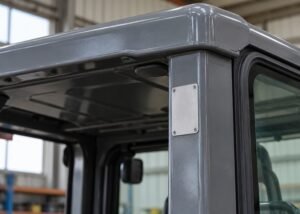
Replacement glazing or a new guard can change the information needed to verify the original arrangement. Ask the service provider to confirm that the installed parts match the approved application and that relevant markings and equipment provisions remain correct. Do not assume a pane that physically fits has the required role.
Retain the replacement part references and applicable instructions with the cab record. If a previous owner altered the enclosure and the history is unknown, state that clearly. A transparent record of uncertainty is more useful than describing the cab as original because it has the same general shape as a brochure image.
Where the cab is replaced as an assembly, treat familiarisation as a new task. Operators may remember locations and actions from the previous arrangement. Update the instructions available with the machine and confirm understanding before the changed equipment returns to its planned use.
A cab provision is one part of a wider emergency plan. Identify who receives a distress report, how the machine’s location is communicated and who controls the surrounding area. The site should not rely on an operator inventing a response while a separate team assumes that every cab has the same escape arrangement.
Keep rescue planning with the appropriately responsible people. This article does not authorize entering a hazardous area, moving damaged equipment or attempting to recover someone from a compromised machine. An owner can still make the response easier by keeping accurate machine information and contact responsibilities available.
The broader mini excavator safety guide provides a related starting point for routine planning. Keep the cab-specific verification record alongside that wider material rather than replacing it with a generic safety checklist that omits the actual exit and equipment identity.
Send the machine and cab identity, relevant manual pages, safe photographs of markings and the observed concern. Explain whether the request concerns delivery acceptance, a missing part, replacement glazing or an accessory change. These cases can require different information and different service decisions.
Ask the supplier to identify the approved arrangement and any follow-up inspection or familiarisation required. Retain the response with its exact scope and date. Avoid rewriting it into a claim that the machine is safe in every emergency; the useful result is verified information and clearly assigned outstanding actions.
No. Identify the designated provision in the applicable cab instructions and markings. Do not infer emergency suitability from an ordinary opening mechanism or the size of a pane.
Do not assume compatibility. Confirm the exact provision, specified equipment and retention arrangement with the manufacturer or authorized provider. This guide provides no glass-breaking method.
Do not improvise a destructive demonstration. The responsible qualified person should use the manufacturer’s appropriate familiarisation method with the machine secured and hazards controlled.
Review it after glazing, guard, accessory or cab changes and whenever a defect or documentation mismatch appears. Keep the actual arrangement, instructions and outstanding actions identifiable.