Telephone/WhatsApp:+86 156 2656 0610

Telephone/WhatsApp:+86 156 2656 0610
Email:info@seekmach.com

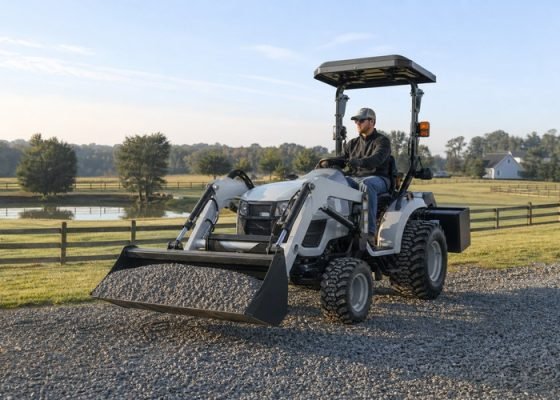

A loader specification can look wonderfully simple: one machine, one lift-capacity number. Real work is less tidy. A tractor that raises a test weight at the pivot pins may not raise the same weight on long pallet forks, and a loader that lifts a heavy bucket may still leave the tractor poorly balanced for travel. Buyers need to ask two separate questions: can the hydraulic system raise the load, and can the complete tractor carry, steer, stop, and place it with a useful safety margin?
This guide turns the specification sheet into a jobsite decision. It explains measurement points, lift height, breakout force, attachment weight, rear ballast, axle loading, and load shape. It also gives a practical test for common property jobs such as moving gravel, firewood, feed, brush, pallets, and snow. Start with the SeekMach tractor category, then compare each candidate using the same load position and operating conditions rather than the largest number in a brochure.
There is no responsible universal payload formula for every tractor-loader combination. Tire type, inflation, wheel spacing, terrain, attachment geometry, hydraulic pressure, and the approved ballast arrangement all matter. The operator’s manuals for the tractor, loader, and attachment remain the controlling references. The goal here is to help you read those references intelligently and reject a setup that only works at its limit.
Lift capacity only makes sense when the measurement point and lift height are stated. A rating at the bucket pivot pins measures the load close to the loader arms. A rating measured forward of the pins better represents a bucket cutting edge, fork load center, or suspended object. Moving the same weight farther forward increases leverage against the loader and tractor, so usable capacity falls even though the object itself has not become heavier.
This explains why a compact tractor may curl a dense object near the bucket heel but fail to raise a long pallet whose center of mass sits well ahead of the fork frame. It also explains why improvised fork extensions can create a serious problem. They change the load center and magnify forces without changing the printed capacity. The OSHA loader safety talk emphasizes approved ballast, rollover protection, seat-belt use, and controlled operation; those basics matter before any capacity comparison.
| Specifica | What it describes | Why buyers misread it | What to verify |
|---|---|---|---|
| Lift at pivot pins | Force close to the attachment hinge | The load usually sits farther forward in real work | Also find the forward load-center rating |
| Lift to full height | Capacity through the complete lift path | A load raised slightly may not reach truck-bed height | Required dump height and clearance |
| Breakout force | Initial digging or curling force near the pile | It is mistaken for carrying capacity | Separate breakout, curl, and lift figures |
| Hydraulic flow | How quickly cylinders may cycle | Faster movement is mistaken for greater capacity | Pressure, geometry, and rated load, not flow alone |
| Attachment capacity | What the bucket, forks, or grapple can safely handle | The loader and attachment ratings may differ | Use the lowest applicable rating |
Ask where the load must finish. Moving a rock six inches above grade is different from loading a high-sided trailer. The loader geometry changes through the lift arc, and stability changes as the combined center of gravity rises. A machine may break material loose and lift it at ground level yet lack comfortable capacity or rollback at full height. A buyer who only tests near the ground can discover this after delivery.
Make a simple job list with three columns: load, pickup height, and placement height. Gravel may be picked up at grade and dumped into a low spreader. A pallet may start on the ground and finish on a trailer deck. A bulk bag may need to clear a hopper. If full-height work is routine, compare the full-height figure at a realistic forward point and confirm the loader can maintain the required attachment angle.
IL SeekMach product overview is useful when the work list reveals that a tractor is not the only possible machine. Repeated tight-cycle loading, excavation, or work on soft ground may lead to a different equipment choice. Do not force a tractor into a job simply because it can lift one sample load once.
The loader raises the attachment and the payload together. A heavy-duty bucket, grapple, fork frame, bale grab, hydraulic coupler, or adapter consumes part of the available capacity before material is added. This deduction is especially important on small tractors, where a few hundred pounds can represent a large portion of the useful payload.
Use this planning sequence:
Wet material is a common surprise. A bucket that feels ordinary with dry mulch can become a very different load with wet clay or stone. Firewood varies with species and moisture. Brush looks light but can extend far ahead of a grapple and shift while turning. Pallets often hide their true center of mass. Whenever the load is uncertain, split it into smaller trips rather than treating the hydraulic relief valve as a weighing device.
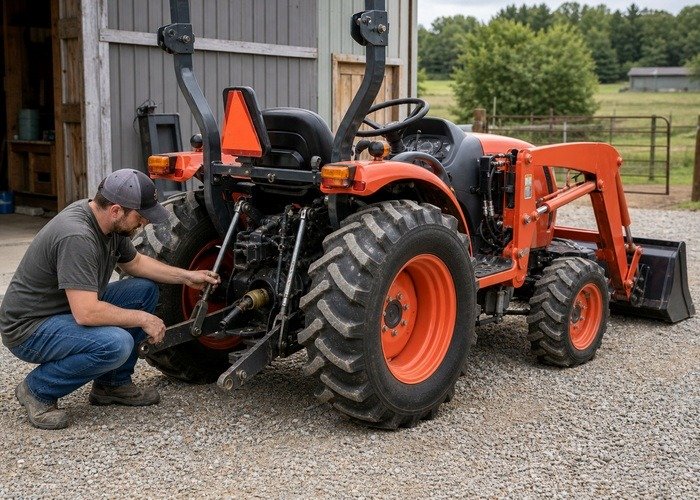
Rear ballast counteracts the forward moment created by the loader. It can keep rear tires loaded, preserve steering and braking control, and make the tractor feel planted. It does not authorize the operator to exceed the loader, axle, tire, frame, or attachment rating. Think of ballast as part of the approved operating configuration, not a modification that creates a larger machine.
Ballast may include a properly sized three-point ballast box, an approved rear implement, wheel weights, liquid-filled tires, or a specified combination. These choices do not act at the same location. Weight carried behind the rear axle creates a counterbalancing moment; weight inside a rear tire adds mass but has a shorter lever arm. Follow the loader manual rather than copying another owner’s setup. Penn State’s material on tractor stability and instability helps explain why center of gravity, slope, speed, and hitching position change rollover risk.
A useful field clue is steering feel, but it is not a capacity meter. If the rear becomes light, a wheel lifts, steering changes, or the tractor rocks during a slow test, stop and lower the load. Do not add throttle and continue. Recheck load weight, ballast, ground, tire pressure, and attachment position. The safest answer may be a smaller load or a larger machine.
Loader work transfers weight onto the front axle. Rear ballast improves overall balance, but it does not make front axle loading disappear. The axle, hubs, wheels, and tires must carry the tractor’s own front weight plus the transferred load. Repeated travel over ruts with a heavy bucket adds dynamic shock that a static rating does not describe.
Check tire load capacity at the actual inflation pressure and speed, and use matched tires of the specified type. Low pressure, damaged sidewalls, loose wheel hardware, or an unsuitable tire can undermine an otherwise sound loader setup. Inspect the loader mounts and front axle area for cracks, movement, leaks, or loose fasteners. The NIOSH agricultural safety topic provides broader context for controlling equipment hazards rather than relying on operator reaction after instability begins.
Pallet forks are where optimistic capacity estimates often fail. The fork frame has weight, and the load center may sit 20 inches, 24 inches, or farther ahead depending on the pallet. Long material can shift or swing. A pallet that is heavier on the far side increases the moment unexpectedly. Never assume a loader rated at the pins can handle that same number at the tip of the forks.
Before purchasing, identify the heaviest routine pallet and its dimensions. Find its actual or documented weight. Mark the center of mass, not merely the geometric center. Confirm the fork-frame capacity, fork-tine capacity, loader rating at that distance, and the tractor’s approved ballast. Keep the load against the frame, tilt it enough to retain it, raise only enough for clearance, and travel slowly on a planned level route.
For work involving several attachments, the SeekMach application solutions page can help organize the choice around lifting, mowing, grading, digging, and cleanup tasks. Capacity should be evaluated with the attachment that creates the most demanding combination, not only with the standard bucket.
Bucket volume encourages operators to fill to the top, but different materials have very different densities. A heaped bucket of damp gravel can be far heavier than the same bucket of loose leaves. The bucket may also trap an oversized rock or a compacted chunk whose weight is not obvious. If the loader stalls or the tractor becomes light at the rear, reduce the load instead of changing hydraulic settings.
Use partial buckets until the material and machine response are understood. Approach the pile square, keep the bucket low, avoid ramming, and curl while maintaining traction. When the machine is loaded, back away slowly before turning. Carry the load close to the ground so a loss of stability has less leverage and the operator retains visibility. Raise only at the placement point on firm, level ground.
The basic definition of a loader and its common configurations) is useful for separating tractor loaders from purpose-built wheel loaders and skid-steer loaders. Similar-looking buckets do not imply equal structure, cycle speed, stability, or duty rating.
Even a load comfortably within the rating on level concrete can be unsafe on a side slope, soft shoulder, rut, or hidden hole. Turning downhill, braking suddenly, or crossing a depression shifts the center of gravity. A raised load amplifies the effect. Survey the route before loading, fill holes where practical, keep away from ditches, and postpone travel if the surface cannot support the machine.
Follow the tractor manual’s slope instructions and avoid creating your own angle rule. Slope capability depends on configuration and conditions. Use rollover protection in its operating position and wear the seat belt as instructed. OSHA’s agricultural safety publication discusses rollover protection and safe tractor operation in a wider farm context.
Bring a written load profile when inspecting a tractor. Do not ask only, “How much will it lift?” Ask these questions instead:
If a demonstration is possible, use a known load, approved ballast, and level ground with a qualified operator. Watch the entire cycle: pickup, rollback, low travel, turn, braking, full-height placement, and lowering. A machine that completes only the first lift has not passed the work test.
The first mistake is treating breakout force as payload. The second is comparing ratings taken at different points. The third is ignoring attachment weight. Other costly habits include traveling with the load raised, turning on a slope, using one bucket corner to pry, carrying loose objects above people, lifting with damaged pins, and increasing relief pressure to chase more capacity.
Hydraulic modifications can move stress into cylinders, hoses, mounts, axles, tires, and the tractor frame. They can also remove the predictable protection built into the system. Keep factory settings unless an authorized procedure specifies otherwise. A slow loader may need correct fluid, warm-up, filtration, or service; it does not automatically need more pressure.
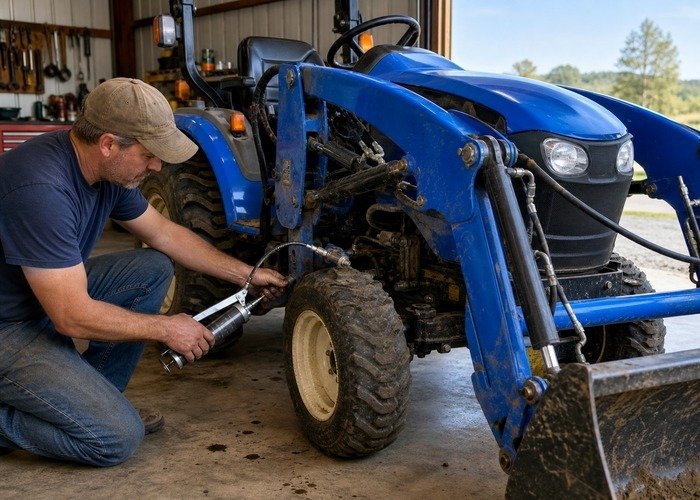
Walk around with the attachment lowered and the machine secured. Look for hydraulic leaks, hose rubbing, bent guards, cracked weld areas, loose mounting hardware, damaged pins, missing retainers, and tire problems. Confirm the attachment is fully locked. Check that ballast is attached correctly, the travel route is clear, and no people are inside the work zone. Test raise, lower, curl, and dump functions at low speed before approaching a load.
IL SeekMach tractor attachment guide offers additional context for matching loader tools and rear implements to property tasks. Selection and maintenance belong together: a well-matched attachment still becomes unsafe if its lock, hoses, tines, or pivot points are neglected.
Choose a tractor-loader combination that handles the heaviest routine load at the real load center and required height while using approved ballast and retaining margin. Occasional exceptional loads should be split, handled by a different machine, or contracted out. Buying for the dramatic once-a-year lift often produces a tractor that is too large for daily mowing and maneuvering; buying only for horsepower can produce a loader that never meets the material-handling need.
The honest answer to “How much can this tractor lift?” is a set of conditions, not a single number. Once measurement point, height, attachment, ballast, axle limits, terrain, and load shape are all visible, the comparison becomes far more useful. That is the difference between a loader that wins a specification contest and one that completes ordinary work with control.
Loader reliability also depends on the base machine. Use the compact tractor maintenance schedule to coordinate loader checks with fluid, tire, cooling-system, and hour-based tractor service.