Telephone/WhatsApp:+86 156 2656 0610

Telephone/WhatsApp:+86 156 2656 0610
Email:info@seekmach.com



Neglecting mini excavator track tension doesn’t just wear out components faster — it silently drains profitability on every single job site hour.
According to Construction Equipment Magazine, undercarriage maintenance accounts for approximately 50% of a tracked excavator’s total lifetime repair costs. That’s not a rounding error — it’s the single largest cost center on the machine, outpacing engine work, hydraulics, and structural repairs combined. For fleet owners and independent operators alike, that number reframes every maintenance decision made at the track level.
Track tension is the one variable operators control directly. Unlike sprocket wear or idler fatigue — which develop gradually over thousands of operating hours — tension can be checked and corrected in minutes. That accessibility makes it the highest-leverage maintenance task available. Yet it’s routinely overlooked because the consequences are slow-moving and invisible until they become expensive.
The relationship between tension and component wear is mechanical and unforgiving. When tracks run too loose, they slap against the sprocket teeth with each rotation, accelerating bushing wear and chewing through the sprocket profile prematurely. Carrier rollers and bottom rollers absorb abnormal side loads, shortening their service life. On the other hand, tracks that are over-tensioned create a different set of problems — specifically, what engineers call parasitic power loss. An over-tight track forces the final drive to work harder against its own drivetrain, burning fuel and generating heat without adding any productive output. In practice, this can measurably reduce machine efficiency and increase hydraulic system strain over time.
Understanding these dynamics is the foundation of smart undercarriage management. The next step is knowing exactly how to measure tension correctly — and that starts with a precise, repeatable procedure most operators have never been formally taught.
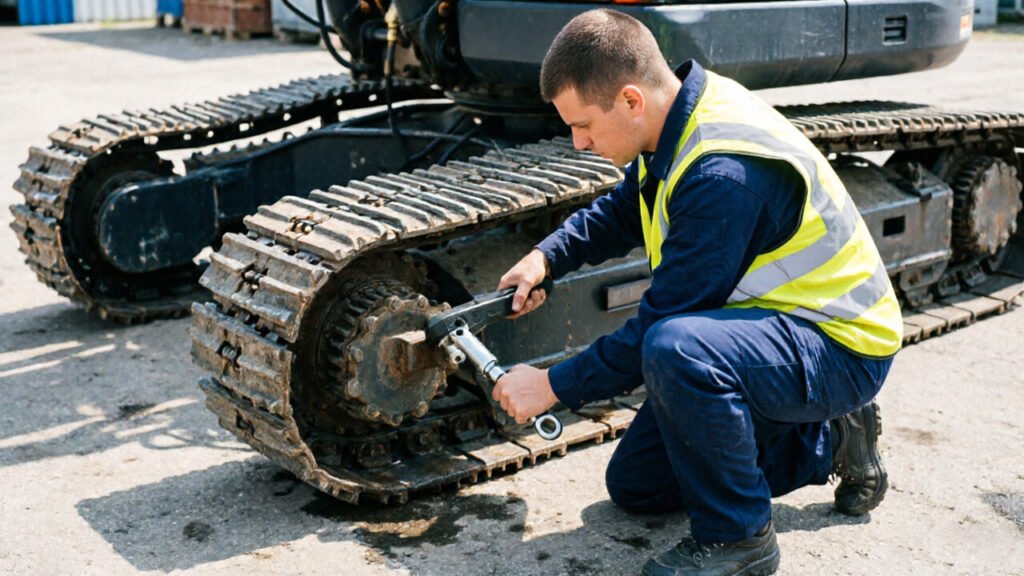
Knowing your tracks are worn is one thing — knowing how to measure them accurately is what separates reactive repairs from proactive cost control. The Sag Method is the industry-standard procedure for measuring excavator track tension, and executing it correctly requires more than eyeballing a sagging track. Done right, it takes under ten minutes and gives you a definitive, actionable reading.
▶ Watch: Step-by-Step Mini Excavator Track Tension Check
Step 1 — Position the machine correctly. Drive the excavator onto a flat, firm surface. Before measuring anything, rotate the tracks slowly to position the master link or grease fitting between the front idler and the first carrier roller. This ensures the measurement is taken at the point of maximum sag, not at a random tight spot that would give you a falsely optimistic reading.
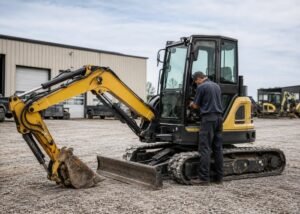
Step 2 — Lift the tracks off the ground. This is the step most operators skip — and skipping it invalidates the entire check. Use the boom, arm, and blade together to raise the machine until the tracks hang freely. Both tracks must be fully suspended with no ground contact for an accurate sag measurement. Even partial ground contact introduces tension that masks true slack. A detailed walkthrough from Bobcat’s service team demonstrates this lift procedure clearly.
Step 3 — Measure the sag. With the track suspended, place a straight edge along the bottom of the track frame. Measure the vertical distance from the top of the lowest track shoe to the underside of the frame rail. Most mini excavators fall within a 0.4–1.2 inch sag tolerance, but that range varies significantly by model.
Step 4 — Defer to manufacturer tolerances. Published sag ranges are model-specific for a reason — track pitch, idler diameter, and roller spacing all influence what “correct” looks like. As covered in reliable operator guides, using a generic standard instead of your OEM spec is a common and costly mistake. Always cross-reference your operator’s manual before adjusting.
What the Sag Method can’t account for, however, is how different operating surfaces change tension dynamically — which is exactly what the next section addresses.
Proper mini excavator track tension isn’t a single fixed number — it’s a dynamic setting that must change with the ground beneath your machine. According to EquipmentWorld, track tension must be adjusted specifically based on the current working terrain to prevent premature component failure. What protects your undercarriage on a rocky jobsite can actively destroy it in deep mud.
The terrain you’re running on today determines the tension setting you need today — not last week’s setting carried over from a different surface.
Here’s how terrain type drives the correct tension profile:
| Tipe Medan | Recommended Tension Profile | Risk of Incorrect Setting |
|---|---|---|
| Soft ground (mud/sand) | Looser — increased sag allowance | Mud packing, over-tensioning, derailment |
| Hard/Rocky surfaces | Tighter — minimal sag | Track whipping, de-tracking on vibration |
| Mixed/Transitional | Moderate, checked frequently | Inconsistent wear, unpredictable behavior |
| Frozen/Compacted soil | Slightly tighter than standard | Brittle track link stress fractures |
Soft terrain demands a looser setting because mud and sand pack aggressively into the undercarriage during operation. As debris builds between the track links and rollers, it effectively tightens the track from the inside — a machine that started at the correct tension can become dangerously over-tensioned within a single shift without a single manual adjustment.
Hard and rocky ground flips the equation. A loose track on uneven, hard surfaces will whip and bounce unpredictably, increasing de-tracking risk and hammering the carrier rollers with every pass.
Seasonal changes add another layer of complexity. Soil that’s loose and workable in spring can freeze solid by late fall, dramatically changing how the ground interacts with track tension. A setting dialed in during summer won’t hold up once freeze-thaw cycles begin compacting and shifting the surface. Savvy operators build terrain checks — not just visual inspections — into their daily walkaround. If you’ve recently replaced your tracks, understanding how tension affects new track wear is equally critical to getting full service life.
Getting terrain-specific tension right protects your undercarriage — but there’s another side of this equation that trips up even experienced operators: the assumption that tighter is always safer.
Over-tightening mini excavator tracks is one of the most damaging habits in the industry — and it’s driven entirely by a myth that tighter always means safer.
Many operators assume that running tracks on the firm side prevents de-tracking, especially in loose or uneven terrain. In practice, the opposite problem emerges: excessive tension creates a mechanical stranglehold on the undercarriage that the engine has to fight against with every rotation of the drive sprocket.
“The most common mistake in undercarriage maintenance is over-tightening the tracks, which creates ‘parasitic’ power loss and increases fuel consumption.” — For Construction Pros
adjust excavator track tensionParasitic friction is the operative term here. When you adjust excavator track tension beyond the manufacturer’s recommended sag tolerance, the rubber or steel track presses against the rollers, idlers, and sprocket teeth with far greater force than the system was designed to handle. The engine must generate additional horsepower just to overcome this internal resistance — power that never reaches the bucket or blade. For fleet managers tracking cost-per-hour metrics, this translates directly into higher fuel burn across every machine running over-tightened tracks.
Long-term mechanical damage compounds the fuel cost problem significantly. The final drive motor — one of the most expensive components on a compact excavator — operates under sustained hydraulic pressure to push against that excess tension. Over time, this strains motor seals, accelerates bearing wear, and can cause premature hydraulic system fatigue. Replacing a final drive motor typically runs $2,000–$5,000 or more in parts alone, a cost that dwarfs the few minutes it takes to verify proper track sag. For operators who want to avoid that downstream expense, understanding how track misalignment stresses drive motors is essential reading.
The takeaway is straightforward: correct tension protects both your fuel budget and your drivetrain. Knowing when that tension needs to be checked — and how consistently — is where daily inspection protocols become indispensable.
Consistent excavator undercarriage maintenance starts long before a component fails — it starts at the beginning of every shift, with a disciplined walk-around that takes less than five minutes.
A daily visual check isn’t optional; it’s the single most cost-effective habit a fleet can develop. Tracks that are inspected every day catch tension drift early, before it cascades into roller damage, sprocket wear, or a full de-tracking event mid-job. For fleet managers overseeing multiple machines across multiple sites, that consistency is only achievable through standardized protocols.
Warning signs to watch for during every pre-shift check:
When performing a grease gun adjustment, positioning matters. According to Machineryline, the machine should be rotated so the grease fitting sits between the idler and the top carrier roller before taking a measurement — this ensures an accurate baseline rather than a false reading skewed by machine position.
Standardizing this process fleet-wide means every operator uses the same check position, the same measurement method, and documents the result. A simple paper or digital log per machine creates accountability and surfaces patterns — a machine consistently requiring re-tensioning after rocky terrain work signals a training gap or terrain-specific protocol that needs updating.
Training is the other half of the equation. Operators who understand how ground conditions drive tension changes — as covered in earlier sections — will self-correct rather than waiting for a supervisor to intervene. Pairing that knowledge with safer operating habits reduces both undercarriage wear and incident rates across the fleet.
Of course, even disciplined daily checks can’t always prevent persistent de-tracking — and when that happens repeatedly, the grease fitting may no longer be the root cause.
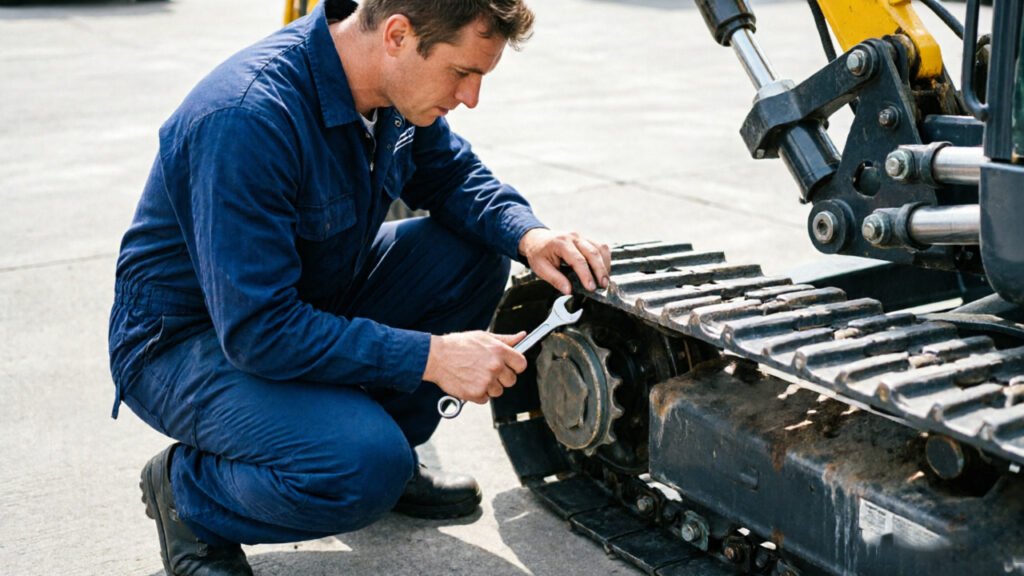
When track tension adjustments stop solving your de-tracking problem, the real issue is almost always mechanical wear that no amount of grease can fix.
Recurring de-tracking is a symptom, not the root problem — and continuing to adjust tension without diagnosing the cause accelerates damage across the entire undercarriage.
Worn sprocket teeth are the first place to look. Sprockets grip the track chain through precisely shaped teeth, and once those teeth wear down or become hooked, the chain can no longer seat properly. As Construction Equipment Magazine notes, excessive tension combined with worn components leads to accelerated degradation of bushings, sprockets, and idlers simultaneously — meaning one neglected part often triggers a cascade of failures.
Bent track frames and misaligned idlers are a less obvious but equally serious culprit. A track frame can suffer subtle bending from hard impacts, rock strikes, or operating on consistently uneven terrain. Even a few millimeters of misalignment at the front idler changes the track’s travel path, creating the kind of lateral drift that eventually walks the track off the sprocket. Visually inspecting the idler’s position relative to the track centerline — and checking for uneven wear patterns on one side of the track links — can reveal misalignment before it becomes a full de-track event. The 2.5-ton class undercarriage overview illustrates why proper frame geometry matters even on compact machines.
The recoil spring is the tensioner’s last line of defense. This spring absorbs shock when the track hits an obstacle, allowing the front idler to momentarily retract rather than transferring the full impact to the chain. When the recoil spring loses its ability to hold pressure — either through fatigue, a failed seal in the hydraulic tensioner, or physical damage — the track runs loose no matter how much grease you pump in.
At that point, the only responsible decision is to stop adjusting and start replacing. Continued operation on a compromised tensioner or worn sprocket doesn’t just risk another de-track event; it damages the track links, roller flanges, and frame in ways that compound repair costs significantly. Knowing where that line falls is what separates reactive maintenance from a disciplined undercarriage strategy — and the quality of the components you’re working with matters just as much as the protocol itself.
The machine you start with determines how hard you’ll work to maintain it — and that reality becomes crystal clear once you’ve spent time troubleshooting undercarriage issues on equipment that was never engineered for easy serviceability.
ISO 9001 manufacturing standards aren’t just a badge on a brochure. When a facility operates under that quality framework, it means track frame dimensions, roller bore tolerances, and sprocket geometry are held to documented, repeatable specifications across every unit produced. Consistent track frame alignment from the factory directly reduces the risk of uneven wear patterns that compound over thousands of operating hours. An undercarriage that arrives in true alignment gives your maintenance team a clean baseline — one where tension adjustments and component wear follow predictable patterns rather than chasing variables introduced during production.
CE-certified undercarriages carry an additional practical advantage for operations running equipment across multiple regions or job sites. Certification confirms the machine meets established safety and performance thresholds, which matters when fleet managers are sourcing replacement parts internationally or coordinating warranty service across distributed teams. Seekmach operates from a 50,000 m² integrated production facility with ISO 9001 quality standards — a scale that supports consistent parts manufacturing and faster access to genuine components when an undercarriage overhaul becomes necessary. Factory-direct sourcing removes the distributor markup that typically inflates replacement roller, idler, and track link costs, making planned maintenance significantly more affordable than the reactive approach. For buyers evaluating compact excavators for confined work, undercarriage serviceability should rank alongside hydraulic performance as a purchase criterion.
Maintenance accessibility — grease fittings positioned for tool clearance, tension adjustment ports that don’t require major disassembly — is an engineering decision made at the design stage, not something that can be retrofitted. When the manufacturer controls both design and production under one roof, those ergonomic details tend to survive into the final product. That combination of quality manufacturing and accessible maintenance points is ultimately what separates equipment that supports a low total cost of ownership from equipment that quietly erodes it — a distinction worth keeping in mind as we pull together the core takeaways from everything covered here.
Track tension is not a set-it-and-forget-it adjustment — it’s a daily discipline that directly determines how long your undercarriage lasts and how much your machine costs to run.
According to Construction Equipment Magazine, proper track tension is the single most effective way to control lifetime repair costs — and undercarriage components routinely account for up to 50% of a machine’s total repair budget. That number puts daily tension checks in a different category entirely. This isn’t routine maintenance; it’s financial management.
Over-tightening is a silent killer. Most operators worry about loose tracks, but excessive tension quietly destroys drive motors, accelerates sprocket wear, and spikes fuel consumption — all without obvious symptoms until the damage is already done. The correct approach isn’t “tight enough to feel secure.” It’s terrain-specific: slightly looser settings for soft or muddy ground, and firmer tension for hard-packed rock where track slap becomes a real wear factor.
Consistency in your measurement method matters just as much as the measurement itself. The Sag Method — lifting the machine clear of the ground and measuring mid-span deflection — removes variables that ground-level checks introduce. Pressure on the lower run and soil contact both distort your reading. Lift it, measure it, trust the number.
Four takeaways worth keeping front of mind:
The right habits are straightforward once they’re established. If you still have questions about intervals, grease types, or why de-tracking keeps happening despite correct tension, the next section addresses the most common points of confusion directly.
Proper mini excavator track maintenance comes down to a handful of questions operators ask repeatedly — and the answers can save you thousands in avoidable repairs.
How often should I check my mini excavator track tension?
Check track tension daily before operation, and recheck after the first hour of work on a new job site. Terrain changes everything — what was correct on compacted gravel may be dangerously loose in mud or sand. According to EquipmentWorld, soft, muddy, or sandy conditions actually require slightly looser tension to allow debris to pass through without building up and forcing the track off the rollers.
What happens if my excavator tracks are too loose?
Loose tracks are the leading cause of derailment and accelerated undercarriage wear. When a track runs with excessive sag, it creates uneven loading across the rollers and idlers, causing metal-on-metal contact that grinds components down far faster than normal. Beyond wear, a loose track can de-track mid-operation — a time-consuming, potentially dangerous situation covered in detail by the complete re-tracking guide at Sany.
Can I use any grease to adjust the track tensioner?
No — use only high-quality, high-pressure grease rated for hydraulic grease fittings. Standard general-purpose grease can degrade under the pressure levels inside a track tensioner cylinder, leading to uneven tension or seal failure. Always refer to your operator’s manual for the manufacturer’s recommended specification. The same discipline applies broadly across compact equipment — just as you’d follow precise maintenance specs on any compact machine, the track tensioner demands the same respect.
Why does my track keep coming off even when the tension is right?
If tension is correct but derailment persists, the issue is likely worn or damaged components — specifically sprocket teeth, front idler wear, or roller flange deterioration. A worn sprocket loses the precise tooth geometry needed to carry the track under load, and no amount of tension adjustment compensates for that. Have the full undercarriage inspected by a qualified technician to rule out component failure before the next work cycle.