Telephone/WhatsApp:+86 156 2656 0610
Telephone/WhatsApp:+86 156 2656 0610
Email:info@seekmach.com

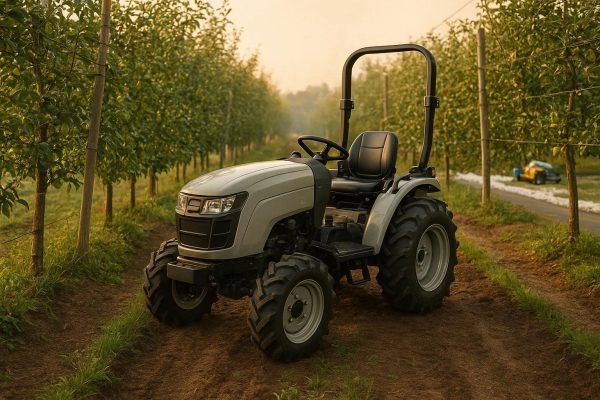
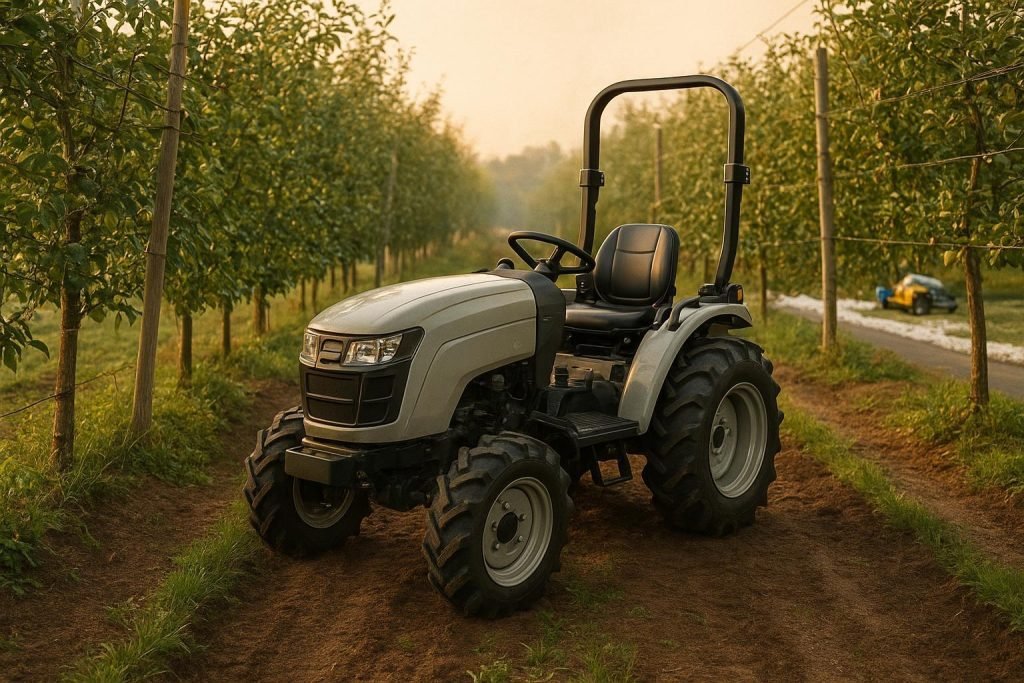
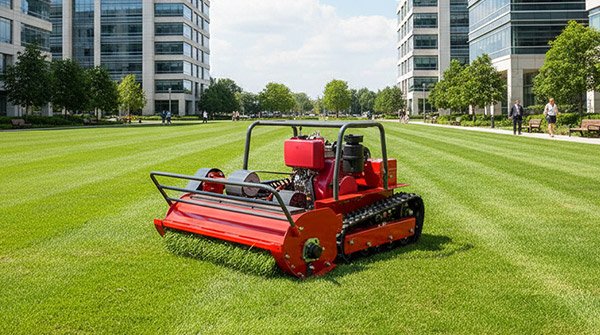
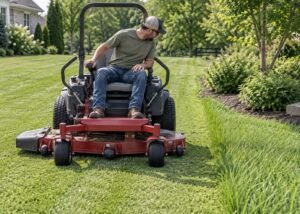
If you work in tight trellised rows, low greenhouses, or parks and sidewalks, a 25HP compact tractor hits a sweet spot: small enough to maneuver, powerful enough to run essential implements, and—when chosen well—affordable to own over the long haul. This guide keeps a sharp focus on lowest total cost of ownership (TCO), while helping you match specs and implements to real jobs so you can buy with confidence. If you’re actively searching for a 25HP tractor for sale, use this guide to confirm dimensions, PTO compatibility, and cost drivers before you commit.
| Spec/Requirement | What to confirm | Why it matters |
|---|---|---|
| Overall width & height | Fit between rows/under trellis or in greenhouse doors | Prevents damage and bottlenecks |
| Turning radius | End-of-row turns and narrow paths | Productivity in tight blocks |
| PTO & PTO HP | 540 rpm rear PTO; available mid/front PTO if needed | Runs mowers, sprayers, blowers correctly |
| Hitch category | Category 1 (Cat 1) with proper pin sizes | Implement compatibility |
| Hidráulica | Flow (GPM or L/min) and number of remotes | For loaders, sprayers, log splitters, etc. |
| Llantas | Narrow/row-crop vs. turf/industrial | Traction vs. turf friendliness; footprint |
| Seguridad | ROPS and seat belt in use | Rollover protection in uneven terrain |
| Service & parts | Filter intervals, local/global parts access | Uptime and predictable TCO |
Tip: Bring your implement list and their minimum PTO HP/hydraulic needs to the conversation. It saves time and prevents mismatches. When you’re comparing any 25HP tractor for sale, walk through this list line by line.
Compact tractors in the 20–30 HP band typically use diesel engines with a rear 540 rpm PTO and a Category 1 three‑point hitch. These fundamentals are widely documented in neutral references such as the Tractor overview on Wikipedia, which also summarizes mid‑PTO options commonly near 2000 rpm for some mowers and blowers (Tractor basics and PTO standards). In practice, a well‑configured 25HP unit is a workhorse for:
Natural limits to respect:
Use this conservative, experience-based matrix as a starting point. Always verify each implement’s manual for exact minimum PTO HP and weight requirements. If you’re vetting a 25HP tractor for sale today, this table gives you realistic ranges to discuss with dealers or suppliers.
| Tarea | Typical implement for 25HP class | Conservative capacity guidance | Notes/Sources |
|---|---|---|---|
| Mowing (parks/orchards) | Flail or rotary mower | 1.2–1.5 m (4–5 ft) width | Check PTO HP and gear ratio; 540 rpm rear PTO is standard (Wikipedia overview). |
| Spraying (orchards/greenhouses) | Rear-mounted sprayer | ~200–400 L (50–100 gal) tanks in tight rows | Validate pump flow vs. PTO HP; confirm width and turning in end rows. |
| Light cultivation | Rotary tiller/cultivator | ~1.2–1.4 m (4–4.5 ft) | Soil type and depth drive power draw; reduce width in tougher soils. |
| Loader work | Compact front loader | 500–800 kg rated lift at pins (class‑level range) | Ballast is critical to safety; mind transport speed and slopes (Penn State—stability). |
| Winter tasks | Front/rear snow blower or blade | 48–60 in, depending on duty | Mid‑PTO or front kits vary by model; verify availability. |
Hitch and hydraulics reminders:
Row spacing, trellis cross‑members, and end‑row geometry dictate your tractor’s width, height, and turning radius. University guidance on trellis end assemblies highlights how end‑row space can tighten turns, making maneuverability a priority for vineyard/orchard work (see the University of Minnesota’s discussion of trellis anatomy and end‑row implications in 2024: trellis anatomy and turning space context). Think of it this way: if the end‑row “pocket” is short, a tighter turning radius saves repeated back‑and‑fill moves.
Operational tips for orchards:
Low door headers and internal structures set hard limits on height; tight aisles set width limits. A compact 25HP platform is attractive in these spaces for precise maneuvering and modest emissions/heat at low loads. Priorities:
City and campus maintenance teams often deploy compact tractors for mowing medians and parks, sweeping, aeration, snow clearing on sidewalks/paths, and light materials handling. Practical checks:
Total cost of ownership blends ownership (depreciation, interest, taxes/insurance/housing) and operating costs (fuel, lube, repairs/maintenance, labor). The Iowa State University Ag Decision Maker framework provides transparent formulas and a calculator you can tailor to your hours, fuel price, and maintenance reality. See the methodology in Estimating Farm Machinery Costs (A3‑29) and its worksheet (Iowa State AgDM A3‑29 PDF; A3‑29 Excel calculator).
Example assumptions for illustration only (your numbers will vary):
| Duty cycle | Fuel ($/hr) | Maint/Repairs ($/hr) | Depreciation ($/hr) | Labor ($/hr) | Estimated total ($/hr) |
|---|---|---|---|---|---|
| Orchard (heavier PTO load mix) | 1.80 | 0.90 | 2.10 | 3.50 | 8.30 |
| Municipal (lighter-average load) | 1.40 | 0.80 | 2.10 | 3.50 | 7.80 |
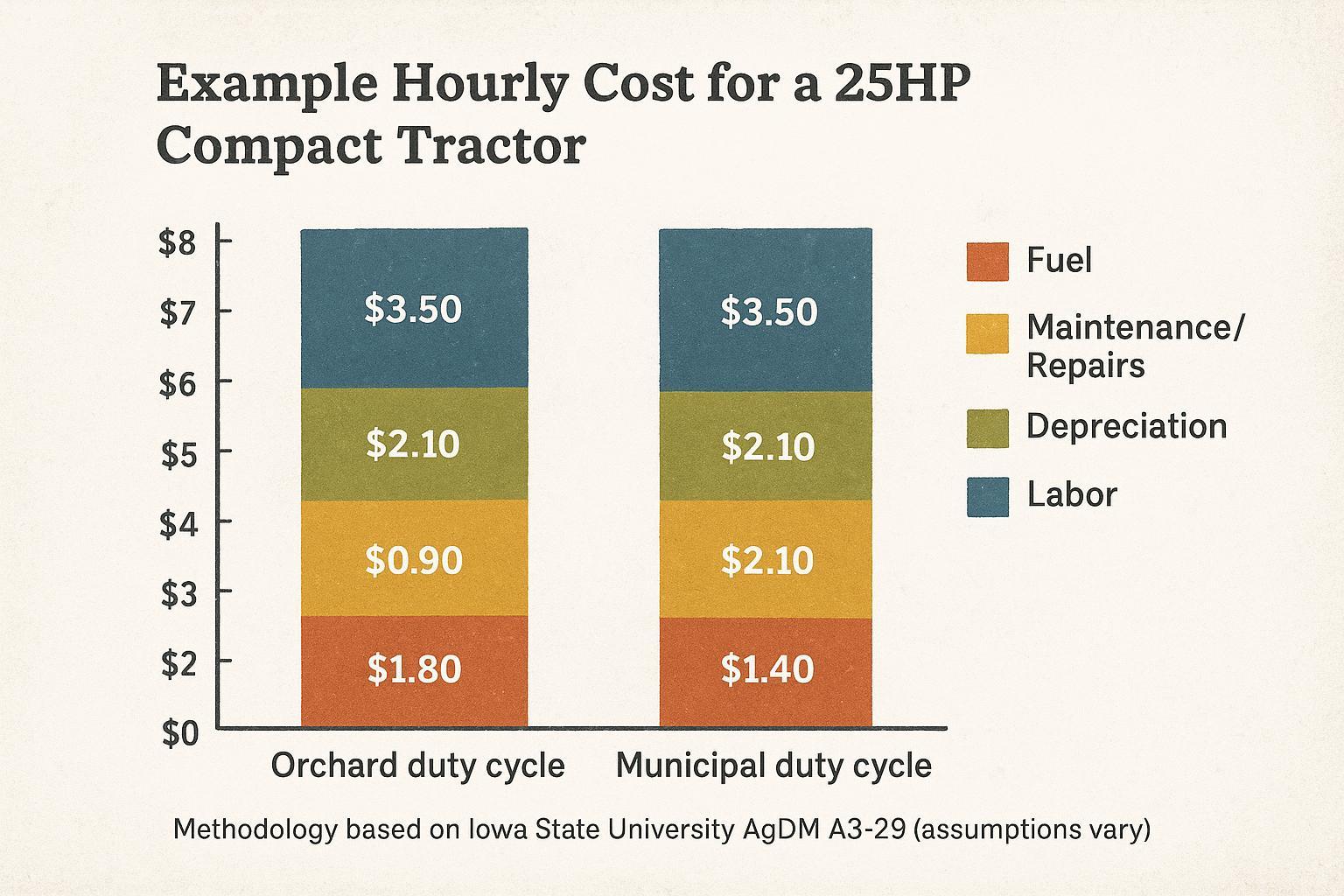
Method note: These illustrative splits mirror typical components in the Iowa State AgDM approach. For your operation, plug in your hours/year, local diesel prices, wage rates, and financing realities to make a precise plan.
If you need a configurable 25HP tractor for tight‑row orchards and greenhouse work, the SeekMach SM‑254Y is a relevant example. You can review the model and request configuration details on the product page: SM‑254Y on SeekMach. A typical narrow‑row scenario might look like this:
Pro tip: If you’re close to a purchase decision and comparing more than one 25HP tractor for sale, revisit the Quick‑buy checklist and match each line item to your implements and site constraints before you sign.
Q1. What jobs can a 25HP compact handle reliably? A. Mowing (4–5 ft), spraying with moderate tank sizes, light cultivation, loader tasks within rated lift, sweeping, and sidewalk snow removal. Confirm PTO HP and implement minimums, along with ballast and stability practices.
Q2. What about safety and ROPS? A. Use the ROPS with a seat belt. Regulatory and research bodies report dramatic reductions in rollover fatalities when ROPS and belts are used correctly; see OSHA’s agricultural safety guidance y NIOSH reviews on ROPS effectiveness.
Q3. How do I estimate hourly costs (fuel, maintenance, depreciation)? A. Use the Iowa State AgDM A3‑29 method and calculator to input your own fuel prices, hours/year, and maintenance assumptions. Start here: Iowa State AgDM A3‑29 PDF.
Q4. Is a 25HP tractor enough for baling hay? A. Mini round balers may be feasible with lower PTO HP minimums; conventional square balers often require significantly more PTO HP and tractor mass. Review implement manuals and see Iowa State Extension’s hay equipment guidance.
Q5. Where can I learn the basics of tractor PTO and hitch categories? A. A concise neutral overview is available on Wikipedia’s Tractor page, which summarizes 540 rpm rear PTO norms and hitch categories commonly used in compact tractors (Tractor definitions and PTO overview).
References (selected):