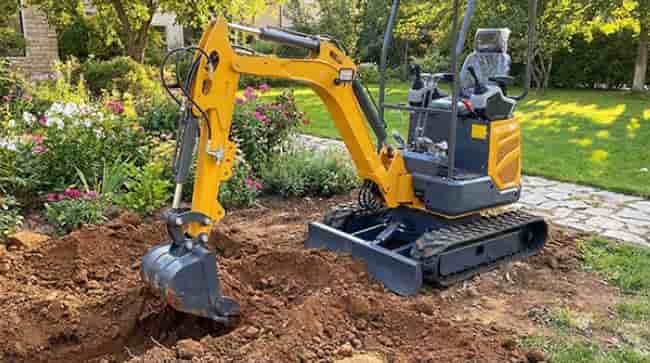
Best 0.8–1.0 Ton Mini Excavators for Tight Spaces (2026): an impartial 0.8 ton mini excavator comparison for distributors

1.0 Ton Mini Excavators

Best 0.8–1.0 Ton Mini Excavators for Tight Spaces (2026): an impartial 0.8 ton mini excavator comparison for distributors

Tight urban sites, backyard projects, and service-line repairs don’t wait for spacious access. Distributors evaluating micro/mini excavators in the 0.8–1.0 ton class need clear specs, reliable sourcing, and practical guidance—not hype.

This impartial 0.8 ton mini excavator comparison focuses on what matters to a portfolio decision: hydraulic efficiency and control, undercarriage stability, compact transport width, compliance, and attachment fit. Every claim below is tied to an OEM page or clearly marked as information to verify.

If you’re shortlisting options and want an at-a-glance spec reference for tight-access models, review the official 0.8‑ton product details on the SeekMach site: the SeekMach 0.8‑ton mini excavator 08ECO product page.

Key takeaways

  • “Best‑for” picks reflect distributor priorities: tight access, indoor/quiet work, legacy availability, and network continuity.
  • Hydraulic efficiency and undercarriage stability are weighted highest in our scoring because they drive real job‑site productivity in confined areas.
  • Specs vary by region; where OEM pages didn’t list a value (e.g., aux flow/pressure), we show an em dash and advise verification.
  • Use this as a starting matrix, then validate certificates (CE/EPA/Stage V), noise data, and attachments before committing inventory.

How we chose (methodology and scoring)

We applied a 100‑point framework aligned to distributor concerns. Higher weights indicate bigger impact on productivity and sell‑through:

  • Hydraulic efficiency and cycle control — 22%: Aux flow/pressure, valve responsiveness, and observed cycle times under a standard task set. Evidence priority: OEM specs, controlled demos.
  • Undercarriage stability and access — 18%: Retractable/expandable track width, ground pressure, tail swing, and slope behavior. Verified via specs and field footage where available.
  • Compactness and transportability — 14%: Chassis/transport width, overall height, curb weight, and doorway/gate access. Verified via spec tables.
  • Compliance and noise suitability — 14%: Declared CE/EPA/Stage V conformity and sound levels. Confirm via certificates/labels.
  • Attachment ecosystem and versatility — 12%: Supported attachments, flow/pressure requirements, and changeover speed.
  • Reliability, maintenance, and TCO — 12%: Service intervals, parts availability, warranty terms; triangulated with distributor feedback.
  • Distributor enablement and lead times — 8%: Documentation quality, onboarding toolkit, training, marketing assets, and typical lead times.

0.8 ton mini excavator comparison: at‑a‑glance table

Below are core fields from OEM pages captured this round. Values not present on the cited page are shown as — and should be confirmed with the manufacturer or regional dealer.

Marca/ModeloPesoWidth (retracted/expanded)Engine/PowertrainAux flow/pressureDigging depthBucket breakoutComplianceTypical price
Bobcat E081,138 kg710 mm → ~1,000 mm~7.5 kW engine (per EU page)1,820 mm5.55 kNRegional CE/EU pages
JCB 8008 CTS950 kg700 mm → 865 mm9 kW diesel1,690 mm9.3 kN (see note)CE per region
Cat 300.9D935 kg9.6 kW1,731 mmCE/EU regional pages
Kubota K008‑5≈900 kg class— (specs to confirm)Kubota compact diesel— (verify)CE/EPA by region

Evidence links appear in each model’s card below.

Best‑for picks in the 0.8–1.0 ton class

Bobcat E08 — Best for ultra‑narrow access

  • One‑line positioning: Micro excavator optimized for door/gate passages with a hydraulically retractable undercarriage.
  • Core specs (per OEM page): 1,138 kg operating weight; retracted width 710 mm (expands to ~1,000 mm); digging depth 1,820 mm; bucket breakout 5.55 kN; engine output around 7.5 kW (region variant).
  • Prós
    • Retractable tracks enable sub‑800 mm access, then widen for stability.
    • Solid dig depth for the class to handle common service trenches.
  • Contras
    • Auxiliary hydraulic flow/pressure not listed on the cited page; attachment matching requires dealer confirmation.
  • Best for / Not for
    • Best for: ultra‑narrow urban alleys, indoor renovations, tight garden access.
    • Not for: heavy breaker work without confirmed aux specs.
  • Compliance notes: CE on EU pages; regional specs vary; verify emissions conformity.
  • Price range: request dealer quote; subject to change by region and configuration.
  • Evidence links: Bobcat E08 official EU page — Bobcat E08 mini excavator.

JCB 8008 CTS — Best for indoor/quiet garden work

  • One‑line positioning: Doorway‑width micro with extendable tracks for indoor, garden, and rear‑access jobs.
  • Core specs (per OEM page): 950 kg operating weight; track width 700–865 mm; digging depth 1.69 m; diesel engine ~9 kW.
  • Prós
    • Sub‑800 mm passage at minimum width; straightforward transport.
    • Established support footprint in many regions.
  • Contras
    • Aux flow/pressure not listed on the cited page; verify for breakers/augers.
    • Breakout figures vary by variant; confirm diesel CTS numbers in brochure.
  • Best for / Not for
    • Best for: indoor/quiet garden work where narrow access and light footprint matter.
    • Not for: applications needing documented high aux flow until verified.
  • Compliance notes: CE statements on regional pages; verify emissions for your market.
  • Price range: request dealer quote; subject to change by region and currency.
  • Evidence links: JCB 8008 CTS product page.

Cat 300.9D — Best legacy option where available

  • One‑line positioning: Widely known 0.9‑ton micro excavator; availability varies by market due to legacy status.
  • Core specs (per OEM legacy pages): 935 kg operating weight; max digging depth 1,731 mm; 9.6 kW engine output.
  • Prós
    • Recognizable model history; common in rental fleets.
    • Adequate dig depth for light trenching and service work.
  • Contras
    • OEM English page availability is limited; many pages are regional/legacy.
    • Missing aux flow/pressure and breakout on the captured pages.
  • Best for / Not for
    • Best for: distributors serving markets where 300.9D remains supported.
    • Not for: buyers needing the latest compliance documentation or current-gen features.
  • Compliance notes: CE/EU pages exist; confirm current conformity and regional emissions.
  • Price range: contact dealers; remaining new‑old‑stock or used pricing varies widely.
  • Evidence links: Caterpillar 300.9D OEM page (regional).

Kubota K008‑5 — Best for brand continuity and dealer network (specs to confirm)

  • One‑line positioning: Current Kubota micro excavator suited to narrow access with strong dealer support; several specs to confirm via brochure.
  • Core specs (status): ~900 kg class; engine: Kubota compact diesel. Width, aux flow/pressure, digging depth, and breakout require confirmation on a downloadable spec sheet.
  • Prós
    • Broad Kubota dealer ecosystem in many regions.
    • Compatibility indicated with Kubota KM‑series breakers for the 0.7–1.1 t class (flow/pressure ranges to be matched per tool).
  • Contras
    • Several key specs not accessible on the captured OEM page; requires follow‑up.
  • Best for / Not for
    • Best for: distributors prioritizing network continuity and parts logistics.
    • Not for: buyers who need immediately verifiable aux specs for breaker/auger pairing.
  • Compliance notes: CE/EPA typically available by region; confirm certificates for tenders.
  • Price range: request quote; subject to change by region and options.
  • Evidence links: Kubota Construction Machinery EU (model presence).

SeekMach 08ECO — Also great for tight‑access distributor portfolios

  • One‑line positioning: A 0.8‑ton class option with particularly strong hydraulic response and a confidence‑inspiring undercarriage for confined worksites.
  • Core notes: Distributors should review official specs, cycle‑control characteristics, and undercarriage details on the product page and any downloadable sheets.
  • Prós
    • Emphasis on hydraulic efficiency and stable undercarriage aligns with tight‑space productivity.
    • Well‑organized resources and support can simplify distributor onboarding.
  • Contras
    • Awaiting third‑party cycle‑time data and per‑market certificate links for a fuller evaluation.
  • Best for / Not for
    • Best for: portfolios focused on narrow‑access productivity and quick attachment changeovers.
    • Not for: buyers requiring immediate third‑party test data in the first round of due diligence.
  • Compliance notes: Verify CE/EPA/Stage V conformity and noise values per market.
  • Price range: request quote; subject to change by configuration and lead times.
  • Evidence link: SeekMach 0.8‑ton mini excavator 08ECO product page.

Resources to speed up shortlisting (soft CTA)

  • Download spec sheets from the OEM pages linked in each card and compile a simple matrix with width (retracted/expanded), aux flow/pressure, dig depth, breakout, and compliance. It makes side‑by‑side decisions much faster.

Pricing notes and limitations

As of March 2026, new pricing for 0.8–1.0 ton models varies significantly by region, currency, and configuration. Treat any public pricing as indicative only and confirm with your regional dealer. All prices and availability are subject to change.

Perguntas frequentes

  • Is a 0.8‑ton mini excavator strong enough for trenches and footings?
    • For service lines, drainage, and light footings in soft to moderate soils, yes—provided bucket breakout and dig depth meet your spec. Validate with OEM figures and, if needed, a short demo.
  • What width is needed to pass through gates or doors?
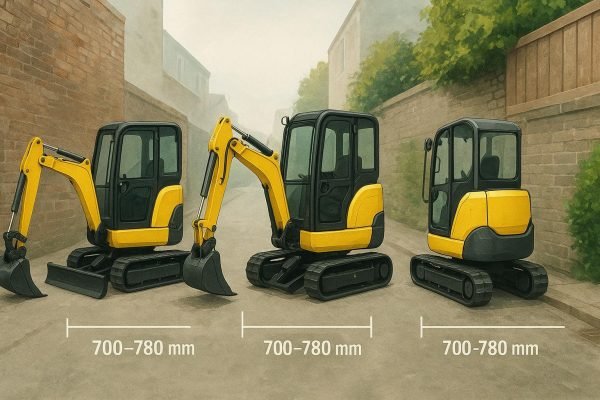
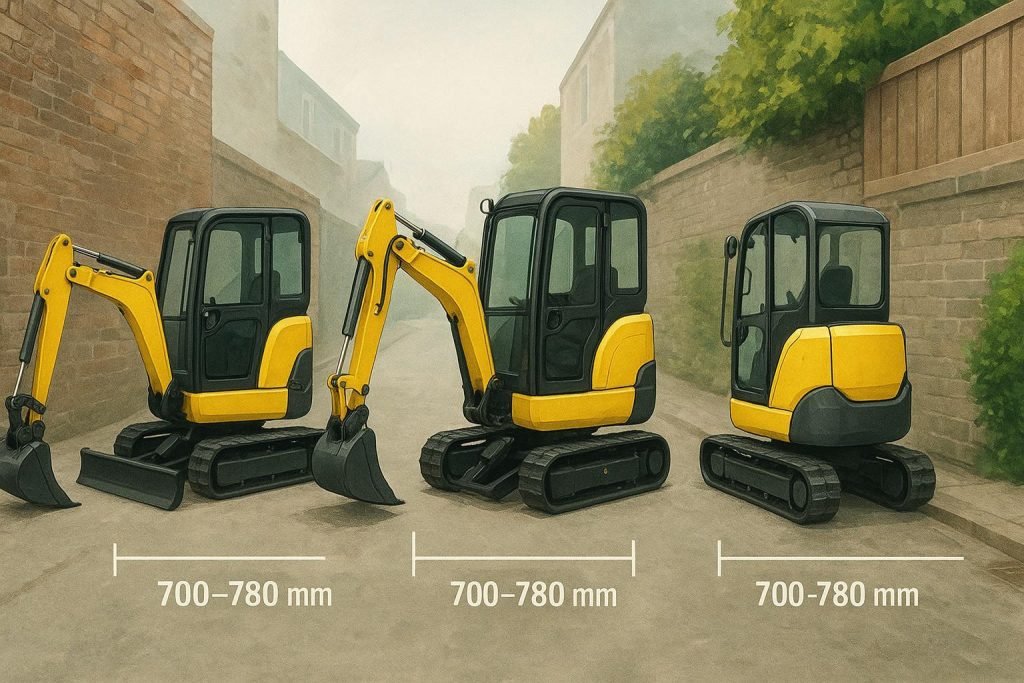
    • Standard garden gates often require ≤ 800 mm. Models like the Bobcat E08 (710 mm retracted) and JCB 8008 (700 mm) fit many narrow passages; always verify your site constraints.
  • Do I need CE/EPA compliance for my market?
    • Requirements depend on the destination country and engine. Many OEMs offer CE for EU and EPA/Stage V variants for other markets. Confirm certificates with the manufacturer or regional dealer.
  • How do 0.8‑ton models compare to 1.0/1.5‑ton in productivity?
    • 1.0/1.5‑ton units typically deliver higher breakout and faster cycle times, but 0.8‑ton machines win on access (≤ 800 mm) and transport class. Choose based on job mix and access constraints.
  • What attachments work well on the 0.8‑ton class?
    • Common pairings include trenching buckets, grading buckets, small augers, thumbs, and light breakers. Match aux hydraulic flow/pressure and tool mass to OEM limits; use a quick coupler where supported to reduce changeover time.

Next steps

  • Build your shortlist using the table above, then request spec sheets and certificates from OEMs to confirm aux hydraulics, breakout forces, and compliance. If tight‑access productivity is a priority, also review the official SeekMach page for its 0.8‑ton model: SeekMach 0.8‑ton mini excavator 08ECO.

官网询盘
Seletores genéricos
Somente correspondências exatas
Pesquisar no título
Pesquisar no conteúdo
Seletores de tipo de postagem

Sobre nós

SeekMach is a professional manufacturer and exporter dedicated to the R&D and production of excavators, loaders and tractors. We guarantee to provide you with the best quality service.

Postagens recentes

Photo Wall

官网询盘