Telephone/WhatsApp:+86 156 2656 0610
Telephone/WhatsApp:+86 156 2656 0610
Email:info@seekmach.com

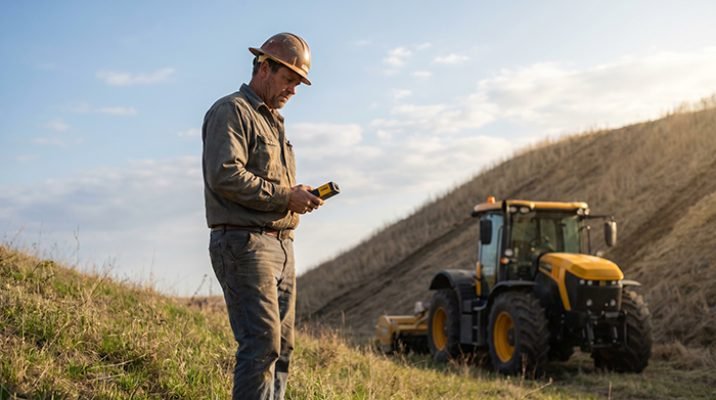
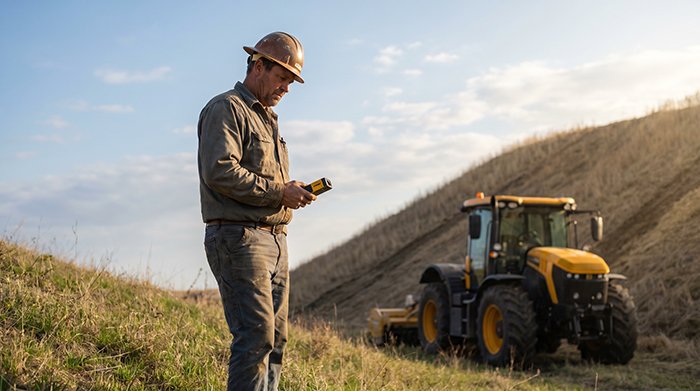
Tractor safety on slopes isn’t a niche concern — it’s the single most consequential variable in agricultural and construction fleet management, and the statistics underscore its importance.
According to the National Agricultural Safety Database, over 50% of tractor-related fatalities are caused by side or rear overturns. No other mechanical failure, no other operational hazard, claims lives at that rate. Yet overturns remain stubbornly common, in large part because operators underestimate how quickly a stable machine becomes a deadly one the moment the terrain tilts.
The human cost is only part of the equation. A single overturn incident carries financial consequences that ripple well beyond the immediate emergency: equipment loss or damage, regulatory investigations, liability exposure, lost productivity, and the psychological impact on crews involved in a rollover. Fleets that lack slope-specific safety protocols aren’t just gambling with lives — they’re accepting an enormous, unpriced operational risk every time a machine climbs a grade. In construction settings, where roll-over protective structures are often the last line of defense, the margin between a close call and a fatality can be measured in inches of lateral drift.
The industry benchmark for managing that risk is the side slope rule — a set of operational guidelines that define the maximum lateral grade angle a given machine should navigate under specific load and terrain conditions. While exact thresholds vary by manufacturer and machine class, the rule functions as a practical floor for fleet safety planning, not a ceiling. Responsible operators treat published limits conservatively, factoring in soil conditions, attachment weight, and speed.
Understanding why those limits exist — and what happens mechanically when they’re breached — starts with one fundamental concept: the center of gravity and its behavior on slopes.
Tractor rollover prevention starts with one principle: when your machine’s center of gravity moves beyond its stability base, physics — not the operator — takes control.
The center of gravity (CG) is the single point where a tractor’s entire weight effectively acts. On flat ground, this point sits comfortably within the machine’s stability base — the area within the contact points of its wheels. Tilt the terrain, and that CG begins migrating toward the downhill edge of the base. According to OSHA, operating on a slope steeper than 20 degrees significantly shifts the CG outside the stability base — the threshold beyond which a side rollover becomes not just possible, but probable. The progression from “manageable incline” to “tipping point” can happen across just a few degrees, leaving almost no reaction window for the operator.
Wheel track width acts as a direct counterweight to that CG migration. A wider stance extends the stability base, giving the CG more lateral room before it breaches the tipping boundary. This is why heavy-duty field tractors with wide rear axles handle side slopes far more forgivingly than compact or narrow-track models. Fleet managers selecting machines for hillside work should treat track width as a primary specification, not an afterthought.
Vertical loading is where many operators are caught off guard. Attaching a front-end loader — even one carrying a modest load — raises the overall CG considerably. What felt stable on a moderate grade with an unloaded machine can become precarious the moment the bucket rises. This same principle applies to any elevated implement; as Penn State Extension notes, raised loads narrow the effective tipping margin dramatically. The physics that govern a raised boom on a compact excavator apply across all lifting equipment working on uneven terrain.
Understanding these mechanical forces is foundational — but knowing where the CG sits is only part of the equation. What happens to the operator when that tipping point is finally crossed brings the conversation to the structural safeguards built into every compliant machine.
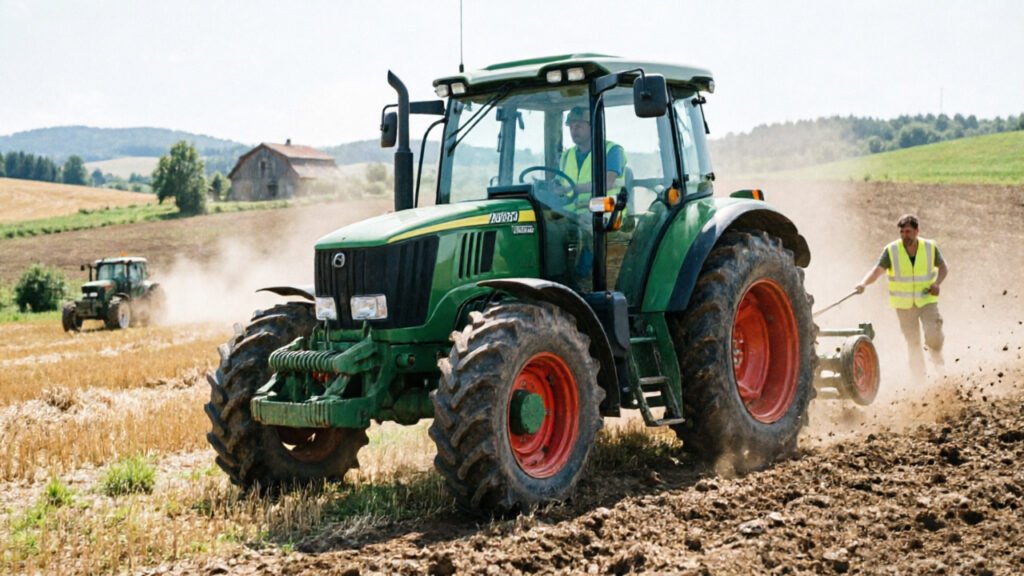
A ROPS frame alone is not a rollover solution, and the half that fails silently when operators skip the seatbelt.
The ‘protective zone’ concept is the foundation of every ROPS design. When a tractor rolls, the reinforced cab structure creates a survival space around the operator. That zone is precisely sized for an operator who remains seated and restrained. The instant a seatbelt goes unfastened, that geometric guarantee collapses entirely.
As Penn State Extension makes clear, a Rollover Protective Structure is only effective when used in conjunction with a fastened seatbelt; without the belt, the operator is likely to be thrown from the protective zone.
This isn’t a cautionary abstraction — it’s physics. During a side-roll, the shift in tractor center of gravity generates centrifugal forces that act on the operator’s body like an outward sling. An unbelted operator doesn’t stay seated; they’re thrown laterally, directly into the crush zone the ROPS was designed to protect. The structure that should have saved them becomes the hazard that doesn’t.
Critical safety fact: The seatbelt and ROPS are a system. One without the other offers a false sense of protection that can be more dangerous than the risk operators think they’re managing.
For fleet managers, this insight carries a direct procurement implication. Each fleet unit should be evaluated based on three criteria: certified ROPS installation meeting current OSHA or ASABE standards, structural integrity with no visible damage, cracking, or unauthorized modifications, and functional seatbelt hardware with intact buckles, retractors, and webbing. As noted in our guide on protective cab structures, ROPS only functions properly when the seatbelt is worn — a pairing that applies equally across tractors and compact equipment.
Understanding the static relationship between frame, belt, and operator is essential groundwork. But rollover risk doesn’t only emerge from parked physics — it compounds when operators make active decisions at the controls. That’s where differential locks and turning dynamics introduce a new layer of hazard entirely.
Specific mechanical decisions made mid-operation are among the most reliable triggers for a tractor rollover — and most happen in under two seconds.
Understanding which inputs cause catastrophic instability is essential for any fleet operator working across uneven terrain. Even machines equipped with tractor rollover protective structures can’t protect operators from physics-driven events that originate in the cab.
The direction of travel matters as much as the degree of slope. The “Up, Down, or Across” debate has a practical answer: traveling directly up or down a slope is generally safer than traversing across it, because side-slope forces act perpendicular to the machine’s widest stable axis. Traversing is sometimes unavoidable — particularly on narrow-profile machines common in orchard operations, where row width drives chassis decisions — but speed and implement height must both be reduced when crossing slopes.
Never engage the differential lock before confirming the tractor is tracking straight and level. This single rule eliminates one of the most preventable mechanisms of lateral rollover.
Passive structural protection and smart operator inputs address the reactive side of stability. What newer machine designs tackle is the proactive side — sensing and correcting dangerous inclines before the operator reaches a critical decision point.
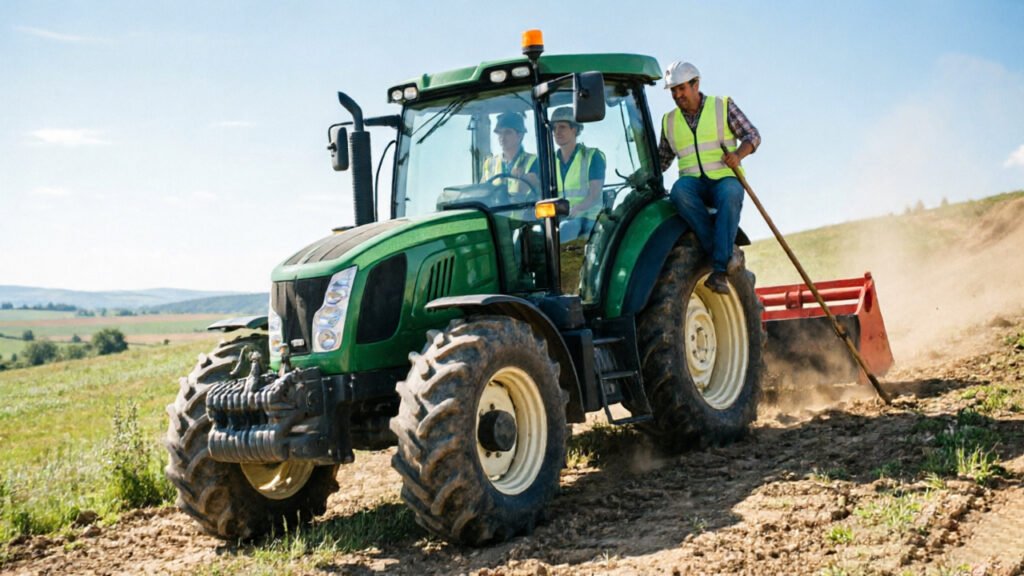
Modern slope safety has moved well beyond passive protection — the most significant shift in tractor engineering right now is the transition from structures that cushion a crash to systems that actively prevent one.
The leap from ROPS to active leveling represents a fundamental rethink of what “safe” means on a hillside.
For operators wondering what is the safest way to drive a tractor on a hill, the honest answer is increasingly tied to the machine itself, not just technique. Passive systems like ROPS protect the operator after a rollover begins. Active leveling systems intervene before the physics become irreversible. That distinction is the entire ballgame on steep terrain.
Sensing the Slope Before You Feel It
Onboard sensors are the foundation of this shift. Accelerometers and gyroscopic units embedded in the chassis can detect incline angles and lateral tilt the moment they develop — often registering instability thresholds before the operator’s body registers any meaningful sensation of lean. This matters because human perception of tilt lags behind actual center-of-gravity displacement, and that lag is exactly where rollovers find their opening. By the time a seat feels wrong, correction may already be too late.
Adjusting the Chassis in Real Time
According to the Smart Agriculture Journal via SciOpen, modern hillside machinery utilizes active leveling technology to shift the chassis independently of the wheel angle — meaning the cab and drivetrain stay closer to vertical even as the wheels conform to uneven ground. The system continuously modulates chassis geometry, effectively narrowing the gap between the machine’s actual tilt and its theoretical rollover threshold. For fleets operating on grades above 15 degrees, this technology represents a measurable reduction in rollover exposure, not just a comfort upgrade. Operators running high-output machines in demanding conditions should treat active leveling as a serious spec consideration, not an optional luxury.
Protecting Through Design Intelligence
Intelligent chassis design works in concert with traditional safety hardware, reinforcing rather than replacing it. The structural goal remains keeping the center of gravity within the stability triangle under dynamic load conditions — but smart systems give that triangle a fighting chance on terrain that would overwhelm any purely passive setup. Understanding how these systems interact with turning dynamics, load shifts, and variable slope angles becomes clearer when you can actually see them in motion — which is exactly what the next section breaks down.
Watching a tractor rollover unfold in slow motion reveals what no written checklist can fully convey — the terrifying speed at which a stable machine becomes an uncontrollable one.
The video resource below breaks down real-world slope scenarios with the kind of visual clarity that classroom instruction rarely achieves. For fleet managers building operator training programs, it’s one of the most efficient tools available.
Tractor Safety 101: How to Stop a Rollover Before It Starts
Watch for these critical moments during training sessions:
In practice, video-based training works best when paired with physical walkarounds on the actual machines operators will run. Visual learning builds the mental model; hands-on time builds the muscle memory. Used together, they close the gap between knowing the theory and reacting correctly under pressure.
Of course, even the sharpest operator judgment depends on a machine that’s mechanically prepared for slope work — and that starts well before the engine turns over.
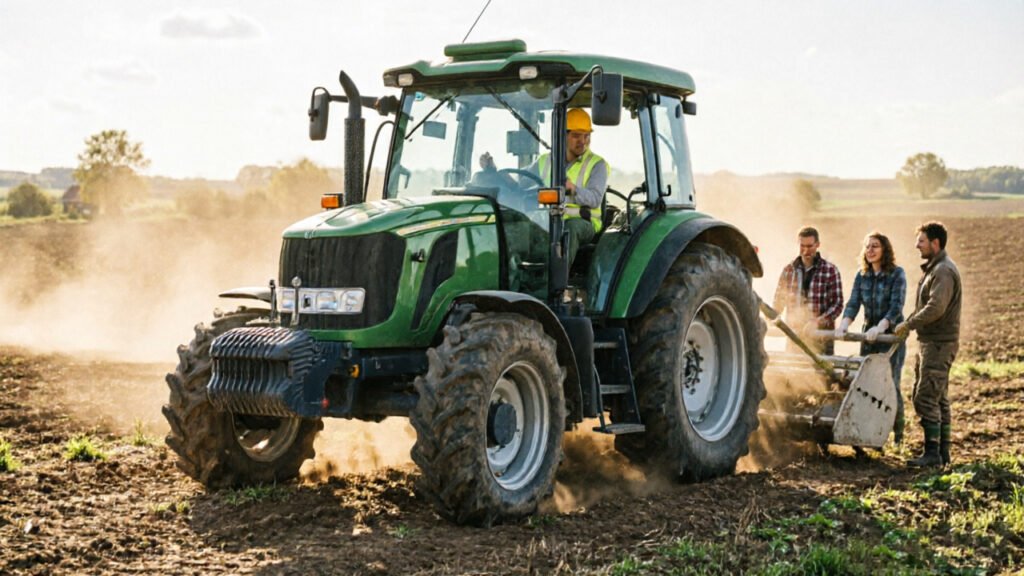
Routine maintenance isn’t just about keeping a tractor running — on slopes, it’s the difference between a safe pass and a catastrophic rollover.
Operators and fleet managers often focus on active technology and operator training, but the physical condition of the machine itself quietly determines how much margin for error exists on any hillside. Three maintenance areas carry the most weight: ballast configuration, tire condition, and brake balance.
Ballast placement is one of the highest-impact, lowest-cost stability interventions available. According to OSHA, properly ballasted tires can lower a tractor’s center of gravity by several inches — a shift that measurably increases a machine’s effective slope rating. Liquid ballast (calcium chloride solution) fills the tire cavity from the inside, while bolt-on wheel weights achieve a similar effect. Either approach widens the stability envelope without modifying the drivetrain. For anyone still comparing compact tractor configurations before a purchase, ballast compatibility should factor into the spec review.
Tire pressure and tread depth are equally critical and far more frequently neglected. Under-inflated tires deform unpredictably under lateral loads, reducing the contact patch that provides hillside grip. Worn tread compounds this by limiting resistance to side-slip — the precursor to a lateral rollover. In practice, tires operating outside their rated pressure range on slopes behave as though the machine weighs significantly more than it does.
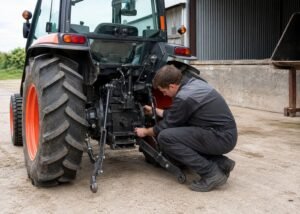
Brake balance is the maintenance item most operators overlook until something goes wrong. Independent rear brakes — standard on most utility tractors — allow sharp turns at low speed. However, if one brake drags more than the other due to wear or hydraulic imbalance, engaging both simultaneously on a slope creates an asymmetric stopping force. That uneven deceleration can snap the rear end sideways faster than a steering correction can compensate.
| Maintenance Item | Safety Impact | Frequenza |
|---|---|---|
| Tire ballast (liquid or weights) | Lowers center of gravity; raises effective slope rating | Seasonal or at reconfiguration |
| Tire pressure check | Maintains lateral grip and load distribution | Before each use on slopes |
| Tread depth inspection | Prevents side-slip on wet or loose terrain | Monthly / at tire rotation |
| Independent brake balance | Prevents brake-steer flip on descents and turns | Every 200 hours or annually |
These four checks form a baseline that no amount of advanced chassis technology can fully substitute for. The next section pulls together the non-negotiable rules — hardware, habits, and hard limits — that every hillside operator should internalize before the next work day begins.
Slope safety on tractors comes down to a handful of non-negotiable principles that, when followed consistently, can prevent the vast majority of fatal incidents on hillside terrain.
According to the National Ag Safety Database, adhering to the 20-degree rule combined with proper ROPS protocol could prevent up to 90% of fatal overturn injuries — a statistic that reframes routine safety habits as life-or-death decisions.
In practice, these four principles reinforce everything covered in this article — from understanding center-of-gravity physics to executing proper maintenance routines. No single piece of equipment or technique works in isolation; slope safety is a system. If you still have questions about specific scenarios — like using a front-end loader on a grade or calculating your field’s exact slope percentage — the next section addresses the most common operator questions directly.
Slope safety questions come up constantly among operators, and getting the answers right can mean the difference between a productive workday and a preventable fatality.
Q: What is the safest way to drive a tractor on a hill?
Drive straight up and down whenever possible. As the University of Missouri Extension confirms, traveling perpendicular to a slope — rather than across it — significantly reduces the risk of a side rollover. Side rolls are statistically more common and less survivable than rear overturns, so this single habit is worth ingraining in every operator on your fleet.
Q: Can I use a front-end loader on a slope?
Yes, but with critical limitations. Keep the bucket low to the ground to reduce the center of gravity, and avoid loading or lifting while positioned across a slope. A raised, loaded bucket on a hillside is one of the fastest ways to shift weight past the tipping point. For reference, wider track stance and lower attachment positioning — principles explored in this breakdown of stability and tipping resistance — apply directly to tractor loader work on grades.
Q: How do I calculate the slope percentage of my terrain?
Divide the vertical rise by the horizontal run, then multiply by 100. A 3-foot rise over 20 feet of horizontal distance equals a 15% slope — already approaching the operating limit for many standard tractors. Use a smartphone clinometer app or a hand level for a quick field measurement before committing to a pass.
Q: What should I do if the tractor starts to tip?
Do not attempt to jump clear — stay in the seat and hold on. If a ROPS-equipped tractor begins to tip, brace yourself, grip the steering wheel, and keep your feet planted. Jumping out places you directly in the rollover path. The best intervention is prevention: know your machine’s stability thresholds before you reach the slope, not while you’re already on it.