













































Quick answer: E-marking, CE conformity, emissions documentation and road registration answer different questions. Before ordering, ask the supplier and your local authority which exact approval, certificate, model variant and original documents are required for the intended country and road use.
Separate the documents before comparing tractors
| Document or mark | Buyer check |
|---|---|
| COC or type approval | Exact model, variant, approval number and target-country acceptance |
| CE documentation | Machinery conformity scope and supplied declaration |
| Emissions evidence | Engine family, stage and market-specific requirement |
| Registration pack | Invoice, serial/VIN details, technical data and originals |
Tanya Jawab Umum
Does an E-mark automatically make every tractor road legal?
No. Registration depends on the complete machine, approval scope, documents, configuration and local rules.
Certifications matter, yet they’re often overlooked or misunderstood when you’re shopping for a traktor pertanian kecil that fits your budget and needs.
The SM-254 comes with Emark certification, but what does that actually mean for your daily operations?
This 25hp farm tractor promises a 30% efficiency boost through its hydraulic system and handles tight spaces with a 3200 mm turning radius.
However, before you compare farm tractor prices or contact a farm tractor supplier, you need to understand what sets certified models apart.
This review breaks down the SM-254’s real-world performance, examines its Emark certification value, and helps you decide if this Chinese farm tractor delivers on its promises.
What is Emark Certification and Why It Matters for Your Farm Tractor
Understanding Emark Standards
Agricultural equipment faces unique electromagnetic and environmental challenges that standard vehicle certifications don’t address. The e-Mark (lowercase) specifically targets agricultural and forestry vehicles like tractors and off-road machinery. This specialized certification operates under Regulation (EU) 167/2013 for general safety and classification, paired with Regulation (EU) 2015/208 for electromagnetic compatibility standards tailored to farm environments.
The certification emerged from the 1958 Geneva Agreement, which established the United Nations Economic Commission for Europe’s role in coordinating vehicle regulations. As European integration progressed, two parallel systems developed. What started as a single framework now encompasses approximately 60 nations spanning Europe, Asia, Africa, and Oceania under UNECE jurisdiction.
How Emark Differs from Other Certifications
The distinction between capital and lowercase letters carries significant weight. E-Mark (capital ‘E’ in a circle) stems from UNECE technical regulations and applies across member states with automatic recognition, though it remains non-mandatory. Conversely, e-Mark (lowercase ‘e’ in a rectangle) operates exclusively within EU territory under EC Directives and carries mandatory enforcement.
This difference extends beyond geographical scope. E-Mark emphasizes testing methodologies and performance requirements, whereas e-Mark places heavier emphasis on production consistency controls and market surveillance practices. Most farm tractor buyers encounter the lowercase e-mark since it’s mandatory for complete vehicles, while E-mark typically applies to spare parts.
Agricultural tractors fall outside CE mark requirements. The testing process involves electromagnetic compatibility (EMC), fuel economy, energy efficiency, and emissions verification. You won’t find CE marks on tractors because vehicles with specific road or agricultural purposes require the more stringent e-Mark certification instead.
Benefits of Buying Emark Certified Farm Tractors
Purchasing an e-Mark certified farm tractor eliminates customs complications. The certification allows legal sales across all EU member states without additional approvals or delays. Once issued by any national authority, the certification receives mutual recognition throughout the EU, simplifying market entry and reducing bureaucracy.
Products lacking e-Mark face border holds or recalls, leading to lost revenue and damaged reputation. The certification confirms compliance with noise, emission, and safety standards specific to agricultural equipment. For you, this translates to reduced risks of operational shutdowns, penalty avoidance, and assurance that your equipment meets strict European environmental and safety protocols.
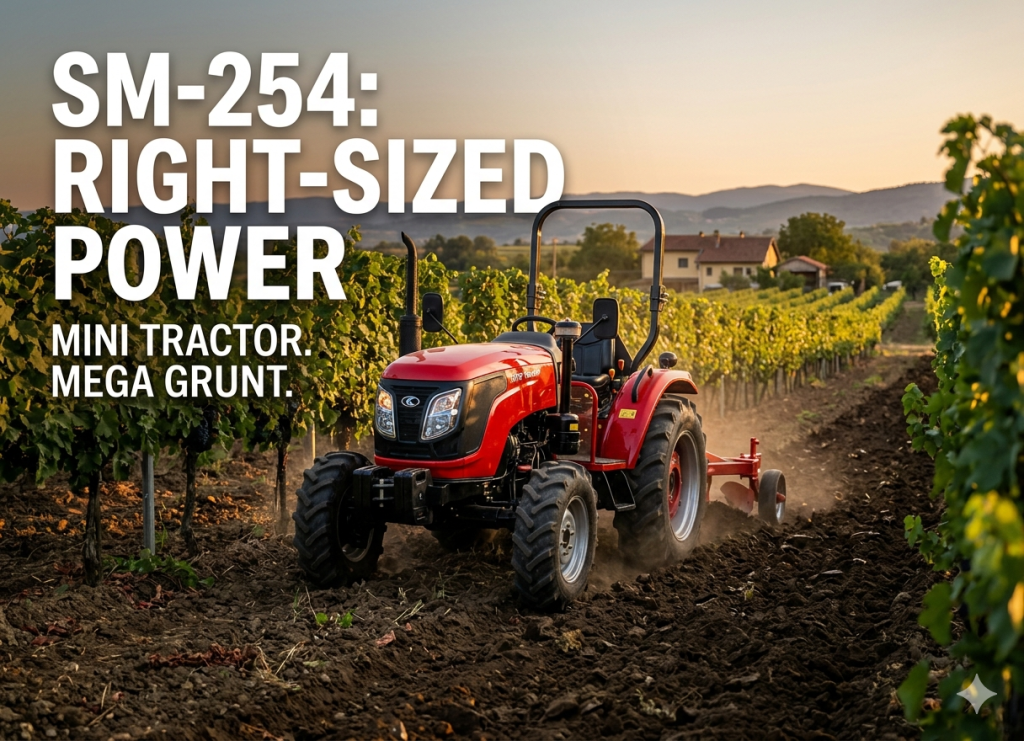
SM-254 Farm Tractor Complete Specifications Review
Performa Mesin dan Efisiensi Bahan Bakar
The SM-254 runs on a Laidong KM385BT engine delivering 25 HP output at 18.4 kW rated power. This EURO V certified diesel engine meets Stage II emission standards, balancing stable power output with fuel economy. Maximum rated drawbar power reaches 7KN for towing and plowing tasks. The three-cylinder configuration provides consistent torque across operating ranges without the weight penalty of larger engines.
4WD System and Ground Clearance
Ground clearance measures 310mm at the front Dan 330mm at the rear, giving you adequate height for uneven terrain without sacrificing stability. The 4WD drivetrain pairs with 1360 kg structural weight, creating traction on muddy or sloped ground. Your turning radius sits at 3200 mm2, allowing navigation through orchard rows and greenhouse aisles where larger tractors struggle.
Transmission and Gear Options
You get 8 forward gears plus 2 reverse through a slide gear gearshift system with optional shuttle gear. Speed range spans 2.06 to 31.30 km/h in forward operation, covering both fieldwork crawl speeds and transport needs. The transmission setup uses spur gear final drive with external gearing.
PTO Compatibility and Three-Point Hitch System
The dual-speed PTO operates at 540/720 rpm when the engine runs at 2400 rpm. This gives you flexibility for different implement requirements. The three-point hitch uses Category 1 connection with open-core independent lifting control. Lift capacity reaches 875 lbs at the link ends.
Build Quality and Weight Distribution
Unladen weight sits at 1480 kg, increasing to 2039 kg when laden. The wheelbase measures 1680mm, distributing weight for stable operation. Heavy-duty tires sized 6.0-16 front Dan 11.2-24 rear handle load bearing across different soil conditions.
Real-World Testing: SM-254 Performance Across Different Farm Applications
Performance in Orchards and Vineyards
Testing between fruit tree rows revealed the SM-254’s advantage in specialized agriculture. The compact design fits tight trellised configurations where standard farm tractors struggle. Manual pruning represents up to 25% of annual labor costs in orchards and vineyards, making equipment efficiency critical. The narrow tire options reduce your footprint between rows, protecting soil structure while maintaining traction for spraying and cultivation tasks. Row spacing in vineyards typically demands low-profile equipment, and the SM-254’s protected components prevent damage from branches during passes.
Small Plot Farming Efficiency
Small to medium-scale operations benefit from the three-point hitch compatibility with plows, seeders, and cultivators. The farm tractor handles primary tillage and crop maintenance on plots where larger machinery proves impractical. You’ll find the dual-speed PTO system supports various implements without requiring multiple farm tractor suppliers for different attachment standards. Cost-effectiveness emerges when comparing chinese farm tractor options against larger models for vegetable patches and poultry operations.
Greenhouse and Tight Space Maneuverability
Height constraints define greenhouse work. Confirm your tractor’s highest point in working configuration stays below cross-members and structural supports. The 3200mm turning radius allows navigation through aisles without damaging plants or infrastructure. Turf tires reduce rutting in damp media zones, preserving greenhouse floor integrity. Modest emissions at low loads matter when operating in enclosed environments.
Dry Land and Sloped Terrain Testing
Ground clearance becomes essential on uneven surfaces and slopes. The robust drivetrain maintains stability during grading and material transport across varied terrain. Ballast requirements increase for loader tasks on inclines, and travel speed restrictions apply on uneven surfaces where stability remains non-negotiable.
Price Analysis and Where to Find SM-254 Farm Tractor for Sale
Factory Direct vs Farm Tractor Supplier Pricing
Direct factory pricing through platforms shows the SM-254 at USD 3,500-3,900 for base configurations, whereas established farm tractor supplier pricing reaches USD 16,300 for loaded models. The price gap exists for specific reasons. Dealers absorb inventory financing, provide local service infrastructure, and maintain parts stock. You sacrifice immediate support when buying direct, but gain cost savings by eliminating middleman markups.
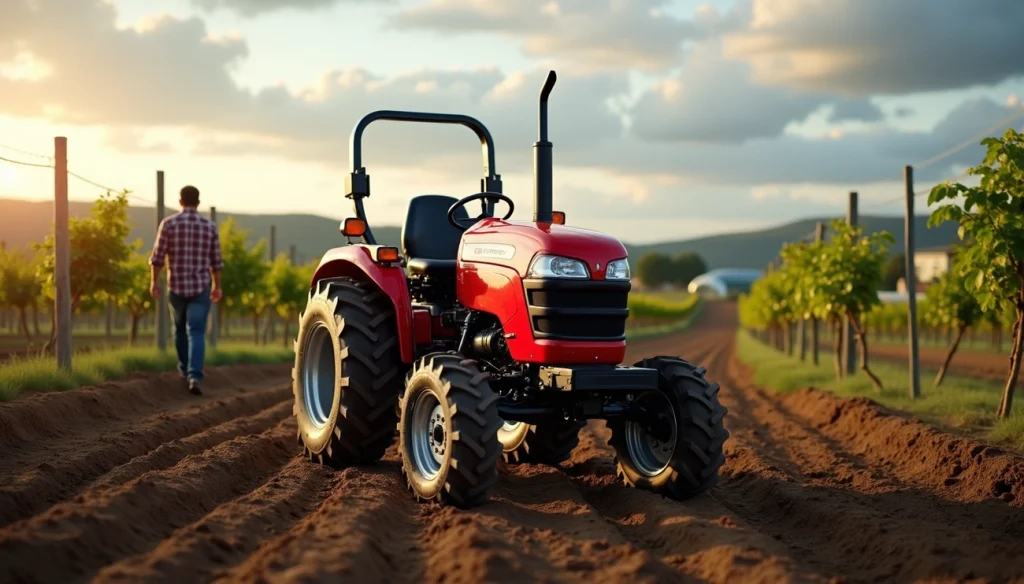
Comparing Chinese Farm Tractor Costs
Marketplace listings for chinese farm tractor models range from USD 2,085 to USD 13,032 depending on specifications and seller. Import layers compound base costs significantly. A farm tractor price starting at USD 4,000 EXW in China can double after freight, customs duty, VAT, clearing fees, and dealer margins are applied. Specifically, manufacturing economies in China stem from lower wages, government subsidies, and established supply chains.
What’s Included in the Purchase
Standard SM-254 packages include the Laidong engine, 4WD system, three-point hitch, and dual-speed PTO. Loader and backhoe attachments increase investment but expand functionality. Verify whether tires, ballast weights, and implements come bundled or require separate purchasing.
Maintenance and Long-Term Ownership Costs
Regular maintenance determines total ownership expenses beyond purchase price. Service intervals, parts availability, and repair complexity affect your budget over time. Chinese farm tractor parts availability has improved, though establishing relationships with suppliers prevents downtime.
Kesimpulan
Overall, the SM-254 delivers solid value if you need a compact farm tractor for tight spaces and specialized agriculture. The Emark certification removes import headaches, while 25HP handles most small-farm tasks without the bulk of larger models. Factory-direct pricing at $3,500-$3,900 looks tempting, though you sacrifice dealer support and parts accessibility. For orchards, vineyards, and greenhouse operations, the 3200mm turning radius and modest footprint justify the investment. Just budget realistically for maintenance and potential import costs.
Tanya Jawab Umum
Q1. What does Emark certification mean for agricultural tractors? Emark certification is a European conformity mark that proves a farm tractor complies with EU regulations for safety, emissions, and electromagnetic compatibility. It’s specifically designed for agricultural and forestry vehicles, ensuring your equipment meets strict European environmental and safety standards while allowing legal sales across all EU member states without additional approvals.
Q2. How much does the SM-254 farm tractor cost? The SM-254 farm tractor ranges from USD 3,500-3,900 for base configurations when purchased factory-direct, while dealer pricing can reach USD 16,300 for fully loaded models. The price difference reflects dealer services like local support, parts inventory, and warranty assistance. Import costs including freight, customs, and VAT can significantly increase the base price.
Q3. What engine power does the SM-254 provide? The SM-254 is equipped with a Laidong KM385BT diesel engine that delivers 25 horsepower at 18.4 kW rated power. This three-cylinder EURO V certified engine meets Stage II emission standards and provides maximum rated drawbar power of 7KN, offering a balance between stable power output and fuel efficiency for small farm operations.
Q4. Is the SM-254 suitable for orchard and vineyard work? Yes, the SM-254 performs well in orchards and vineyards due to its compact design and 3200mm turning radius. The narrow tire options reduce soil compaction between rows, while the protected components prevent damage from branches. Its size makes it ideal for navigating tight trellised configurations where standard tractors cannot operate effectively.
Q5. What transmission options does the SM-254 offer? The SM-254 features 8 forward gears plus 2 reverse gears through a slide gear gearshift system with an optional shuttle gear. The speed range spans from 2.06 to 31.30 km/h in forward operation, covering both slow fieldwork speeds and faster transport needs. It also includes a dual-speed PTO operating at 540/720 rpm for various implement compatibility.
Get a quote for this type of Tractor
Related buyer checks
2026 buyer update: evidence to verify before committing
Search performance shows readers need a faster answer for emark tractor. Confirm the exact model, operating weight, included equipment, service support, documents, and recurring ownership costs in writing. Compare alternatives on the same scope and never substitute a headline number for a complete delivered-and-supported specification.
| Check | Evidence | Decision |
|---|---|---|
| Machine fit | Manual and serial-specific specification | Pass only when job limits are covered |
| Mendukung | Parts list, warranty route, response owner | Price downtime risk separately |
| Total cost | Written quote with exclusions | Compare like for like |
Related planning: used compact tractor inspection checklist Dan mini excavator trailer transport guide.
European Road-Use and Import Document Check
2026-08-26 performance update: evidence to verify before committing. Do not treat E-mark, CE marking, emissions documentation and a certificate of conformity as interchangeable. Before ordering, identify whether the tractor will work only on private land or must be registered for public-road use, then obtain written confirmation for the destination country and exact machine configuration.
- Confirm model and serial-number coverage on every declaration.
- Ask which road-approval document and vehicle category apply locally.
- Verify lighting, mirrors, braking, tires, speed and hitch equipment for the intended use.
- Separate customs clearance from machinery and road-use compliance.
- Have the importer, registration authority or qualified adviser review unclear documents before shipment.
Use the compact tractor inspection checklist to connect document review with the actual machine specification and condition.