Telephone/WhatsApp:+86 156 2656 0610
Telephone/WhatsApp:+86 156 2656 0610
Email:info@seekmach.com



If you’re shopping the 50 horsepower class, you’re usually not browsing—you’re trying to avoid a costly mismatch.
At ~50HP, tractors start to live in a “decision zone” where:
This guide is built for US buyers and import-minded dealers evaluating a Chine Tracteur in the 50HP range. We’ll use one concrete reference throughout: the 50HP Tractor SM-504-C Emark (two configurations: open 504 and cabin 504C).
Key Takeaway: Don’t “buy horsepower.” Buy PTO compatibility + hitch fit + stability for your real jobs.
Both configurations are 50HP 4WD tractors built around the same power class and core drivetrain specs. The differences show up in dimensions, weight, and operator environment.
Source: SeekMach product page — 50HP Tractor SM-504-C Emark specifications (see the internal resources section below).
| Spécifications | Open (504) | Cabin (504C) | Why it matters |
|---|---|---|---|
| Puissance | 50 | 50 | Baseline power class |
| Drive | 4x4 | 4x4 | Traction in mud/slopes |
| Transmission | 8F + 2R | 8F + 2R | Work-speed control |
| PTO speeds | 540 / 1000 | 540 / 1000 | Implement compatibility |
| Wheelbase (mm) | 1900 | 1900 | Stability + ride |
| Turning radius (mm) | 3600 | 3600 | Maniabilité |
| Overall dimensions (mm) | 3220 × 1605 × 2770 | 3500 × 1605 × 2540 | Fit in barns, trailers, row spacing |
| Unladen weight (kg) | 1695 | 1955 | Stability + transport |
| Laden weight (kg) | 2209 | 2439 | Loader and ground-engagement behavior |
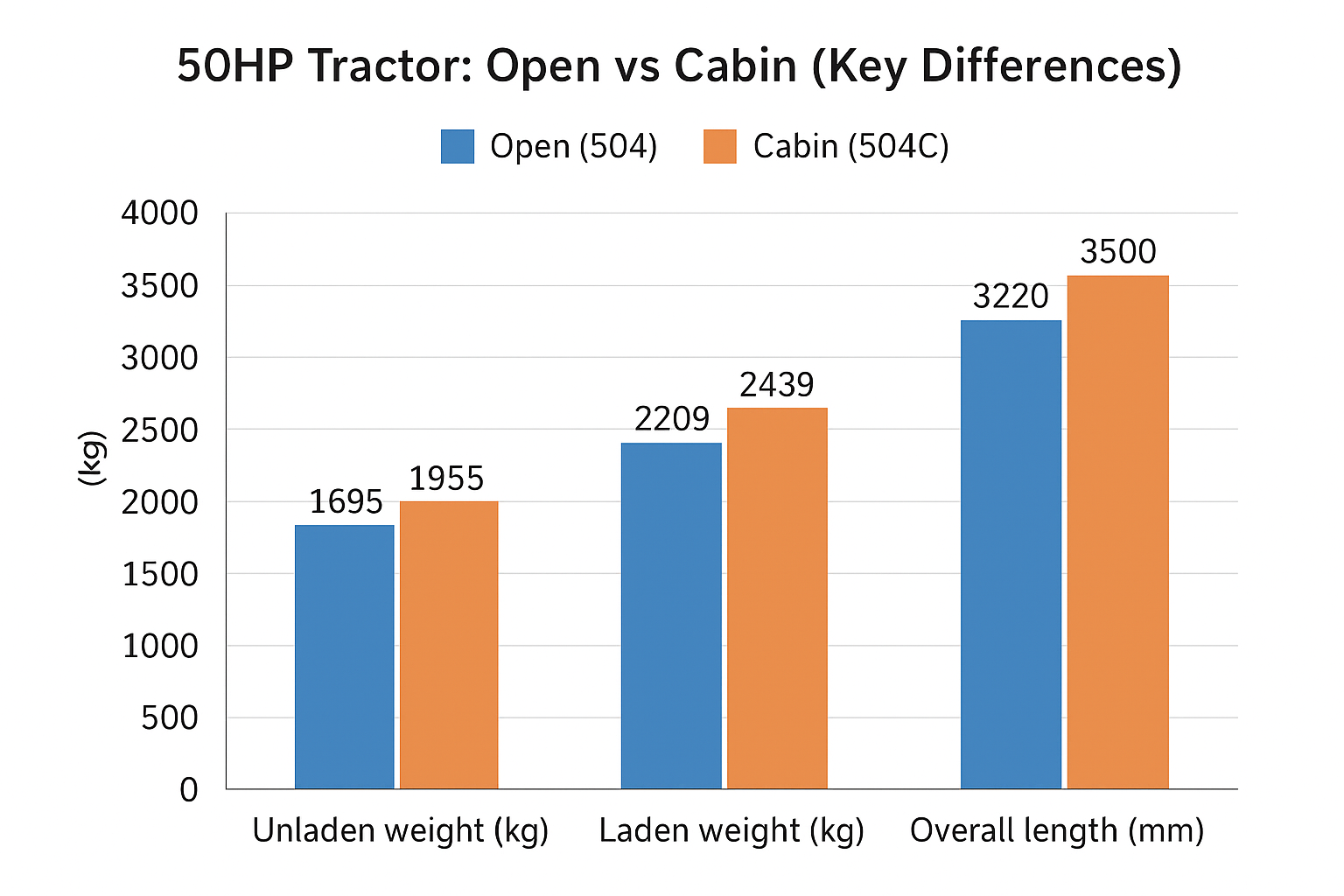
How to interpret this chart
You don’t need a 20-point checklist. You need the six that change outcomes.
UN power take-off (PTO) is the rotating shaft that transfers power from a tractor to implements like rotary cutters, tillers, pumps, and post-hole augers.
Most agricultural implements are designed around standardized PTO speeds—commonly 540 tr/min et 1000 RPM. If an implement is built for 540, you run it at 540 (not 1000).
The SM-504-C Emark lists 540 / 1000 PTO speeds, which is a practical advantage because it gives you more flexibility across implement classes—as long as you match the implement’s rated PTO speed.
Independent PTO generally means PTO operation is controlled separately from ground drive, allowing implement operation without tying it directly to tractor motion.
⚠️ Warning: Never assume “PTO listed” means “PTO-friendly for your implement.” Always verify: PTO speed(s), engagement method, and required shaft type on the implement.
UN three-point hitch is the standardized mounting system (two lower arms + top link) used to attach and control implements.
In the US, many owners already have implements that are effectively Cat 1 or Cat 2 sized. Categories determine pin diameter, spacing, and safe load class.
A 50HP tractor often sits near the boundary where either Cat 1 or Cat 2 might appear depending on configuration and intended duty. The practical takeaway is simple:
“E/e-mark” is commonly associated with UNECE type approval frameworks used across many countries to show a vehicle or component meets specific regulations.
Rather than treating the word “Emark” as a blanket promise, treat it as a reason to ask for documentation.
Ask for:
For reference on how UNECE approval marks are structured and shown in examples, see the UNECE documents linked in the “Internal resources” section below.
Pro Tip: If you’re buying for resale or import, put “documentation pack required” in your procurement checklist. It saves weeks later.
If the tractor is intended for the US market, diesel engine compliance is not a marketing detail—it’s a clearance and liability detail.
The US EPA explains the nonroad diesel standards and the Tier 4 program in its official pages (linked in the “Internal resources” section below), along with an enforcement alert PDF on importing nonroad engines.
Because this is a 50HP 4WD Tracteur agricole with 540/1000 PTO and a practical dimension/weight profile, it tends to fit buyers who need:
The fastest way to reduce “spec confusion” in a buying conversation is to watch a quick explainer and then verify your implement requirements.
<div data-type="node-video" data-provider="youtube" data-url="https://www.youtube.com/watch?v=O3MLJSDQJlE" data-embed-url="https://www.youtube.com/embed/O3MLJSDQJlE"></div>
Use these pages to build your comparison set and request the right configuration quickly:
Answer these with “yes” before you shortlist any 50HP China Tractor.
Not necessarily. The deciding factors are your implements, terrain, and whether you’ll do loader work. A heavier tractor can be safer and more stable—but it also needs space to maneuver and transport.
They’re standardized PTO speeds for different implement requirements. Use the implement’s rated PTO speed—running a 540 implement at 1000 can damage equipment and create safety risks. For a definition of PTO, see the external sources linked in the “Internal resources” section above.
If you do a lot of PTO-driven work (mowing, tilling, augers), independent PTO can be a quality-of-life upgrade because PTO operation can be controlled separately from ground drive. See the Messick’s PTO explainer linked above.
Measure your implement pins and confirm spacing. Categories are standardized for compatibility. Start with the Wikipedia three-point hitch category table linked above, then verify your specific implement documentation.
It’s often used in contexts related to UNECE type approval. Don’t treat it as a blanket guarantee—treat it as a reason to request the certificates and confirm the approval number and marking. UNECE provides examples of approval mark layout in its documents (linked in the “External references used in this guide” section above).
Ask for the engine compliance documentation for the destination market and confirm you understand the relevant EPA requirements. The US EPA summarizes the Tier 4 nonroad diesel program and provides an importer warning (see the EPA links in the “External references used in this guide” section above).
Open station tends to be simpler and easier to transport. Cabin tends to win when the job is long hours, dusty conditions, cold seasons, or you’re buying for operator comfort and productivity. Use the comparison table and chart above to understand the size/weight tradeoff.
If you want, I can turn this into a “ready-to-quote” checklist by mapping your top 3 jobs to:
Start with the official spec page, then request the configuration and documentation pack: