Telephone/WhatsApp:+86 156 2656 0610

Telephone/WhatsApp:+86 156 2656 0610
Email:info@seekmach.com



A mini excavator safety lock lever or control-isolation device must be used according to the exact machine instructions before an agreed approach. Stopping the bucket or releasing the joysticks does not establish that accidental control contact cannot move the machine. The operator and ground worker need a shared approach arrangement, confirmation that the required isolation has been applied, and a safe place to communicate. The lever does not replace a planned exclusion area.
This guide addresses communication around a stationary excavator. It does not prescribe a universal lever position, demonstrate a functional test or provide a servicing isolation procedure. Device functions vary by machine and configuration. Obtain the correct operator manual and competent instruction for the actual excavator before deciding what a particular control disables.
The UK Health and Safety Executive’s August 2025 safety notice on excavator control isolation describes the danger of unintended movement when people are near plant. Its practical message is that correct device use and clear communication before approach belong together. Treat this as published UK guidance and check the requirements that apply at the actual site.
A pause in work may look different to the people involved. An operator may be waiting for instructions while a ground worker thinks the task has finished. A supervisor may approach to discuss the next location while the machine remains capable of responding to control contact. Agree how these pauses are handled during the briefing, rather than relying on assumptions made at the cab door.
Plan a communication point that keeps people away from the working arc and other moving plant. Use the site’s agreed signals and ensure everyone understands who may give the approach instruction. Poor visibility, noise, unfamiliar workers or a change of attachment can require the arrangement to be reviewed. If communication is unclear, people remain outside the danger area until the situation is resolved.
Record the machine model, serial number and manual edition. Locate the control-isolation instructions in that manual, including any restrictions associated with attachments or optional controls. A familiar lever shape on another excavator is not evidence that this machine behaves the same way. Labels and warning decals should be readable and consistent with the documentation.
Ask the supplier or competent service contact to clarify any uncertainty in writing. Useful questions include which controls are inhibited, which functions remain available, what indications the operator should observe and which approved checks establish correct operation. Do not infer answers from an online photograph or from another manufacturer’s equipment. Keep the explanation with the machine’s handover records.
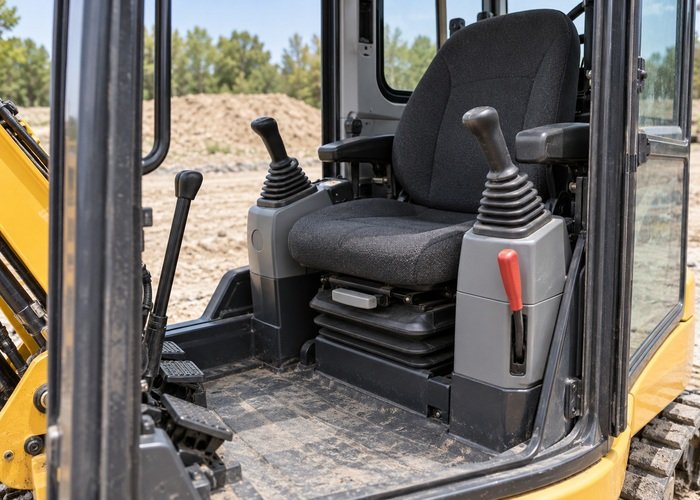
A control-isolation device addresses a defined machine function. It must not be assumed to remove every energy source or make maintenance safe. An excavator can involve hydraulic pressure, electrical energy, gravity and attached equipment. The required precautions depend on the work and the manufacturer’s instructions, not simply on whether a control lever has been moved.
HSE’s work equipment maintenance guidance explains the need to plan maintenance and control risks, including energy isolation where appropriate. Servicing, clearing a blockage and accessing components require their own approved arrangements. Do not use an approach briefing as permission to enter a maintenance danger zone, loosen a hose or work beneath raised equipment.
State the boundary clearly during training: authorization to approach a properly prepared stationary machine is a specific communication decision. Authorization to perform maintenance is a separate decision with different controls and competence requirements. Where the intended task changes, stop and reassess before anyone starts work.
The site supervisor should establish the arrangement with operators and everyone who may work near the excavator. It needs to fit the layout, visibility and work activity. A delivery driver, visiting surveyor or replacement worker may not know the normal signals. Include their access in the plan instead of expecting them to recognize an informal routine.
| Planning question | Evidence to establish | When to stop and clarify |
|---|---|---|
| Who may request approach? | Named roles and understood communication method | Conflicting signals or an unfamiliar person |
| Where should people wait? | A designated safe position outside the danger area | The route crosses another machine’s work area |
| How is the machine prepared? | Exact manual and site instructions understood by the operator | Device function or indication is uncertain |
| Who confirms approach? | Clear confirmation under the agreed arrangement | Visibility or communication has been lost |
| How does work restart? | Confirmation that people are clear under the site plan | A person cannot be accounted for |
This table is a briefing framework, not a sequence for operating a particular machine. The manufacturer’s procedure determines how the fitted device is used. The site’s risk assessment determines the exclusion area, communication and supervision needed for the activity. Avoid replacing these decisions with a universal distance or a gesture that some workers have never been taught.
Include the device in the checks required by the correct manual and the site’s inspection system. Only carry out functional checks using the prescribed conditions and competent supervision. A person standing near the excavator must never be used as evidence that a safety device works. If the check method is unclear, obtain instructions before attempting it.
HSE’s excavator safety overview covers inspection and dealing with safety-critical defects. Where a defect could affect safe use, withdraw the machine from service under the site’s arrangements and refer it to a competent person. Do not defeat an interlock, bridge wiring or normalize an intermittent response because the machine is needed for a job.
A useful defect description records what was observed, the machine identity, the date and the circumstances. Distinguish an observation from a diagnosis. For example, an unexpected indication can be recorded without claiming that a particular sensor has failed. Preserve relevant photographs taken from safe positions and identify who has responsibility for the next decision.

Rental and shift handovers should identify the fitted controls, manual location, inspection requirements and unresolved defects. Refer to the mini excavator handover and return record guide for organizing machine identity and condition evidence. A signed collection form alone does not establish that an unfamiliar operator understands the isolation device.
Keep general awareness and fault diagnosis distinct. The site’s mini excavator safety guide provides broader operating context. A separate boom-will-not-raise article discusses an inhibited movement symptom; it is not permission to bypass a control lock. Report uncertainty through the responsible supervisor or service contact.
When considering a different mini excavator configuration, request the operator documentation and a suitable handover explanation before delivery. Confirm the actual fitted equipment rather than treating a catalogue photograph as a complete control description. Any attachment change should also prompt a review of visibility, access and the communication arrangement.
A workable plan needs review when the machine moves to another area, a new crew arrives or visibility changes. Check whether the waiting position is still suitable and whether other plant now crosses the approach route. The review should address the actual change; repeating the same briefing without checking the layout can leave a new hazard unaddressed.
Supervisors should observe whether the agreed arrangement is understood and followed. If workers improvise signals or approach before receiving confirmation, pause the activity and resolve the reason. Better communication, a different meeting point or further instruction may be needed. Record consequential changes so that the next shift receives the current arrangement.
After a reported defect, keep the machine status clear to everyone who could take over the controls. Record who assessed the problem, what work was completed and which required checks were documented. The responsible person should confirm release under the site system before the excavator returns to the task. A parts delivery or an informal message that the machine seems better is not a complete release record. Include any revised instructions in the next handover, particularly if an adjustment or replacement has changed what the operator should observe.
No. The correct position, device function and indications must come from the exact machine instructions. Do not copy another excavator’s arrangement or rely on the position shown in an illustrative image.
A stationary bucket is not confirmation of isolation or permission to approach. Follow the site arrangement, remain outside the danger area and wait for clear confirmation after the required machine preparation.
Do not assume so. Maintenance requires its own planned precautions and machine-specific energy-isolation instructions. Stored energy and gravity hazards need consideration by competent people responsible for the task.
Stop using the machine where safe operation may be affected, document the observation and follow the site’s defect and withdrawal arrangements. Have a competent person assess it. Do not attempt a bypass or an improvised test near people.