Telephone/WhatsApp:+86 156 2656 0610
Telephone/WhatsApp:+86 156 2656 0610
Email:info@seekmach.com

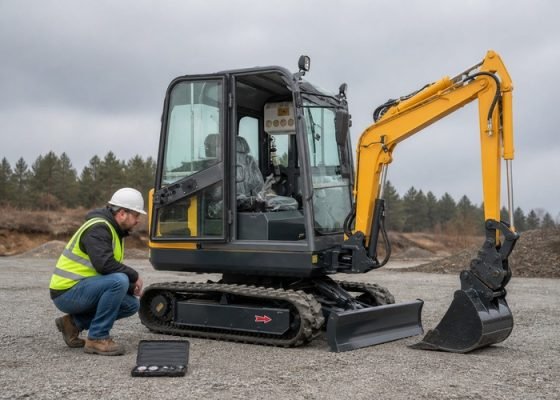
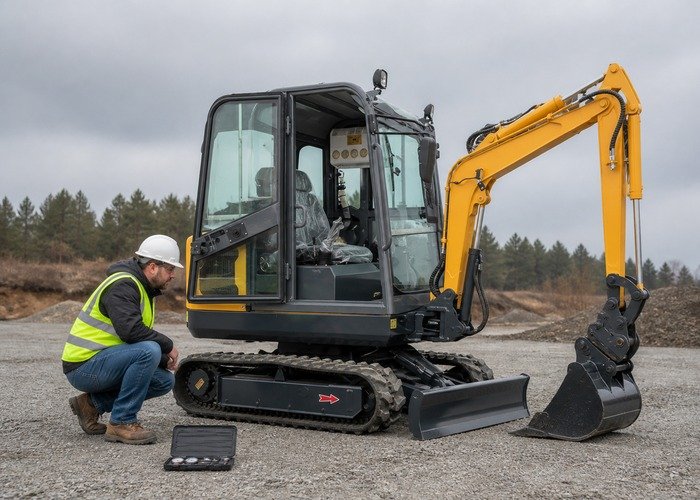
Some movement between a mini excavator’s upper structure and undercarriage is normal, but a visible clunk, uneven rotation, metal in the grease, or movement beyond the manufacturer’s limit deserves immediate attention. The important first step is to identify where the movement originates. Slew-bearing clearance, loose bearing fasteners, swing gearbox backlash, worn mounting structures, and boom or bucket pin play can feel similar from the cab.
A slew ring supports the upper structure while allowing it to rotate. It carries changing axial, radial, and overturning loads as the boom reaches, digs, travels, and lifts. Because these loads are large, inspection must be controlled. Never place any part of the body between the upper and lower structures, under a raised attachment, or within the swing radius during a test.
Use this guide as a diagnostic framework, then apply the model’s service manual for measurement points, torque procedures, allowable clearance, and replacement steps. Pair it with the mini excavator maintenance checklist so the observation is considered alongside track, hydraulic, and undercarriage condition.
Common complaints include a knock when changing swing direction, a cab that rocks over the carbody, inconsistent swing resistance, a scraping sound, or a gap that appears to open and close at the bearing joint. Operators may also report that grading feels less precise because the upper structure settles after the control returns to neutral.
Do not assume every knock is the bearing. Excess bucket, coupler, dipper, or boom-pin clearance can travel through the structure. A loose blade linkage or track frame component may also sound like it comes from the center. Have one trained person operate at idle while another observes from a designated safe position, maintaining communication and exclusion zones.
Check recent history. A machine that has worked with poor greasing, frequent side loading, heavy breakers, repeated lifts near its limit, corrosive washdown, or loose mounting bolts deserves more scrutiny. Review the mini excavator grease-point routine before adding grease; fresh grease can hide contamination evidence.
Rotational free play is not the same as vertical bearing clearance. When the bucket is grounded and the swing direction reverses gently, a small delay may come from gear backlash between the swing pinion and ring gear. Vertical separation or rocking at the bearing joint points elsewhere. Mark the upper and lower structures with removable reference tape and observe the joint rather than relying only on the control lever.
Inspect mounting bolts before applying any test load. Look for fretting dust, chipped paint around bolt heads, shifted witness marks, missing fasteners, cracked welds, or deformation. Do not tighten a suspect bolt casually. Slew-ring fasteners often require a specified sequence, clean thread condition, and calibrated torque or tension method. A broken or loose group can alter load distribution and damage the bearing or mounting surface.
Le Cat mini excavator maintenance overview illustrates the broader inspection discipline, while an equipment-specific manual such as this mini excavator operation and maintenance manual shows why model instructions take priority.
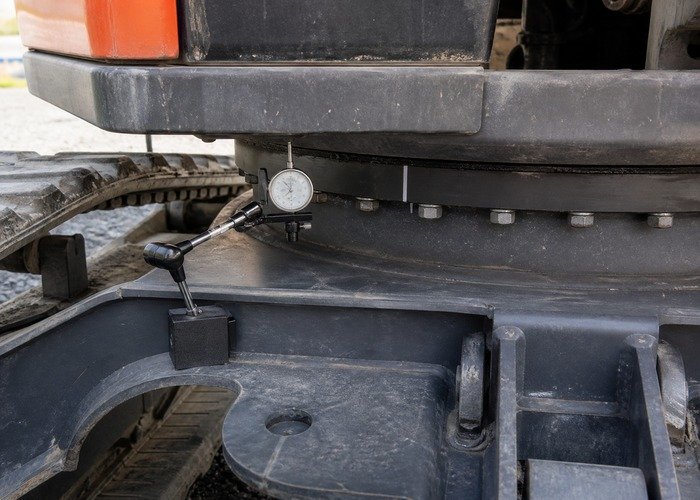
A dial indicator turns a vague “it moves” complaint into a repeatable measurement. Use a rigid magnetic base on a clean structural surface and place the indicator tip at the manual’s specified point across the bearing interface. The base and tip must not shift as the load changes. Photograph the setup and record machine hours, temperature, boom position, attachment, blade position, surface condition, and measurement location.
Park on level, stable ground with no bystanders in the swing radius. Inspect the attachment and quick coupler first. Use the minimum controlled hydraulic movement needed to alternate the bearing load, normally at low idle and without shock. The exact method varies: some manuals use the boom and bucket to transfer load, while others specify a measurement geometry or lifting arrangement. Never improvise a lift point.
Zero the gauge only after the structure is settled. Apply load slowly in one direction, record the maximum, return to the neutral reference, then load in the opposite direction and repeat. Take several cycles. If readings do not repeat, investigate base movement, pin play, ground settlement, or operator inconsistency before blaming the bearing.
Compare the total indicated movement only with the machine manufacturer’s limit and method. Generic internet tolerances are useful for understanding the concept, not for condemning a specific machine. The Mevas slew-ring play reference demonstrates a measurement approach but also reinforces the need for machine-specific evaluation.
Measure at more than one upper-structure orientation if the manual permits it. Uneven readings can reveal localized race wear, mounting distortion, contamination, or a damaged section. A smooth but elevated reading is different from a tight spot followed by a jump. Listen and feel for roughness during slow rotation with the attachment safely positioned.
If the clearance is acceptable but the operator still feels a clunk, check swing motor mounts, gearbox output, pinion-to-ring-gear backlash, boom-base pins, and attachment linkage. The mini excavator lift-chart guide helps reconstruct whether repeated work at long radius may have contributed excessive overturning load.
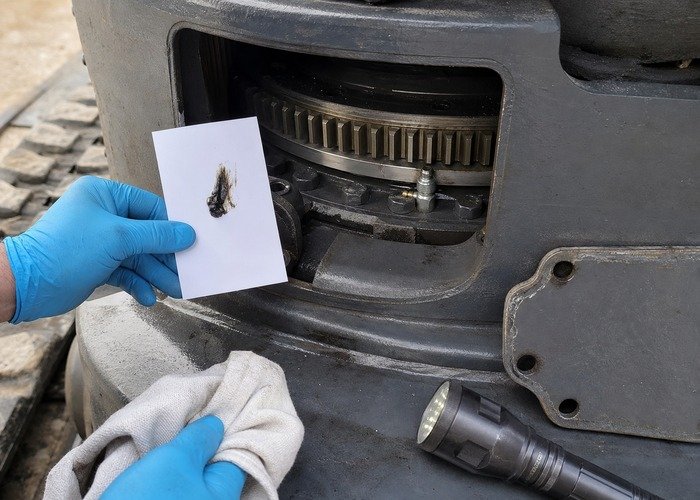
Use the designated access cover and keep dirt out. Observe whether grease is distributed around the ring, dry in sections, contaminated with water, packed with grit, or carrying shiny metal. Do not reach into the gear path. Rotate only according to the manual, replace the cover before normal operation, and account for every tool and rag.
Too little grease accelerates wear, while excessive grease can damage seals or create messy pressure pockets depending on the design. Follow the stated quantity, interval, fitting sequence, and rotation steps. Grease type matters; compatibility and load-carrying properties must match the manufacturer’s specification.
A service and operation manual from Genesis Attachments provides a useful example of inspection records and fastener discipline around rotating equipment. The exact values in that document do not transfer to a mini excavator.
Cleaning and correct lubrication may resolve poor grease distribution, but it will not reverse damaged races or rolling elements. Loose fasteners may require engineering assessment of threads, bolt stretch, mounting-face condition, and bearing damage before replacement and retorquing. If a mounting face is warped or cracked, installing a new bearing alone can lead to rapid repeat failure.
Bearing replacement usually requires the upper structure to be supported and separated with rated lifting equipment, documented lift points, blocking, and controlled hose or electrical disconnection. This is not a routine field lift. The repair facility must consider the upper structure’s mass and center of gravity, fastener procedure, gear alignment, seals, grease, and post-installation checks.
The following repair video helps visualize the scale and sequence. It is not a substitute for the machine’s service procedure, engineered supports, or trained lifting personnel.
Before approving replacement, document whether the measured clearance exceeded the specified limit, whether fasteners or mounting faces contributed, and whether roughness or metal was present. That record helps the owner decide between immediate repair, restricted use pending repair, or monitored service.
After replacement, verify smooth full rotation at low speed, correct gear backlash if specified, hose and harness clearance, fastener records, grease distribution, and absence of unusual noise. Repeat the dial-gauge measurement to establish a baseline for future inspections.
Then shorten the first follow-up interval. Early checks can reveal settling, a missed grease path, or a fastener issue before it becomes a major failure. Add the bearing baseline, repair parts, torque documentation, and photos to the machine file.
When evaluating a used machine, also confirm track fit and wear using the rubber track size guide. Record the exact parts information described in the mini excavator spare-parts guide; bearing and fastener identification should never depend on appearance alone.
Keep people outside the swing radius and follow applicable site-control rules. The OSHA trenching and excavation resource is especially relevant when the inspection occurs near an excavation, where ground stability and access add hazards beyond the machine itself.
A repair decision improves when the evidence is organized. Record the machine model, serial number, hours, attachment, counterweight configuration, recent work, and any known collision or rollover history. Photograph the full machine on level ground, the bearing joint at four upper-structure positions, every fastener group, the gauge base and tip, and the final readings. Include a scale or identified measurement point in close photographs.
Write down the sequence used to load and unload the bearing. A reading without the boom, stick, bucket, blade, and upper-structure positions cannot reliably be repeated. Note whether the tracks settled, whether the gauge returned to zero, and whether pin play was visible elsewhere. Three repeatable cycles are more persuasive than one unusually high movement.
For a used-machine evaluation, ask for grease records and previous bearing or swing-drive invoices. Fresh paint around the joint, mismatched bolts, new grease covering rusty material, or missing torque marks should lead to more questions, not an immediate conclusion. If the owner permits oil or grease sampling, keep the sample clean, sealed, labeled, and linked to the inspection photos.
A complete repair estimate should separate bearing parts, single-use fasteners, seals, grease, lifting and blocking, transport, labor, mounting-face measurement, machining or welding if allowed, swing-gear work, and post-repair testing. Downtime and access to lifting equipment may change the economic decision as much as the bearing price.
Good lubrication is only one part of bearing life. Avoid using the side of the bucket to push the machine laterally, striking the swing stop repeatedly, or carrying a heavy load at maximum radius over rough ground. Keep the load close, travel slowly, and use the blade and machine orientation recommended in the manual.
Breakers and compactors transmit repeated shock and vibration. Match the attachment to the carrier, maintain tool pressure correctly, and avoid prolonged firing without effective contact. Inspect bearing fasteners and grease intervals according to the severe-duty schedule when these tools are used regularly.
Cleaning matters as well. Do not direct high-pressure water into bearing seals or the ring-gear access opening. Remove packed soil that traps moisture around the joint, but protect seals and vents. After deep mud or water exposure, inspect earlier than the normal interval.
Operator reporting completes the program. Encourage operators to report a new click, hesitation, rough spot, or change in grading precision before the movement becomes obvious. Establishing a baseline dial reading when the machine is healthy makes those reports much easier to assess later.
Recheck after transport or major attachment changes when a new symptom appears, and keep the result beside the earlier baseline for a defensible trend.
Yes, a bearing requires internal clearance, but the acceptable amount depends on the machine and the prescribed measurement. Visible movement or a clunk is a reason to measure, not an automatic diagnosis.
Only if the manufacturer specifies that method and it can be performed safely. Improvised lifting can overload components, destabilize the machine, and put people in crushing zones.
Not without the service procedure. Loose fasteners may indicate thread damage, bolt stretch, bearing movement, or mounting-face damage. The correct sequence, condition, and torque method matter.
No. Correct grease can reduce wear and noise, but it cannot restore worn races, rolling elements, fasteners, or mounting surfaces.
Stop and obtain qualified assessment when movement exceeds the specified limit, bolts are loose or missing, cracks or metal appear, rotation binds, or the structure shifts unpredictably.