Telephone/WhatsApp:+86 156 2656 0610
Telephone/WhatsApp:+86 156 2656 0610
Email:info@seekmach.com



Raw horsepower no longer wins contracts — the right tractor application solutions, matched precisely to the job, do.
The “bigger is better” mentality that defined equipment procurement for decades is quietly losing ground. Modern contractors, particularly those operating in urban and peri-urban environments, are discovering that a 300 HP machine can’t navigate a municipal right-of-way, a tight landscaping corridor, or a utility-adjacent work zone without creating more problems than it solves. Constraints are real: narrow access points, weight-restricted surfaces, and regulatory limits on ground disturbance are reshaping what “capable” actually means on a job site.

The defining shift: value is no longer measured in displacement — it’s measured in deployment flexibility.
That’s exactly why the 35HP–90HP multi-purpose power unit has surged in relevance. According to Equipment World, contractors are increasingly choosing 50–70 HP tractors equipped with advanced hydraulic systems over larger, less maneuverable units for urban infrastructure projects. These compact-to-mid-range machines pair with a rotating roster of attachments — augers, mulchers, boom mowers, snow blades — making them revenue-generating assets across multiple seasons and trades. For a deeper look at how this power band is evolving, the 35–90HP segment’s app-first trajectory makes a compelling case for rethinking the spec sheet entirely.
Application Solutions, as a procurement concept, reframes the conversation. It’s not about the tractor in isolation — it’s the synergy of three components working together:
This three-part framework is what separates a depreciating asset from a ROI-generating platform. And as smart technology continues to filter down from large-scale agriculture into the contractor market, that data layer is becoming the most decisive factor of all — which is exactly where the procurement conversation needs to go next.
Precision agriculture equipment delivers measurable cost reductions — not just operational novelty — and procurement managers who treat it as optional are leaving real money on the table.
GPS-guided steering has moved well beyond the row-crop farmer. For any fleet operator managing large maintenance corridors, municipal green spaces, or commercial land, automated guidance systems reduce fuel burn by eliminating redundant passes. According to the USDA Economic Research Service, precision agriculture technologies can cut fuel consumption by up to 10% and reduce overlap by as much as 90% — a figure that directly translates into lower operating costs per acre and significantly extended wear life on cutting decks, tires, and drivetrain components.
Reduced overlap isn’t just a fuel story. When a machine covers the same ground twice, it doubles mechanical stress on blades, belts, and hydraulic seals. Trimble’s acquisition of IRON Solutions reflects exactly this thinking — the industry is converging toward connected farm solutions that tie GPS data, machine telematics, and maintenance scheduling into a single operational picture.
IoT-enabled predictive maintenance is the next frontier for fleet managers. Sensors tracking hydraulic pressure, engine temperature, and PTO load can flag abnormal readings before they become breakdowns. In practice, this shifts maintenance from a reactive cost to a scheduled, budgeted line item — a critical distinction when downtime on a commercial contract means penalty clauses.
Tech-ready chassis make this transition accessible without replacing entire fleets. Many mid-size tractors now ship with CAN bus architecture and pre-wired harness points that accept aftermarket automation kits. For buyers comparing acquisition costs, it’s worth considering how well a machine accommodates future upgrades — the same way factory-direct equipment sourcing prioritizes long-term value over upfront price.
The real return on smart farming technology, however, depends on how effectively a machine converts that data into mechanical output — which is precisely where PTO system engineering becomes the critical differentiator.
A single mid-size tractor, properly equipped with modern power take-off systems, can perform the work of three specialized machines — without the capital overhead of owning all three.
The engineering behind the efficiency starts with shaft speed management. Contemporary mid-range tractors (35HP–90HP) offer independent PTO clutches that decouple attachment speed from ground drive, allowing operators to maintain precise rotational output regardless of load changes. This isn’t incremental improvement — it fundamentally changes how procurement teams calculate cost-per-task.
Débit hydraulique is where most buyers make an expensive miscalculation. Engine displacement determines raw power availability, but it’s the hydraulic gallons-per-minute (GPM) delivered to an attachment that determines real-world performance. A tractor pushing 15+ GPM with adequate system pressure unlocks a genuinely different category of attachment capability — from high-torque augers to multi-function loader arms — compared to a higher-displacement machine with a restrictive hydraulic circuit.
Transitioning between tools is faster than most operators expect on well-configured units. Quick-attach hydraulic couplers and standardized three-point hitch interfaces allow flail mowers, front loaders, tillers, and spray booms to swap within minutes rather than hours. The result is a flexible daily workflow that justifies the capital investment across multiple operational budgets — agriculture, landscaping, and municipal services alike.
According to the Association of Equipment Manufacturers (AEM), specialized attachments genuinely transform a standard 35HP–90HP tractor into a multi-purpose tool for both forestry and municipal maintenance — a finding that validates cross-sector procurement strategies.
Consider a typical dual-use scenario:
For teams evaluating compact multi-use equipment across urban agriculture and infrastructure projects, PTO versatility is frequently the deciding variable. The smarter question isn’t just what does this tractor cost — it’s how many revenue streams can one power unit support?
That question of operational efficiency connects naturally to where you source the unit itself — and what that sourcing decision actually costs.
Factory-direct procurement eliminates layers of markup that have quietly eroded machinery budgets for decades — and for smart farming operations, the savings compound fast.
The distributor markup on heavy agricultural equipment typically ranges from 15% to 30% above manufacturer pricing. That “middleman tax” doesn’t just inflate the purchase price; it adds friction to every subsequent interaction — parts orders, technical support, warranty claims. When procurement managers bypass that chain entirely, they recover margin that can be redirected toward precision attachments, software subscriptions, or fleet expansion.
OEM/ODM customization is where the factory-direct model truly separates itself. Regional agricultural conditions vary dramatically — soil density in the Pacific Northwest differs from hardpan clay in the Southeast, and row spacing standards differ across export markets. Working directly with a manufacturer means specifications can be adjusted before production, not jury-rigged in the field afterward. Facilities like Shandong SeekMach’s 50,000 m² integrated manufacturing complex are purpose-built to accommodate this kind of design-to-order flexibility at scale, supporting customized global export runs without sacrificing lead times.
Compliance and certification present another compelling argument. CE certification, EPA emissions standards, and regional safety requirements are non-negotiable in most markets. Sourcing direct from a manufacturer that builds to these standards from the outset removes the risk of post-purchase compliance gaps — a problem that surfaces frequently when equipment passes through multiple distribution hands. As explored in this breakdown of procurement ROI for high-flow equipment, pricing transparency and direct factory access are consistent differentiators for buyers managing tight compliance timelines.
Assistance après-vente also shifts fundamentally under a factory-direct arrangement. Direct-to-manufacturer communication channels enable 24-hour technical response, with engineering teams who actually built the machine rather than third-party service reps reading from manuals. For operations running equipment across multiple shifts, that responsiveness isn’t a perk — it’s a continuity requirement.
As operations grow more complex, the question isn’t just about who builds the machine. Increasingly, it’s about whether the machine can operate when no one’s available to drive it.
Agricultural and construction operations are facing a workforce gap that no hiring incentive alone can close — and autonomous tractor solutions are emerging as the most scalable answer available today.
Autonomous tractors function as tireless operators, capable of running night shifts, logging consistent hours across planting windows, and never calling in sick during harvest crunch. Where a fatigued operator loses precision after hour eight, an autonomous system holds the same line accuracy at hour sixteen. That reliability directly protects yield and reduces costly rework on land that’s already been prepped.
Skill gap compression is one of the more underappreciated benefits of smart automation. Integrated guidance systems, automated depth control, and real-time feedback loops allow a novice operator to perform at the level of a seasoned professional within a fraction of the normal learning curve. What typically happens is that semi-autonomous controls handle the technically demanding inputs — row alignment, implement pressure, speed calibration — while the operator monitors and manages at a higher level.
The market has clearly recognized this shift. Global demand for autonomous tractor solutions is projected to grow at a CAGR of 20.9% through 2030, according to Grand View Research — a figure that carries serious implications for fleet planning. Operations that invest in automation-ready equipment now are building toward a future where resale value, compatibility, and operational efficiency all converge. Sourcing factory-direct heavy machinery with pre-integrated autonomous capability locks in that advantage before retrofit costs escalate.
Safety architecture in modern autonomous systems is equally impressive. LiDAR sensors combined with 360-degree obstacle detection create a real-time perimeter around the machine, triggering automatic stops when people, animals, or unexpected objects enter the work zone. In practice, these systems often outperform human reaction times under low-visibility or high-fatigue conditions.
Understanding how automation fits your specific operation — whether in row crops, construction grading, or compact equipment work — is the first step. The next question is whether your machinery is configured for the task at hand, which is exactly where purpose-built customization becomes the deciding factor.
The same base tractor platform can generate radically different ROI depending on how deeply its configuration is matched to the job at hand — and OEM customization is the mechanism that makes that possible.
The right attachment package doesn’t just add capability — it multiplies productive hours per machine.
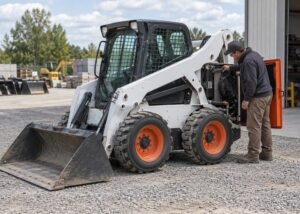
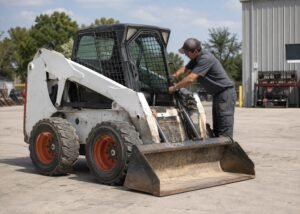
Construction and site work demand raw utility. Skid steer loader attachments — bucket configurations, augers, hydraulic breakers — transform a standard utility tractor into a compact earthmoving platform. High-flow hydraulic systems are non-negotiable here: operators running mulchers or cold planers need sustained flow rates that base-spec machines simply can’t deliver. For operators expanding into excavation-adjacent work, understanding how specialized configurations drive site efficiency is increasingly a competitive differentiator.
Precision agriculture pulls customization in the opposite direction — toward data density rather than brute force. Key configuration priorities include:
As TechRadar notes, “the farmer isn’t disappearing — they’re moving up the stack,” with AI reshaping their role from equipment operator to data decision-maker. Customization is what bridges the machine to that evolving workflow.
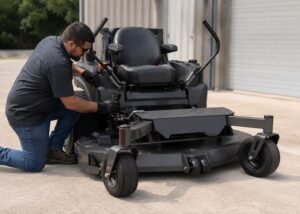
Landscaping operations require a third configuration logic entirely — one built around maneuverability and cycle time. High-efficiency cutting decks, compact turning radius kits, and slope-stability packages define productivity in this segment, where labor cost per acre is the primary metric.
Finally, CE-certified quality standards matter most when fleets cross borders. Operators deploying equipment across North American and European job sites need machines built to recognized certification frameworks from day one — not retrofitted for compliance after purchase. That reliability foundation becomes especially critical as the machinery landscape evolves further — which is exactly where the next wave of tractor technology is headed.
The machinery decisions made today will define operational competitiveness for the next decade — and the 2026 tractor landscape is shifting faster than most fleet managers anticipate.
Electric drivetrains and intelligent data layers are no longer experimental — they’re entering mainstream procurement cycles. The emergence of electric mid-size tractors signals a genuine inflection point. These platforms deliver near-silent operation, dramatically reduced fuel costs, and lower scheduled maintenance compared to conventional diesel units. For operations running multiple daily shifts in noise-sensitive or emissions-regulated environments, the calculus strongly favors electrification — particularly where mid-size tractor efficiency is already a competitive priority.
Telematics evolution is equally significant. The industry has moved well beyond simple GPS pinging. By 2026, agricultural machinery has transformed into a highly sophisticated instrument for data integration, synthesizing soil moisture readings, yield-mapping outputs, weather overlays, and fuel consumption into unified decision dashboards. The shift is from “where is my machine?” to “what should my machine do next?”
Data privacy, however, introduces a genuine caveat. As connected farm platforms accumulate sensitive operational data — field performance records, yield histories, input costs — compliance obligations are tightening. Fleet managers sourcing machinery should evaluate vendor data-sharing policies as rigorously as they evaluate horsepower specs. Ownership of machine-generated data is increasingly a negotiating point, not a footnote.
Right-sized machinery also emerges as the sustainable choice heading into 2026. Oversized equipment burns excess fuel, compacts soil, and inflates insurance costs — all quantifiable liabilities. One practical approach is aligning machine scale precisely to task requirements, a principle that extends naturally to fleet-wide procurement strategy across every equipment category.
For a practical breakdown of how technology is already translating into measurable field ROI, this discussion is worth your time:
[YOUTUBE EMBED: https://www.youtube.com/watch?v=VaLeiqN5PyE]
These converging trends — electrification, intelligent telematics, data governance, and right-sizing — each have concrete implications for how fleet managers should be structuring purchasing decisions right now.
Machinery decisions that ignore application fit, sourcing strategy, and automation readiness will consistently underperform — regardless of brand or horsepower rating.
As covered throughout this article, the shift from iron-first to solution-first thinking isn’t theoretical. It’s measurable. For fleet managers making purchasing or upgrade decisions in 2025 and beyond, these five principles distill the core argument:
On the other hand, none of these principles operate in isolation. The highest-performing fleets combine all five into a coherent procurement and operations framework — which raises practical questions that deserve direct answers.
Choosing the right tractor application solution comes down to matching capability to context — and these common questions cut straight to what fleet managers and operators need to know.
What are tractor application solutions?
Tractor application solutions go beyond the machine itself to encompass the full ecosystem of attachments, software integrations, and precision guidance systems designed for a specific task. Rather than buying generic iron, operators select configurations purpose-built for row crop farming, site grading, landscape maintenance, or materials handling. The result is measurably higher output per operating hour.
How does precision ag reduce operational costs?
Precision agriculture technology — including GPS-guided planting, variable-rate input controls, and telematics — eliminates overlap, reduces input waste, and cuts fuel consumption across large acreage. In practice, farmers using data-driven field management report significant reductions in fertilizer and chemical spend season over season. Understanding how power upgrades align with precision tools is an important first step for operations scaling into precision methods.
Can mid-size tractors handle heavy construction tasks?
Mid-size tractors in the 60–90 HP range can manage light-to-moderate construction tasks — finish grading, material transport, and utility trenching — when paired with purpose-rated attachments. However, sustained heavy lifting, deep excavation, or high-tonnage grading demands dedicated construction equipment. Matching rated capacity to actual task load is non-negotiable for both safety and equipment longevity.
Is autonomous machinery safe for urban job sites?
Modern autonomous systems rely on RTK GPS and advanced vision technology to maintain centimeter-level accuracy, even in low-visibility conditions. That said, urban environments introduce pedestrian traffic, variable sight lines, and regulatory complexity that require layered safety protocols beyond the machine itself. Deployment should follow local ordinance guidance and include geofenced operating boundaries.
What are the benefits of factory-direct machinery sourcing?
Factory-direct sourcing eliminates dealer markup, compresses delivery timelines, and often includes direct access to engineering support for application-specific configurations. Buyers also gain transparency into component sourcing and build quality that traditional dealer channels rarely provide. On balance, factory-direct procurement consistently delivers stronger total cost-of-ownership outcomes for both single-unit buyers and growing fleets.