Telephone/WhatsApp:+86 156 2656 0610

Telephone/WhatsApp:+86 156 2656 0610
Email:seekmach@gmail.com



A CE-marked tractor isn’t wearing a sticker — it’s carrying a legal declaration that every critical system meets binding European safety, health, and environmental standards.
That distinction matters more than most buyers realize. As TÜV SÜD notes, “The CE marking is not just a quality mark, but a declaration by the manufacturer that the product meets all relevant European safety, health, and environmental protection requirements.” In practice, that declaration shifts accountability. When a manufacturer affixes the CE mark, they are asserting — on the record — that their engineering choices survive regulatory scrutiny.
The CE mark functions as a technical passport: it unlocks market access, establishes liability boundaries, and signals structural integrity before the machine ever turns a wheel.
Think of it this way. A tractor crossing borders without CE compliance isn’t simply delayed at customs — it becomes a liability exposure for every party in the supply chain. Importers, dealers, and fleet operators can all find themselves holding responsibility for non-conforming equipment if an incident occurs. The certification framework draws a clear line between documented compliance and legal risk.
What makes this particularly relevant for heavy-duty equipment is the direct connection between the certification process and physical hardware. CE compliance isn’t self-reported on a form. It requires documented evidence that the chassis can withstand defined load cycles, that operator protection structures meet stress tolerances, and that the machine performs within environmental limits. The paperwork reflects real engineering decisions made in the design phase.
This is where the regulatory architecture becomes important. Two frameworks govern how heavy tractors earn and maintain CE status: the Directive 2006/42/EC on Machinery and the EU Mother Regulation for agricultural vehicles. Understanding what each demands — especially regarding chassis integrity and operator survival zones — is where the real engineering story begins.
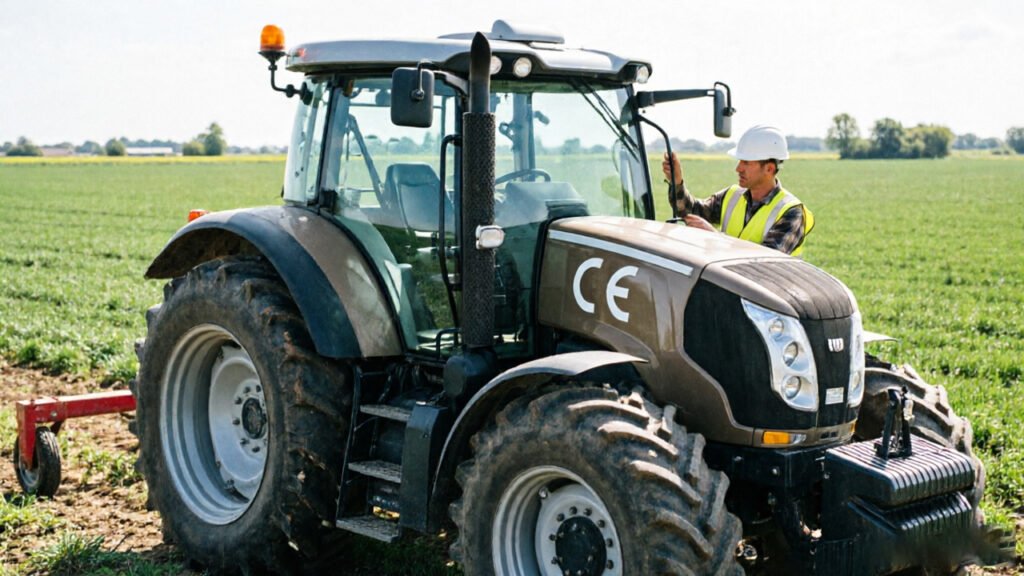
CE-certified chassis aren’t just structurally sound on paper — they’re engineered to keep operators alive when the worst happens.
Tractor overturns are among the most lethal events in agricultural and industrial settings. According to the Health and Safety Executive, over 30% of fatal agricultural accidents are caused by tractor overturns — a sobering figure that makes Roll-Over Protective Structures (ROPS) not a luxury, but a legal mandate.
los Machinery Directive 2006/42/EC is the foundational framework that makes this protection binding. For mobile machinery operators, it requires that every CE-marked vehicle incorporate protective structures capable of maintaining what engineers call the deflection-limiting volume (DLV) — essentially, a survival zone around the operator that must remain geometrically intact even during a crushing rollover event. The chassis itself must be designed to absorb and redirect impact energy, not transfer it into the cab.
Testing for CE marking puts that claim to proof. Certified chassis undergo a rigorous battery of mechanical evaluations, including:
Entendiendo el meaning of the EC Declaration of Conformity is critical here: it’s the manufacturer’s legally binding declaration that all these tests have been passed and documented. Without it, there’s no verifiable evidence the DLV can be maintained.
These structural requirements set the stage for how broader regulatory frameworks — particularly around dynamic performance — govern what happens in the moments before a potential overturn. That’s where braking standards become equally consequential.
Regulation EU 167/2013 sets the definitive framework for tractor type-approval across Europe, and its braking requirements are where quality of tractor chassis is put to its hardest test.
Known informally as the “Tractor Mother Regulation,” EU 167/2013 established a unified type-approval system replacing a patchwork of national standards. Under this regulation, every certified tractor must undergo standardized testing for braking performance — verifying not just stopping power, but the structural integrity of the chassis and axle components that absorb the forces involved.
| Regulation Component | Engineering Requirement |
|---|---|
| Braking deceleration | Defined minimum deceleration rates across load conditions |
| Response time | Maximum allowable lag between brake input and full engagement |
| Axle load distribution | Chassis must maintain alignment under emergency stop forces |
| System redundancy | Backup braking capacity required if primary system fails |
The critical insight here is that a braking test is simultaneously a chassis stress test. During a high-load emergency stop, deceleration forces push axle mounts, frame welds, and suspension geometry to their limits. A chassis that flexes or deforms under that load doesn’t just fail the brake test — it signals a structural vulnerability that could collapse under field conditions.
In practice, this is where the gap between certified and non-certified equipment becomes operational rather than theoretical. Tractors without EU 167/2013 type-approval may lack documented evidence that their braking systems were ever tested under standardized conditions. In industrial and municipal settings — where heavy loads, grade changes, and tight maneuvering are routine — that missing documentation represents a real liability.
The regulation’s value, then, extends beyond braking performance alone. It creates a documented evidence trail for every critical mechanical system. Understanding exactly what that documentation looks like — and what it legally obligates a manufacturer to prove — leads directly to the EC Declaration of Conformity.
The EC Declaration of Conformity is the legal backbone behind every CE mark — and procurement teams who ignore it are accepting risk on behalf of their organizations.
The CE mark on a tractor chassis is a label. The Declaration of Conformity is the proof. These two elements are not interchangeable. A manufacturer can affix a CE mark, but without a valid DoC, that mark carries no legal standing. Per European Union Standards, the EC Declaration of Conformity is a mandatory document where the manufacturer takes full legal responsibility for the product’s compliance with all applicable EU directives — including those governing safety standards for ROPS and structural chassis integrity.
Essential elements a valid DoC must contain:
In municipal and industrial procurement, the DoC carries real contractual weight. A missing or incomplete DoC can void equipment warranties, disqualify a purchase from regulatory sign-off, and — critically — expose the procuring organization to liability if an operator is injured. Procurement officers operating in government, agriculture, or heavy industry should treat the DoC as a non-negotiable deliverable alongside any purchase order.
What’s worth noting is that the CE mark and the DoC address mechanical and structural safety as a unified system — but they don’t cover every compliance dimension a modern tractor must meet. Understanding where CE marking ends and other regulatory frameworks begin is equally important, which makes it essential to look at how CE interacts with directives like RoHS that govern the electronic components increasingly embedded in today’s machines.
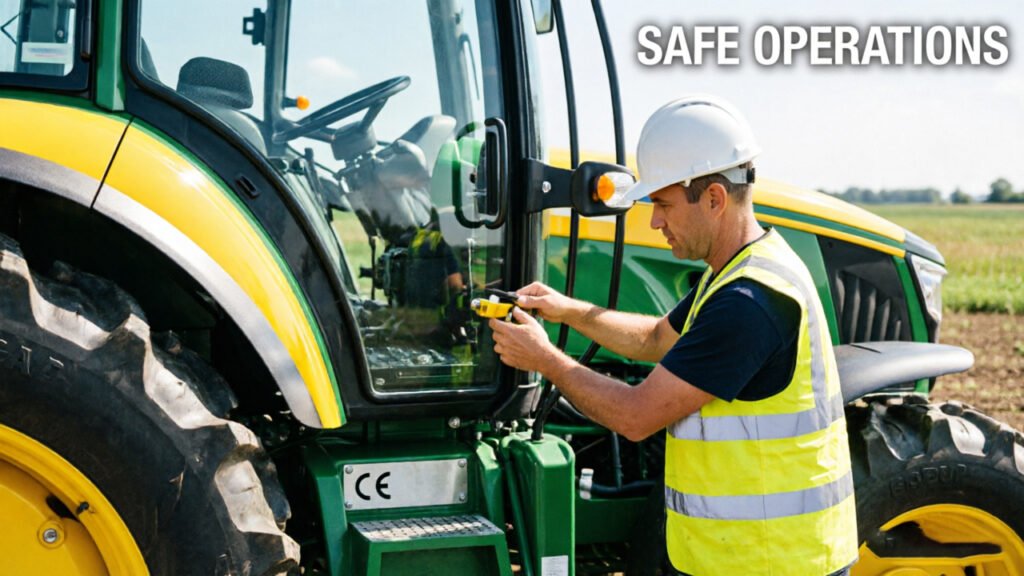
CE and RoHS are not interchangeable — and for heavy-duty tractor chassis, confusing the two can leave a machine legally non-compliant despite carrying multiple certification marks.
CE marking is a broad safety framework; RoHS is a narrow restriction on hazardous substances in electronic components. The distinction matters enormously in procurement decisions.
CE marking, anchored by the Directive 2006/42/EC on Machinery, governs the full mechanical safety profile of a tractor — structural integrity, braking systems, operator protection zones, and risk assessment documentation. It demands that the entire machine meets safety thresholds before it can be legally placed on the market. RoHS (Restriction of Hazardous Substances), by contrast, targets specific materials — lead, mercury, cadmium, and similar substances — within electrical and electronic sub-components. As noted in industry analysis, RoHS is often a subset of the requirements needed to achieve final CE marking for products containing electronic components, not a replacement for it.
For a modern tractor chassis, both certifications serve distinct but complementary roles. CE covers the machine’s mechanical and operational safety. RoHS applies to the internal sensors, display panels, and electronic control units increasingly found in today’s precision agricultural and industrial equipment. A tractor with RoHS-compliant electronics but no CE marking under the Machinery Directive is still an uncertified machine from a legal standpoint.
The warning sign: Some manufacturers highlight RoHS compliance prominently while downplaying — or omitting — full CE marking. This is a red flag, not a reassurance.
Procurement teams should require documentation for both certifications independently, verify that CE marking references the applicable directives, and treat any claim that “RoHS equals compliance” as a reason to ask harder questions. True compliance means both frameworks are satisfied — and the sourcing model behind certification matters just as much as the paperwork itself.
Buying CE-certified heavy-duty tractor chassis directly from the manufacturer isn’t just a procurement preference — it’s a structural advantage that protects margins, timelines, and long-term safety outcomes.
When certification is built into the design from day one, compliance stops being a cost center and starts being a competitive asset. Manufacturers operating under the EU 167/2013 Tractor Mother Regulation framework must integrate safety requirements at the engineering stage — not bolt them on after fabrication. Factory-direct sourcing means procurement teams get machinery where CE compliance was a design constraint, not a documentation exercise completed by a third-party distributor.
Eliminating middlemen delivers measurable cost savings without sacrificing certified quality. Each link in a distribution chain adds margin, introduces potential for documentation gaps, and distances the buyer from the original test records and technical files. Sourcing directly from the OEM means access to those files on request, faster responses to technical audits, and pricing that reflects actual production cost rather than reseller markup.
OEM/ODM customization is another area where factory-direct relationships create real value. Buyers can specify load ratings, chassis geometry, and interface configurations — all within validated CE safety parameters. This flexibility allows procurement teams to match machinery to operational requirements without triggering re-certification risk, because a capable manufacturer has already mapped the boundaries of what’s permissible under applicable directives.
Seekmach operates a 50,000m² facility supplying CE-certified agricultural and industrial machinery to over 50 countries — a scale that reflects the kind of institutional expertise, process discipline, and supply chain integration that consistent ISO/CE compliance demands. That level of output doesn’t happen without 15+ years of accumulated engineering knowledge baked into every production run.
Before examining what that expertise looks like under load, it’s worth seeing how structural integrity is validated in practice — something that numbers alone can’t fully convey.
Watching safety of industrial tractors testing in action bridges the gap between technical certification language and real-world mechanical confidence.
Reading about ROPS crush tests and lateral stability assessments is one thing — seeing them is another. Structural testing videos offer something documentation alone cannot: visible proof that a chassis holds under load, bends without catastrophic failure, and protects the operator through controlled deformation. According to OECD Tractor Codes, standardized tractor testing includes both lateral stability and longitudinal load-bearing assessments for the chassis — the kind of sequential, measurable pressure that separates compliant machinery from equipment that merely looks the part.
[YouTube Video Placeholder]
What to look for in a CE-compliant structural test video:
In practice, these visual benchmarks complement the compliance paperwork. A machine that passes on paper and performs on screen gives procurement teams — and operators — the full picture. With that foundation in place, the final considerations for making a confident, compliant purchase decision come into clear focus.
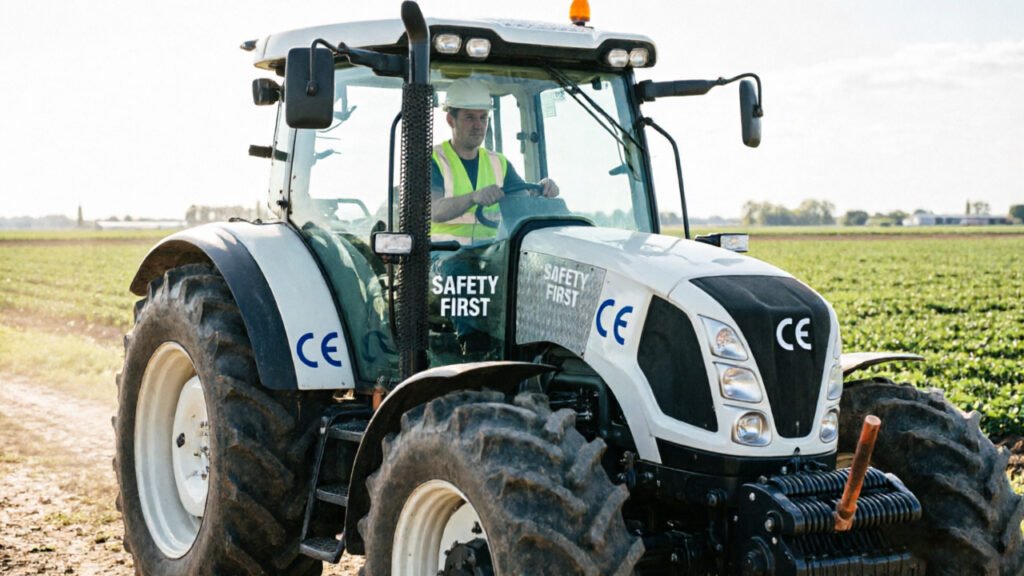
CE marking is not a bureaucratic checkbox — it is a legally binding mechanical standard that directly determines whether a heavy-duty tractor chassis is safe, marketable, and liability-proof. As TÜV SÜD notes, the CE mark serves as a “technical passport,” proving that the structural integrity of the chassis has been verified against established EU directives. For procurement teams and fleet operators, that passport carries real financial and legal weight.
The chassis is the foundational safety component. Everything else — the cab, the drivetrain, the load system — depends on a chassis that has passed ROPS (Roll-Over Protective Structure) testing and full stability evaluation. These aren’t optional performance upgrades. They are the minimum threshold that defines whether a machine qualifies for operation under CE standards. A chassis that skips this verification doesn’t just risk fines — it exposes operators to life-threatening conditions and exposes businesses to unlimited liability in the event of an incident.
The EC Declaration of Conformity is your procurement safety net. This document proves that the manufacturer — not a distributor, not a reseller — has taken legal responsibility for the machine’s compliance. In practice, it becomes the critical reference point during customs clearance, workplace safety audits, and insurance claims. Without it, buyers are left holding accountability they never agreed to carry.
Sourcing factory-direct from a certified manufacturer removes the compliance ambiguity that often comes with multi-tier supply chains. Middlemen rarely transfer the full documentation trail, and gaps in that trail can invalidate coverage when it matters most.
Here’s what any serious buyer should keep front of mind:
If questions remain about exactly how these certification layers interact — from RoHS to ROPS to the Declaration of Conformity itself — the next section addresses the most common buyer and operator questions directly.
CE marking for heavy-duty tractor chassis raises practical questions that operators, fleet managers, and procurement teams encounter every day — here are the most important answers.
What is the difference between CE and RoHS for tractors?
CE marking confirms that a tractor meets broad safety, health, and environmental requirements under EU machinery directives — including structural integrity and operator protection. RoHS, by contrast, restricts the use of specific hazardous substances in electrical and electronic components. For most heavy-duty tractor chassis, CE marking is the directly relevant standard; RoHS applies primarily when electronic assemblies are part of the machinery package.
What does the EC Declaration of Conformity mean for my business?
The EC Declaration of Conformity is the manufacturer’s legally binding written guarantee that the equipment meets all applicable EU directives. For procurement managers, it functions as documented proof of compliance — reducing liability exposure, simplifying audits, and ensuring that equipment is legally operable within regulated markets.
Why do tractors need ROPS under CE standards?
According to the European Commission, any mobile machinery carrying a risk of overturning must feature a certified protective structure under Directive 2006/42/EC. ROPS — Roll-Over Protective Structures — exist because overturning is one of the leading causes of fatal operator injuries in heavy machinery environments. CE standards mandate that ROPS designs undergo defined load testing before market entry.
Is CE marking required for tractors used outside the EU?
CE marking is legally mandatory only for equipment sold or operated within the European Economic Area. However, many international buyers and regulatory bodies treat CE marking as a baseline quality benchmark. In practice, CE-certified equipment often faces fewer trade barriers and smoother insurance underwriting processes globally.
Understanding these distinctions positions your organization to make smarter procurement decisions and avoid costly compliance gaps — so verify certification documentation before any purchase commitment.