Telephone/WhatsApp:+86 156 2656 0610

Telephone/WhatsApp:+86 156 2656 0610
Email:seekmach@gmail.com

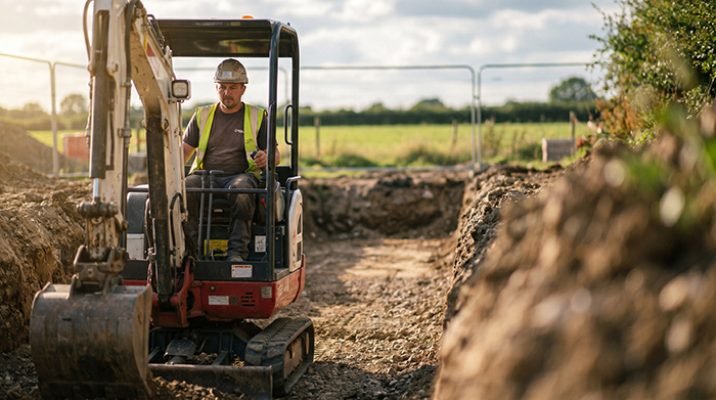
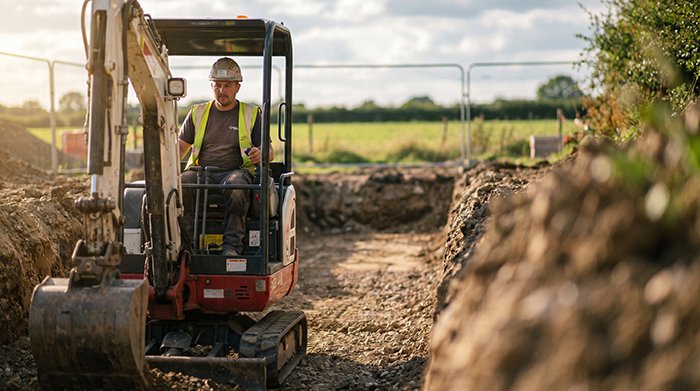
Choosing the wrong machine for a job doesn’t just waste money — it damages soil, crushes infrastructure, and stalls timelines. That’s the real cost of overkill in modern excavation.
Bigger hasn’t always meant better, yet job sites kept defaulting to massive standard excavators out of habit. For decades, the assumption was straightforward: more tonnage meant more capability. Contractors rented or purchased full-size machines for every task, from major earthmoving to simple utility trenching, regardless of whether the site actually demanded that kind of power.
Hydraulic efficiency has quietly changed that equation. Modern compact frames now house high-performance hydraulic systems that deliver force-to-weight ratios that were unthinkable two decades ago. Precision valve technology, load-sensing circuits, and improved pump designs allow smaller machines to handle tasks previously reserved for their larger counterparts — with far greater control.
The market has noticed. According to Off-Highway Research, mini excavators under 6 metric tons now represent a significant portion of the total global excavator market share — a figure that signals a genuine strategic shift, not a passing trend. Procurement teams across agriculture, construction, and utilities are rethinking their default machine choices. The question “what size excavator do I need” is finally getting a more nuanced answer than “as large as possible.”
Site constraints are driving much of this recalibration. Matching machine weight to actual ground conditions, access widths, and load-bearing limits isn’t just practical — it’s becoming a competitive necessity. As the compact equipment segment continues to evolve, innovations like zero-tail-swing design are extending what smaller machines can safely accomplish in tight, sensitive environments.
That sensitivity to ground pressure matters nowhere more than on working farms — and that’s exactly where the compact advantage becomes impossible to ignore.
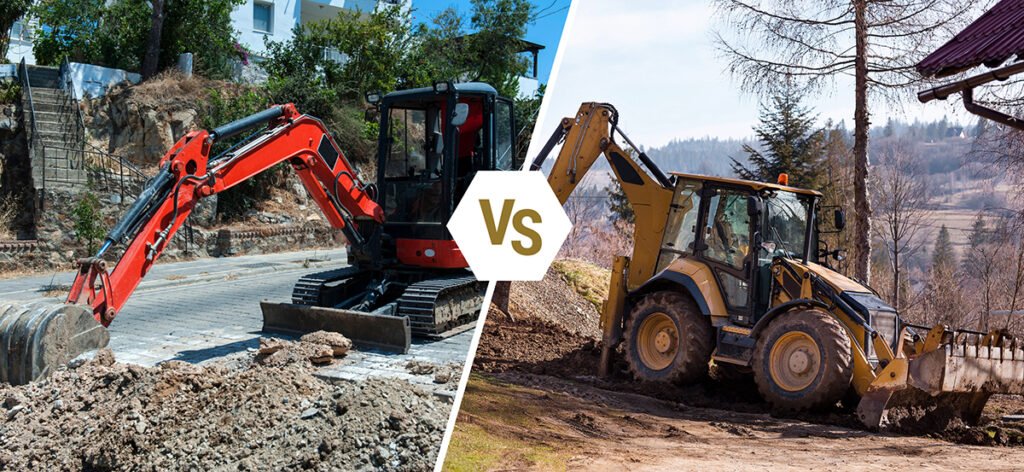
Ground pressure is the single most underestimated factor when selecting a mini excavator for farm work — and ignoring it can mean crushed drainage tile, damaged irrigation lines, and compacted soil that takes seasons to recover.
PSI (pounds per square inch) measures how much force a machine distributes across the ground beneath it. Standard excavators, often weighing 40,000+ lbs, concentrate enormous force through their tracks. Mini excavators, by contrast, spread a fraction of that load — and the difference is dramatic in practice.
As For Construction Pros notes:
“The decision between a mini and a standard excavator often comes down to ‘ground pressure’ — mini excavators exert significantly less PSI, preserving the integrity of finished landscapes and underground utilities.”
On working farms, that lower PSI isn’t just a technical footnote. It’s the difference between a productive day and an expensive repair bill.
Farms present a specific set of ground-pressure risks that standard machines routinely trigger:
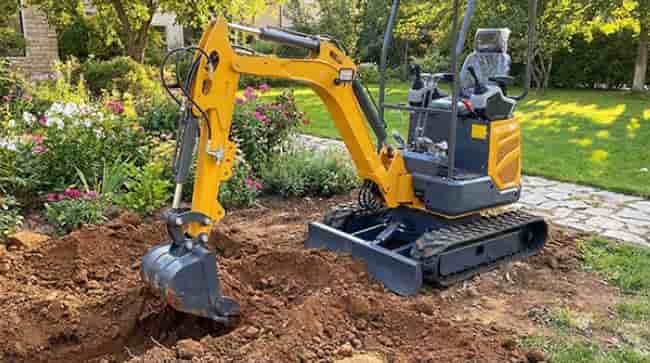
Mini excavators in the 1–2 ton operating range are especially well-suited for tight agricultural environments — orchard corridors, greenhouse foundations, and field-edge trenching where surface integrity matters as much as digging depth.
Beyond raw pressure, the machine’s design footprint shapes what it can access — a point that connects directly to one of the most useful innovations in compact equipment today.
ZTS technology is one of the clearest differentiators in the mini excavator vs standard excavator debate — and understanding it changes how operators approach confined jobsites entirely.
Zero tail-swing (ZTS) refers to a design where the machine’s counterweight and rear housing rotate within the width of the tracks. On a conventional excavator, the counterweight swings well beyond the track frame during rotation — sometimes by several feet. That overhang is manageable in open fields, but in tight urban corridors, indoor demolition zones, or alongside live traffic lanes, it becomes a genuine liability.
ZTS capabilities allow operators to rotate the chassis within the width of the tracks, preventing damage to existing structures. In practice, this translates to real safety gains:
The impact on operator confidence is notable. A common pattern is that crews working ZTS machines complete repositioning cycles faster because they’re not mentally calculating swing clearance on every rotation. That cognitive reduction translates directly to jobsite throughput.
For trench work and utility installation in dense residential areas, compact ZTS designs have shifted from a specialty feature to a baseline expectation. Municipalities and general contractors increasingly specify ZTS capability outright in procurement requirements.
However, ZTS configurations do involve trade-offs — primarily in counterweight mass, which can affect stability on severe slopes. Understanding those limits is essential before spec’ing a machine.
That balance between agility and raw capability points to an important question: when does a compact machine simply hit its ceiling?
Credibility demands an honest answer: compact machinery has real limits, and certain job conditions make a standard excavator the only viable tool on site.
The case for mini excavators built across earlier sections — ground pressure advantages, zero tail-swing precision — doesn’t apply universally. Understanding where the threshold sits is just as important as knowing when to go compact. The Association of Equipment Manufacturers notes that standard excavators deliver significantly higher breakout force and deeper dig depth, making them essential for heavy-duty quarrying and large-scale foundation work.
Three scenarios where standard machines remain non-negotiable:
The efficiency threshold is straightforward: when dig depth exceeds 14 feet, breakout force requirements surpass 30,000 lbs, or daily volume targets exceed 800 cubic yards, a standard machine is the correct call.
In practice, operators who understand attachment limitations on smaller units make better procurement decisions — including knowing when factory-direct heavy machinery at full scale is the right investment. That calculation is also shifting as the compact segment evolves technologically, a trend worth examining closely.
Mini excavator market research future projections tell a compelling story: compact machines are not a passing trend but a structural shift in how construction and agriculture deploy ground-engaging equipment.
Market Research Future indicates a sustained upward trajectory for mini excavator adoption through 2035, driven by urbanization, tighter job-site access requirements, and the growing demand for multi-attachment platforms that can switch between augers, hydraulic thumbs, and tilt buckets on a single frame. The compact segment is outpacing full-size excavator growth precisely because versatility now outranks raw power as the primary purchasing criterion.
Key forces shaping the market through 2035:
| Year Range | Primary Market Driver |
|---|---|
| 2024–2026 | Urban infill construction and residential site demand |
| 2027–2029 | Electrification: battery-electric compact units reaching commercial scale |
| 2030–2032 | Semi-autonomous grade control and remote operation in compact class |
| 2033–2035 | Agricultural sector adoption of multi-tool platforms at scale |
Electrificación is accelerating faster in compact units than in full-size machines — smaller battery packs deliver viable operating windows, and the zero-emission profile opens indoor demolition and urban contracts previously unavailable to diesel-powered equipment.
Resale value trends also favor compact machines. Lower initial purchase prices, broader rental market demand, and attachment compatibility keep residual values stronger than comparable-age standard excavators, which depreciate faster as payload requirements shift.
Este shift toward specialized excavation solutions mirrors what’s happening across the broader equipment market — operators want machines that adapt rather than machines that merely dig.
Understanding where the market is heading naturally raises the next practical question: with so many capable compact models available, how do you identify the right one for your specific project requirements?
Every solid excavator buying guide starts with the same principle: size your machine to what 80% of your jobs demand, not your most extreme outlier project.
The right mini excavator isn’t the biggest one you can afford — it’s the most capable one you’ll actually use.
Work through these four criteria before committing to a purchase or rental:
As this size-selection resource reinforces, matching machine specs to realistic job conditions — rather than worst-case scenarios — is the foundation of smart procurement. Understanding where that specification comes from, and who builds it, leads directly to your next consideration: the sourcing relationship itself.
Sourcing heavy equipment directly from a certified manufacturer is one of the most effective ways to reduce procurement costs without sacrificing build quality or after-sales support.
Traditional dealership markups typically add 20–40% to the base machine price. That premium covers showroom overhead, regional distribution networks, and multi-tier commission structures — costs that deliver no mechanical value to the end buyer. For contractors managing tight project margins or distributors scaling a fleet, that gap is significant.
The factory-direct model changes the equation entirely. Rather than paying for intermediaries, buyers engage the production source. Seekmach’s integrated manufacturing campus spans over 50,000m², enabling high-volume output under one roof — from fabrication and welding to final assembly and quality inspection. According to Seekmach Industrial Data, this scale supports global export-standard quality compliance within a single ISO 9001 certified facility. That certification isn’t a formality — it means documented process controls, traceable component sourcing, and consistent tolerances across every unit shipped.
OEM and ODM services are where factory-direct relationships become particularly valuable for distributors and large contractors:
Global logistics support rounds out the picture. Factory-certified equipment ships with full documentation, parts traceability, and direct technical support — reducing warranty resolution time considerably.
As you weigh all of these factors together, it’s worth distilling what they mean for your actual buying decision — which is exactly where the final takeaways come in.
Choosing between a mini and a standard excavator isn’t a matter of preference — it’s a strategic decision that directly affects your operating costs, site safety, and long-term ROI.
As Seekmach puts it: “Built for the toughest jobs on earth, the right machinery choice balances direct-from-factory value with certified performance.” That principle ties together everything covered in this guide. Here are the four decisions that matter most:
The takeaway is straightforward: match your machine class to your dominant workload, prioritize safety features that protect your crew and property, and source strategically to protect your margin.
Still have specific questions about your situation? The next section tackles the most common buyer dilemmas directly.
Smart equipment decisions start with the right questions — and these four come up consistently among farmers and contractors evaluating compact versus standard machines.
What is the most versatile excavator size for a 50-acre farm?
For a 50-acre operation, a 1.0-ton compact machine typically hits the sweet spot. It’s light enough to avoid soil compaction in planted areas, yet powerful enough to dig irrigation channels, clear fence lines, and move material. If your terrain varies significantly, reviewing farm-focused compact specs — particularly gradeability and tail swing profiles — will help you match the machine to your ground conditions.
Can a mini excavator handle trenching in hard clay?
Yes, with the right setup. Hard clay demands high breakout force and a narrow bucket — two factors that compact machines in the 1.0–2.5 ton class handle effectively when properly configured. Pairing a rock or heavy-duty bucket with reduced swing speed keeps productivity high without mechanical strain.
How do I maintain a factory-direct machine without a local dealer?
In practice, most certified manufacturers supply digital service manuals, remote diagnostic support, and pre-negotiated parts shipping. Routine maintenance — fluid changes, track tension, filter replacements — follows standard intervals any competent mechanic can perform. The absence of a dealer does not necessarily mean the absence of support.
What attachments are essential for construction contractors?
According to brand comparison data, the core attachment set includes an auger, hydraulic breaker, grading bucket, and thumb. Contractors working tight sites should also explore units with superior hydraulic flow — a factor covered in depth for sub-ton machine buyers.
For a visual overview of these machines in action on farm tasks, consider watching this demonstration:
Choosing the right compact excavator ensures it fits both your budget and your land needs.