Telephone/WhatsApp:+86 156 2656 0610
Telephone/WhatsApp:+86 156 2656 0610
Email:info@seekmach.com

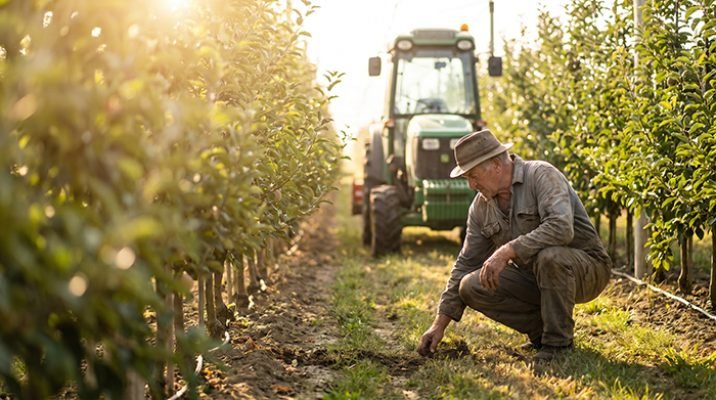
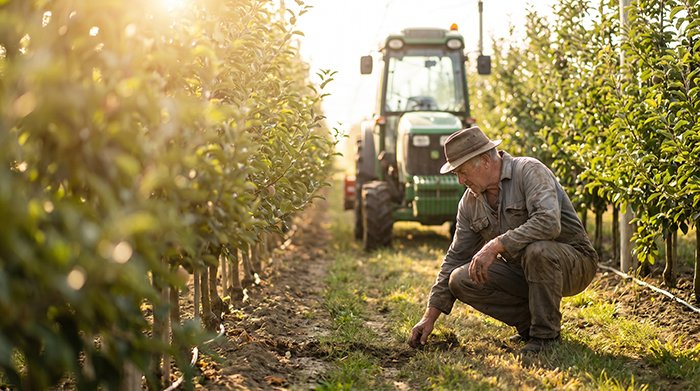
Modern orchard design has outpaced the machinery built to serve it — and the gap is costing growers real money every season.
Over the past two decades, growers have aggressively adopted high-density planting systems, squeezing trees into rows as tight as 8 to 10 feet apart to maximize yield per acre. Apple, cherry, and almond operations now routinely plant at densities two to three times higher than traditional layouts. The result is a fundamental incompatibility: standard utility tractors, typically 72 inches or wider, simply cannot pass through these corridors without scraping bark, snapping lateral branches, and knocking fruit to the ground.
That physical damage isn’t just cosmetic — it’s a direct revenue loss on every pass through the orchard.
This is where the demand for orchard tractors for narrow row spacing has accelerated sharply. Specialized orchard tractors typically measure less than 60 inches (1.5 meters) wide to navigate high-density planting rows without contact — a threshold standard utility machines rarely meet. The mechanical footprint problem compounds further at the headlands: oversized equipment demands wider turning areas, effectively removing productive rows from the layout and reducing the net planted acreage that generates income.
Das economic math is straightforward. Wider headlands mean fewer trees. Fewer trees mean lower yield ceilings regardless of how well the crop is managed. Add recurring limb damage and fruit knock-off, and the ROI case against non-specialized equipment becomes undeniable.
Horsepower range matters here, too. The 35HP to 90HP band has emerged as the practical sweet spot for specialty crop operations — compact machines in this range deliver enough draft force for mowing, spraying, and tillage without the chassis width penalties that plague larger agricultural workhorses.
Verständnis why standard machines fail is only the first step. The real engineering question — how narrow is narrow enough, and how do you measure for it — is where the precision work begins.
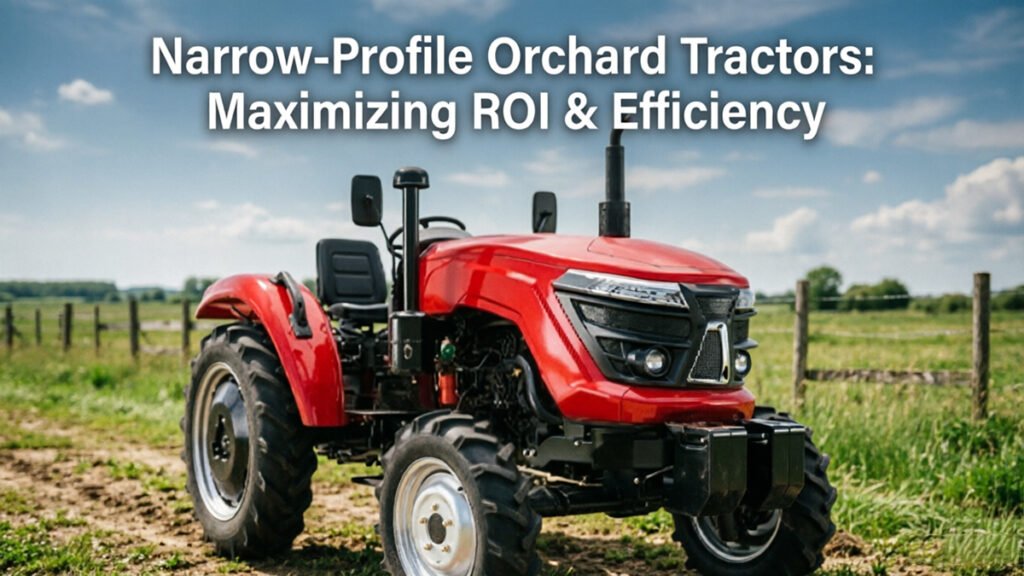
Tractor geometry — not raw horsepower — determines whether your machine fits, functions, and pays for itself in a modern high-density planting system.
Narrow vs. Super-Narrow Defined. In the industry, “narrow” typically refers to tractors with an overall width between 47 and 59 inches, while “super-narrow” machines compress that profile below 47 inches. Compact vineyard tractors with high clearance often combine sub-47-inch widths with undercarriage heights exceeding 16 inches — a pairing that allows safe passage through low-canopy blocks without sacrificing implement depth. According to market research on orchard equipment, the global orchard tractor segment is valued at $8.7 billion and growing, largely driven by demand for precisely this kind of specialized geometry.
Measuring Row Spacing Accurately. Before spec’ing any machine, ground-truth your row measurements at multiple points — rows are rarely perfectly parallel over an entire block. Use these practical tips:
Adjustable Wheel Tracks. Growers operating across multiple crop systems — say, wine grapes alongside apples — benefit significantly from tractors with adjustable front and rear wheel tracks. Swapping between 47-inch and 55-inch configurations without major downtime keeps one machine productive across varied blocks. A narrow-profile tractor review highlights how reduced tire widths also minimize soil compaction in those vulnerable under-vine zones.
Center of Gravity Warning: On slopes exceeding 15 degrees, a slimmer chassis raises rollover risk — always verify your tractor’s lateral stability rating before operating on hillside vineyard terrain.
The geometry question doesn’t end at width and clearance, though. How your machine manages hydraulic power across multiple implements is equally decisive — and that’s precisely where the next conversation begins.
Raw horsepower sells tractors, but hydraulic flow capacity is what actually determines whether modern orchard attachments perform — or fall short mid-row.
“The shift toward precision viticulture requires tractors with high-flow hydraulic systems to power complex attachments simultaneously.” — Vineyard & Winery Management Magazine
Hydraulic demand vs. engine output is where most growers discover a costly mismatch. Multi-row sprayers, under-vine cultivators, and mechanized leaf removers don’t just need power — they need a sustained, high-volume hydraulic supply measured in gallons per minute (GPM). A tractor rated at 60 HP can easily underdeliver if its hydraulic pump outputs only 8–10 GPM, leaving pressure-hungry attachments starved during peak operation. The real benchmark isn’t horsepower — it’s whether your system can sustain 15+ GPM under simultaneous load.
PTO efficiency compounds this issue further. Among specialty crop tractors 35HP to 90HP, engine horsepower and PTO-delivered horsepower are rarely the same number. Mechanical losses, pump draw, and auxiliary system demands can shave 10–15% off usable PTO output. Growers selecting machines based on advertised HP alone often discover that real-world attachment performance lags considerably — particularly when running mid-mount implements alongside rear remotes. For California operations already navigating seasonal power demands, matching output to attachment load is a year-round operational priority.
Managing rear and mid-mount remotes efficiently is the key to true one-pass productivity. Tractors equipped with multiple independent hydraulic circuits allow operators to run a mowing deck, spray system, and GPS-guided implement simultaneously — cutting labor passes per acre and reducing compaction exposure. However, this requires thoughtful valve and flow-divider configuration, not just extra ports.
Future-proofing matters. As precision ag attachments grow more hydraulically complex, the tractors that hold long-term value will be those engineered with expandable hydraulic capacity from the outset — a point that connects directly to how your machine handles the tight headland turns where all that efficiency gets tested.
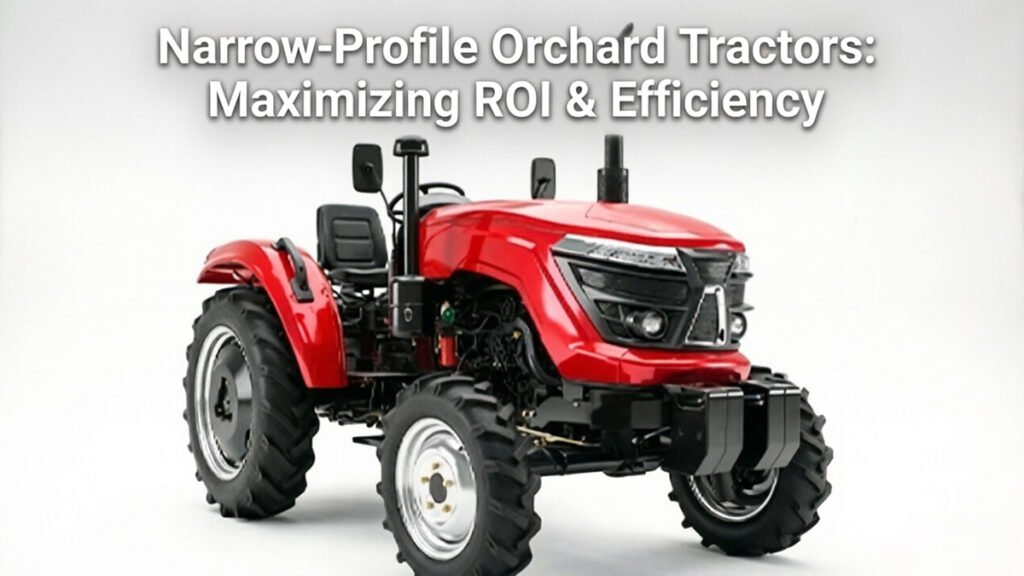
Tight headlands are where inefficient tractors lose time, damage vines, and compact soil — and where smart steering geometry pays back every dollar invested.
The headland is the proving ground for any orchard tractor. Rows end, space disappears, and the machine must reverse direction without clipping a trellis post or spinning out on rain-softened ground. Knowing how to choose the right tractor width for vineyards is only the starting point — how that tractor pivots once it reaches the row end matters just as much.
Steering angle is the defining spec here. According to Progressive Farmer, tractors designed for this niche must achieve a steering angle of 55 degrees or more to complete row-to-row transitions without multi-point turns. In a high-density planting with headlands under 15 feet, that geometry difference can reduce cycle time by several seconds per turn — compounding across hundreds of passes into measurable labor savings.
Key steering and traction specifications to evaluate:
Soil compaction deserves serious attention. Repeated headland turns concentrate wheel traffic in a narrow strip. A well-distributed, lighter-footprint machine running 4WD traction — rather than a heavier 2WD unit fighting for grip — puts less sustained pressure on that critical zone. The result is better root health along the row ends and lower tillage costs over time.
Getting the turning geometry right sets the stage for the next critical consideration: keeping the operator protected while working under low-hanging canopies and tight overhead clearance.
Orchard tractors operate in one of agriculture’s most demanding environments — where a single wrong turn can injure the operator, damage expensive vines, or contaminate an unsprayed crop.
Folding ROPS represent the most critical safety innovation in modern orchard design. Standard roll-over protective structures stand too tall for dense canopy rows, forcing operators to choose between structural protection and clearance. Folding ROPS solve this directly — they collapse hydraulically or manually before entering low-hanging rows, then lock back into the certified upright position at the headland. According to University of California, Agriculture and Natural Resources, specialized orchard models use curved fenders and folding ROPS specifically to pass under heavy foliage without bruising the crop.
Fender geometry is the second line of defense. Straight-edged fenders catch vine canes and trellis wires, creating drag that snaps cordons and strips fruit. Low-profile fenders with smooth, curved trailing edges guide plant material around the machine rather than into it — a detail that separates true orchard engineering from a narrowed field tractor.
Pressurized cabs matter most during spraying operations. A sealed, positive-pressure environment keeps chemical drift out of the operator’s breathing space, which is both a regulatory requirement in many states and a practical productivity factor. Operators who aren’t fighting chemical exposure work longer shifts with fewer breaks.
Ergonomics in compact spaces close the loop. Narrow cabins force compromises on seat travel, pedal placement, and visibility angles. Leading designs counter this with adjustable suspended seats, angled instrument clusters, and wide-angle rear mirrors — reducing fatigue during eight-hour harvest days.
For commercial fruit growers evaluating factory direct compact tractors for commercial fruit growers, these safety features aren’t optional extras — they are non-negotiable specifications that directly affect labor retention and liability exposure. Understanding where machines are built and how they’re sourced turns out to be just as consequential as the spec sheet itself.
Sourcing orchard tractors directly from certified manufacturers is now one of the fastest-growing levers for reducing total equipment cost without sacrificing performance or compliance.
Traditional dealership markups have long inflated equipment budgets by 20–35%, a margin that large-scale growers increasingly can’t justify as input costs rise across labor, fuel, and water management. When narrow-profile tractors already command a premium due to their specialized engineering, adding a distribution layer compounds the problem further.
The factory-direct model addresses this head-on across four critical dimensions:
Buying factory-direct from an ISO 9001-certified facility can eliminate thousands in markup while improving customization access and reducing parts lead times.
Seekmach operates from a 50,000 m² production facility, supplying ISO 9001-certified machinery to global markets without intermediary markups — a procurement model that pairs naturally with precision-driven farm equipment decisions where exact specifications determine ROI.
The same logic extends across every specialized environment where narrow-profile tractors work — from dense vineyard rows to the controlled corridors of greenhouse operations.
Compact orchard tractors in the 35HP–90HP range deliver meaningful ROI across a surprisingly wide range of environments — well beyond traditional apple and pear orchards.
The right narrow-profile tractor isn’t just an orchard tool; it’s a multi-environment workhorse that pays for itself across seasons.
Understanding where these machines perform best sets the stage for identifying the procurement criteria that matter most before you buy.
Choosing the right orchard tractor comes down to one core principle: narrow-profile engineering delivers more measurable ROI than raw horsepower for high-density row operations. As covered throughout this article — from factory-direct sourcing advantages to greenhouse and vineyard applications — the machinery decisions you make at the procurement stage shape your operational efficiency for years. Here are the four most actionable takeaways.
Procurement decisions in this category rarely have simple answers, and every operation carries its own constraints around acreage, row spacing, and attachment needs. The good news: once you know which specs to prioritize, the path to the right machine becomes considerably clearer — and the next section addresses the most common questions growers still have when making that final call.
Selecting the right narrow-profile orchard tractor is easier when you have clear, direct answers to the questions growers ask most often.
Q: What is the ideal horsepower for a 50-acre vineyard?
For most 50-acre vineyard operations, a tractor in the 50HP–75HP range hits the practical sweet spot. That output handles multi-row sprayers, mowing, and cultivation without the added bulk that comes with higher-horsepower platforms. Operations with steeper terrain or heavier implement loads may want to push toward the 75HP–90HP ceiling, while flatter, well-maintained sites can often run efficiently at the lower end.
Q: Can I use a sub-compact tractor for commercial orchard work?
Sub-compact tractors are generally not recommended for full commercial orchard production. Their hydraulic capacity, PTO output, and structural durability rarely meet the demands of daily commercial use — including spraying, harvesting assists, and cover crop management. They work acceptably for small hobby plots or supplemental tasks, but a purpose-built narrow-profile model in the 35HP–60HP class will deliver far better long-term ROI at commercial scale. For a practical look at how compact narrow tractors perform under real-world conditions, this tractor capability breakdown is worth reviewing.
Q: How does 4WD affect the turning radius in tight rows?
4WD adds traction but can modestly increase the turning radius on some platforms. However, modern narrow orchard tractors are engineered to minimize this tradeoff — a 55-degree steering angle is the industry benchmark for efficient headland transitions, and the best 4WD models achieve this even with front axle drive engaged.
Q: What maintenance is unique to narrow-profile tractors?
Narrow-profile machines require closer attention to front axle pivot points, low-profile tire pressure, and the seals on articulated or offset frames. Cooling systems also demand regular inspection, since reduced airflow in confined canopy rows can accelerate heat buildup.