Telephone/WhatsApp:+86 156 2656 0610
Telephone/WhatsApp:+86 156 2656 0610
Email:info@seekmach.com



Mini excavator whole-body vibration should be managed through the actual task, travel route, exposure pattern and seat setup together. Buying a softer seat or counting engine hours alone does not establish that exposure is controlled. Start by identifying when the operator experiences vibration or repeated shocks, then improve the work arrangement and obtain competent assessment where required.
This guide concerns occupational exposure planning, not medical diagnosis or a universal allowance for operating hours. Machine condition, ground, attachment use, posture and daily work patterns differ. Apply the relevant local requirements and the manufacturer’s instructions. Operators reporting pain or other health concerns should use the employer’s reporting and appropriate occupational-health channels.
A report that an excavator vibrates can describe several different issues. The owner may be investigating an abnormal engine symptom, a rough travel route, a poorly adjusted seat or repeated impacts during a work task. Record what happens and under which conditions before deciding that a particular component is responsible.
Das UK HSE overview of whole-body vibration describes vibration transmitted through a supporting seat or feet, including shocks and jolts associated with mobile machinery. It also recognizes other contributors to back problems. That makes a description of the complete job more useful than assuming every discomfort report has one cause.
Noise is a separate exposure question. The mini excavator and breaker noise guide can help plan that assessment, but a noise-control decision does not establish that whole-body vibration is controlled. Keep the assessments connected through the work plan while retaining their distinct evidence and responsibilities.
Break the day into recognizable activities: travelling to the work area, repositioning, excavation, attachment work, waiting and any other equipment the operator uses. Record the route and conditions for each relevant activity. Engine-running time and the time a person is actually exposed to a particular task are different records.
Use observations from representative work rather than a convenient demonstration on smooth ground. A short route to the stockpile may produce a different pattern from stationary digging. A recently repaired route may differ from the same route after rain or repeated vehicle traffic. Note these differences so that the assessment refers to identifiable conditions.
| Observation | Information to gather | Decision it supports |
|---|---|---|
| Repeated jolts while travelling | Route location, surface condition and actual work pattern | Route improvement or alternative task arrangement |
| Discomfort during a particular task | Task description, duration pattern and operator report | Competent exposure and ergonomic review |
| Seat adjustment uncertainty | Seat identity and applicable instructions | Training, correct adjustment or maintenance referral |
| Changed conditions | New route, attachment, operator or machine condition | Review of the existing assessment |
Do not turn an observation form into a diagnostic instrument. A person can describe a jolt without measuring vibration magnitude, and an hour-meter entry does not supply that missing measurement. Label the information honestly: observed, reported, estimated from suitable evidence or measured by the responsible assessor.
Ask whether the task requires the same travel and repeated repositioning in the first place. Better placement of materials, a different approved access route or a revised work sequence may reduce unnecessary travel. Evaluate proposed changes within the complete site plan, including ground stability, people, services and other moving equipment.
Inspect the route through the site’s normal arrangements. Identify locations that repeatedly create shocks and decide who will address them. A route marked for repair remains an open action until the responsible person has confirmed its condition. Do not ask an operator to compensate indefinitely for a known route defect by adopting an improvised driving technique.
Das HSE employer guide to controlling back-pain risks from whole-body vibration discusses a combination of equipment, work organization and other contributing factors. Use it as UK guidance for planning the assessment, rather than extracting a single recommendation and treating that as a complete control package for every mini excavator.
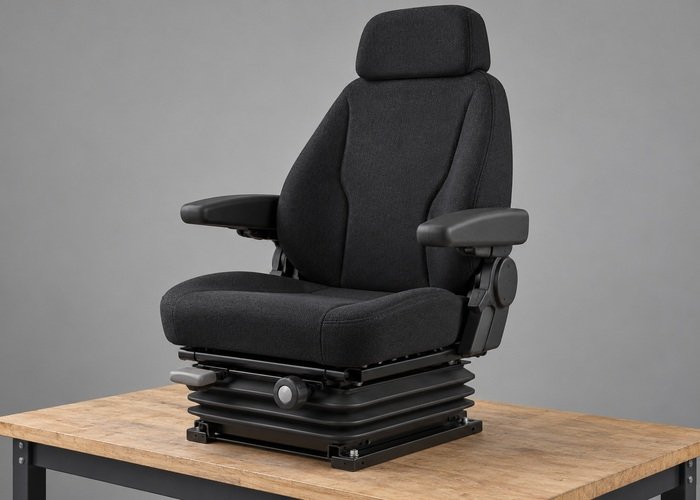
Identify the actual seat and any relevant suspension or adjustment system. Ask the supplier for the applicable instructions and confirm that the operator understands the adjustments provided. A setting copied from another driver or machine does not establish the appropriate setup for this installation.
Record loose, damaged or nonfunctional adjustments through the defect process. Maintenance should follow the manufacturer’s method and be performed by the appropriate competent person. Do not add improvised cushions, change mounting arrangements or substitute a suspension assembly without approval; apparent comfort does not demonstrate that the altered installation is suitable.
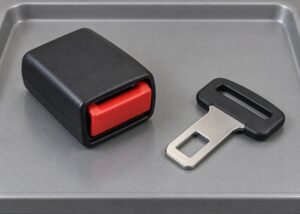
Das seat-belt inspection guide addresses the complete restraint separately. A change to a seat can affect more than comfort, so the supplier needs to confirm the approved complete arrangement. A vibration concern is not permission to disconnect a restraint or modify its mounting.
Manufacturer information can help a competent assessor, but its test conditions and applicability need to be understood. Do not paste a declared emission figure into a site form and call it the operator’s daily exposure without examining the actual work. The assessor should explain which information is suitable and what uncertainty remains.
If measurement is needed, have the responsible competent person select the method and equipment. This article does not prescribe sensor placement, calculation shortcuts or an exposure limit. Keep any assessment report with its conditions, task descriptions, measurement or estimation basis and the actions that follow from it.
HSE’s introduction to managing vibration at work distinguishes whole-body vibration from hand-arm vibration. A mounted attachment and a handheld tool can create different exposure questions. Replacing a handheld process with machine-mounted equipment should therefore prompt an assessment of the resulting work, not an automatic claim that every vibration risk has disappeared.
For each proposed control, record the problem it addresses, the person responsible and how effectiveness will be checked. A route repair, a seat repair and a revised materials-delivery arrangement have different completion evidence. A useful action list makes those distinctions clear rather than closing everything under a single entry called operator comfort.
Use operator feedback as part of the review, with a consistent way to identify the task and location. Improvement reported during one activity does not prove that another activity is controlled. Equally, an unchanged complaint deserves investigation rather than an instruction to tolerate the problem because a new component has been purchased.
Maintain the machine under its applicable instructions. The mini excavator maintenance checklist helps assign routine observations, but it is not an exposure assessment. Where a defect is suspected, connect the service record to the task assessment so that the assessor knows whether the equipment condition has changed.

Give operators a clear route for reporting uncomfortable vibration, repeated shocks, defective seating and health concerns. Those reports may need different recipients. A technician can investigate equipment condition, while a health professional addresses the individual’s symptoms. Neither role should be silently replaced by a parts-sales conversation.
Keep personal health information within the appropriate confidential process. The machine defect log needs the operational information required to act, not a detailed public medical history. Supervisors should know what work restrictions or follow-up actions apply through the authorized process without circulating unnecessary personal details.
Review the plan when the route, task, attachment, machine, seat or operating pattern changes. Retain earlier assessment references so that a future reviewer can understand which conditions were considered. A dated control plan with named actions is more useful than an undated declaration that the excavator has an ergonomic seat.
For a supplier inquiry, describe the installed machine and seat, the applicable instructions and the observed task conditions. Ask for documentation and approved options rather than requesting a promised number of safe hours. That gives the supplier a clear technical question while leaving the occupational assessment with the responsible competent person.
No. The seat is one part of the system. Its suitability, adjustment and condition need to be considered alongside the machine, route, task and exposure pattern. Do not treat the presence of suspension as proof of adequate control.
Not without examining the actual work. An engine may run during activities with different exposure conditions or while the operator is elsewhere. Keep representative task information and let the assessor determine the appropriate exposure basis.
No. Back pain has multiple possible contributors and requires appropriate professional assessment. Report symptoms through the proper health channel while also recording relevant work conditions and equipment defects for investigation.
Review it when relevant work conditions change, controls deteriorate or reports suggest they are ineffective. Keep the task, route and equipment information current and record who will decide whether additional assessment is needed.