Telephone/WhatsApp:+86 156 2656 0610

Telephone/WhatsApp:+86 156 2656 0610
Email:info@seekmach.com

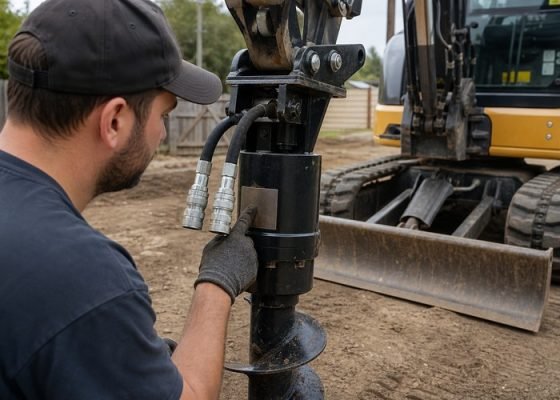
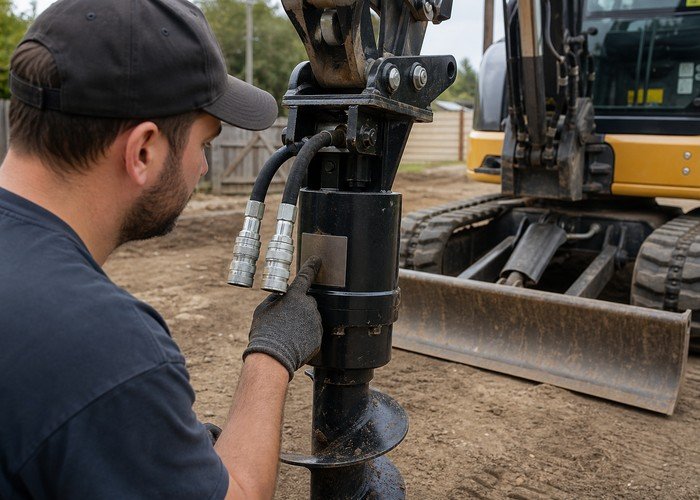
Mini Excavator Auxiliary Hydraulic Flow: Match Augers, Breakers, and Powered Attachments gives buyers and operators a structured way to verify condition, fit, and safety before money or machinery moves.
Continue through the SeekMach equipment range, compare the tractor range, review Kompaktbagger, see Kompaktlader, and browse lawn mowers.
Start with records, ratings, and the exact machine: Attachment matching begins with six written values: required flow, maximum pressure, one-way or two-way operation, return and case-drain needs, coupler type, and attachment mass. Compare those values with the exact excavator configuration and manual before ordering.
Start with records, ratings, and the exact machine: An auger, breaker, flail, compactor, and tiltrotator can demand very different circuits even when the couplers look alike. Too little flow slows or stalls the tool; excessive flow can create heat, overspeed, seal damage, and shortened service life.
Start with records, ratings, and the exact machine: Breakers commonly need correct hammer mode, return routing, pressure setting, and duty-cycle technique. Motor-driven tools may require reversible flow and sometimes a low-pressure case drain. Never assume a spare-looking port provides the required function.
Start with records, ratings, and the exact machine: Measure coupler body series and hose routing, not only nominal diameter. Similar-looking halves may not lock or flow correctly. Confirm attachment weight, pin or quick-coupler fit, hose length through the full boom arc, and protection from pinch and abrasion.
Start with records, ratings, and the exact machine: Commission the tool at low engine speed in a clear area. Cycle slowly, watch hose movement, check for leaks without using hands, and monitor heat, noise, chatter, speed, and carrier stability. Stop immediately when behavior differs from the attachment manual.
Safety-first walk-around before operation: Attachment matching begins with six written values: required flow, maximum pressure, one-way or two-way operation, return and case-drain needs, coupler type, and attachment mass. Compare those values with the exact excavator configuration and manual before ordering.
Safety-first walk-around before operation: An auger, breaker, flail, compactor, and tiltrotator can demand very different circuits even when the couplers look alike. Too little flow slows or stalls the tool; excessive flow can create heat, overspeed, seal damage, and shortened service life.
Safety-first walk-around before operation: Breakers commonly need correct hammer mode, return routing, pressure setting, and duty-cycle technique. Motor-driven tools may require reversible flow and sometimes a low-pressure case drain. Never assume a spare-looking port provides the required function.
Safety-first walk-around before operation: Measure coupler body series and hose routing, not only nominal diameter. Similar-looking halves may not lock or flow correctly. Confirm attachment weight, pin or quick-coupler fit, hose length through the full boom arc, and protection from pinch and abrasion.
Safety-first walk-around before operation: Commission the tool at low engine speed in a clear area. Cycle slowly, watch hose movement, check for leaks without using hands, and monitor heat, noise, chatter, speed, and carrier stability. Stop immediately when behavior differs from the attachment manual.
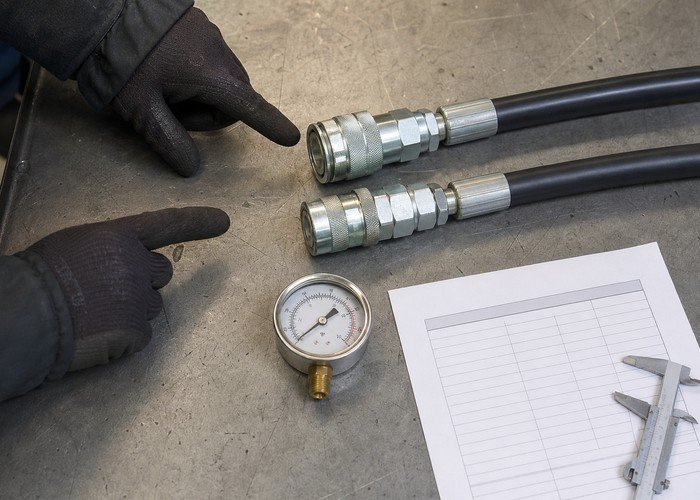
Engine, fluids, cooling, and leak checks: Attachment matching begins with six written values: required flow, maximum pressure, one-way or two-way operation, return and case-drain needs, coupler type, and attachment mass. Compare those values with the exact excavator configuration and manual before ordering.
Engine, fluids, cooling, and leak checks: An auger, breaker, flail, compactor, and tiltrotator can demand very different circuits even when the couplers look alike. Too little flow slows or stalls the tool; excessive flow can create heat, overspeed, seal damage, and shortened service life.
Engine, fluids, cooling, and leak checks: Breakers commonly need correct hammer mode, return routing, pressure setting, and duty-cycle technique. Motor-driven tools may require reversible flow and sometimes a low-pressure case drain. Never assume a spare-looking port provides the required function.
Engine, fluids, cooling, and leak checks: Measure coupler body series and hose routing, not only nominal diameter. Similar-looking halves may not lock or flow correctly. Confirm attachment weight, pin or quick-coupler fit, hose length through the full boom arc, and protection from pinch and abrasion.
Engine, fluids, cooling, and leak checks: Commission the tool at low engine speed in a clear area. Cycle slowly, watch hose movement, check for leaks without using hands, and monitor heat, noise, chatter, speed, and carrier stability. Stop immediately when behavior differs from the attachment manual.
Hydraulics, structure, and working components: Attachment matching begins with six written values: required flow, maximum pressure, one-way or two-way operation, return and case-drain needs, coupler type, and attachment mass. Compare those values with the exact excavator configuration and manual before ordering.
Hydraulics, structure, and working components: An auger, breaker, flail, compactor, and tiltrotator can demand very different circuits even when the couplers look alike. Too little flow slows or stalls the tool; excessive flow can create heat, overspeed, seal damage, and shortened service life.
Hydraulics, structure, and working components: Breakers commonly need correct hammer mode, return routing, pressure setting, and duty-cycle technique. Motor-driven tools may require reversible flow and sometimes a low-pressure case drain. Never assume a spare-looking port provides the required function.
Hydraulics, structure, and working components: Measure coupler body series and hose routing, not only nominal diameter. Similar-looking halves may not lock or flow correctly. Confirm attachment weight, pin or quick-coupler fit, hose length through the full boom arc, and protection from pinch and abrasion.
Hydraulics, structure, and working components: Commission the tool at low engine speed in a clear area. Cycle slowly, watch hose movement, check for leaks without using hands, and monitor heat, noise, chatter, speed, and carrier stability. Stop immediately when behavior differs from the attachment manual.
Functional test under realistic load: Attachment matching begins with six written values: required flow, maximum pressure, one-way or two-way operation, return and case-drain needs, coupler type, and attachment mass. Compare those values with the exact excavator configuration and manual before ordering.
Functional test under realistic load: An auger, breaker, flail, compactor, and tiltrotator can demand very different circuits even when the couplers look alike. Too little flow slows or stalls the tool; excessive flow can create heat, overspeed, seal damage, and shortened service life.
Functional test under realistic load: Breakers commonly need correct hammer mode, return routing, pressure setting, and duty-cycle technique. Motor-driven tools may require reversible flow and sometimes a low-pressure case drain. Never assume a spare-looking port provides the required function.
Functional test under realistic load: Measure coupler body series and hose routing, not only nominal diameter. Similar-looking halves may not lock or flow correctly. Confirm attachment weight, pin or quick-coupler fit, hose length through the full boom arc, and protection from pinch and abrasion.
Functional test under realistic load: Commission the tool at low engine speed in a clear area. Cycle slowly, watch hose movement, check for leaks without using hands, and monitor heat, noise, chatter, speed, and carrier stability. Stop immediately when behavior differs from the attachment manual.
Decision table: pass, negotiate, or stop: Attachment matching begins with six written values: required flow, maximum pressure, one-way or two-way operation, return and case-drain needs, coupler type, and attachment mass. Compare those values with the exact excavator configuration and manual before ordering.
Decision table: pass, negotiate, or stop: An auger, breaker, flail, compactor, and tiltrotator can demand very different circuits even when the couplers look alike. Too little flow slows or stalls the tool; excessive flow can create heat, overspeed, seal damage, and shortened service life.
Decision table: pass, negotiate, or stop: Breakers commonly need correct hammer mode, return routing, pressure setting, and duty-cycle technique. Motor-driven tools may require reversible flow and sometimes a low-pressure case drain. Never assume a spare-looking port provides the required function.
Decision table: pass, negotiate, or stop: Measure coupler body series and hose routing, not only nominal diameter. Similar-looking halves may not lock or flow correctly. Confirm attachment weight, pin or quick-coupler fit, hose length through the full boom arc, and protection from pinch and abrasion.
Decision table: pass, negotiate, or stop: Commission the tool at low engine speed in a clear area. Cycle slowly, watch hose movement, check for leaks without using hands, and monitor heat, noise, chatter, speed, and carrier stability. Stop immediately when behavior differs from the attachment manual.
Questions to ask the seller or operator: Attachment matching begins with six written values: required flow, maximum pressure, one-way or two-way operation, return and case-drain needs, coupler type, and attachment mass. Compare those values with the exact excavator configuration and manual before ordering.
Questions to ask the seller or operator: An auger, breaker, flail, compactor, and tiltrotator can demand very different circuits even when the couplers look alike. Too little flow slows or stalls the tool; excessive flow can create heat, overspeed, seal damage, and shortened service life.
Questions to ask the seller or operator: Breakers commonly need correct hammer mode, return routing, pressure setting, and duty-cycle technique. Motor-driven tools may require reversible flow and sometimes a low-pressure case drain. Never assume a spare-looking port provides the required function.
Questions to ask the seller or operator: Measure coupler body series and hose routing, not only nominal diameter. Similar-looking halves may not lock or flow correctly. Confirm attachment weight, pin or quick-coupler fit, hose length through the full boom arc, and protection from pinch and abrasion.
Questions to ask the seller or operator: Commission the tool at low engine speed in a clear area. Cycle slowly, watch hose movement, check for leaks without using hands, and monitor heat, noise, chatter, speed, and carrier stability. Stop immediately when behavior differs from the attachment manual.
A repeatable field checklist: Attachment matching begins with six written values: required flow, maximum pressure, one-way or two-way operation, return and case-drain needs, coupler type, and attachment mass. Compare those values with the exact excavator configuration and manual before ordering.
A repeatable field checklist: An auger, breaker, flail, compactor, and tiltrotator can demand very different circuits even when the couplers look alike. Too little flow slows or stalls the tool; excessive flow can create heat, overspeed, seal damage, and shortened service life.
A repeatable field checklist: Breakers commonly need correct hammer mode, return routing, pressure setting, and duty-cycle technique. Motor-driven tools may require reversible flow and sometimes a low-pressure case drain. Never assume a spare-looking port provides the required function.
A repeatable field checklist: Measure coupler body series and hose routing, not only nominal diameter. Similar-looking halves may not lock or flow correctly. Confirm attachment weight, pin or quick-coupler fit, hose length through the full boom arc, and protection from pinch and abrasion.
A repeatable field checklist: Commission the tool at low engine speed in a clear area. Cycle slowly, watch hose movement, check for leaks without using hands, and monitor heat, noise, chatter, speed, and carrier stability. Stop immediately when behavior differs from the attachment manual.
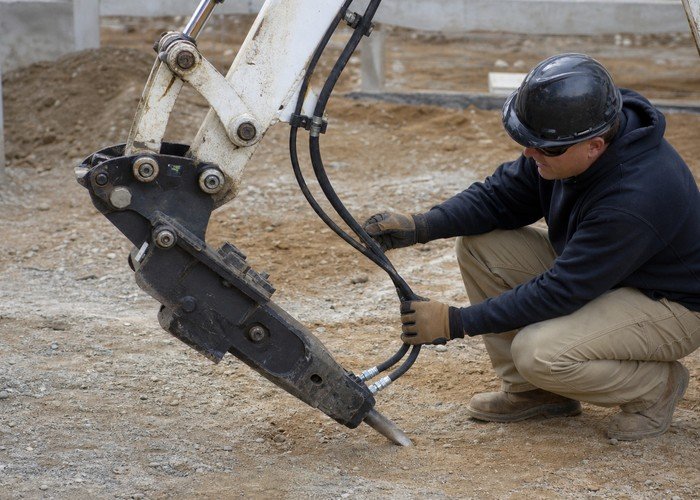
Common mistakes that create expensive surprises: Attachment matching begins with six written values: required flow, maximum pressure, one-way or two-way operation, return and case-drain needs, coupler type, and attachment mass. Compare those values with the exact excavator configuration and manual before ordering.
Common mistakes that create expensive surprises: An auger, breaker, flail, compactor, and tiltrotator can demand very different circuits even when the couplers look alike. Too little flow slows or stalls the tool; excessive flow can create heat, overspeed, seal damage, and shortened service life.
Common mistakes that create expensive surprises: Breakers commonly need correct hammer mode, return routing, pressure setting, and duty-cycle technique. Motor-driven tools may require reversible flow and sometimes a low-pressure case drain. Never assume a spare-looking port provides the required function.
Common mistakes that create expensive surprises: Measure coupler body series and hose routing, not only nominal diameter. Similar-looking halves may not lock or flow correctly. Confirm attachment weight, pin or quick-coupler fit, hose length through the full boom arc, and protection from pinch and abrasion.
Common mistakes that create expensive surprises: Commission the tool at low engine speed in a clear area. Cycle slowly, watch hose movement, check for leaks without using hands, and monitor heat, noise, chatter, speed, and carrier stability. Stop immediately when behavior differs from the attachment manual.
Final verification before transport or purchase: Attachment matching begins with six written values: required flow, maximum pressure, one-way or two-way operation, return and case-drain needs, coupler type, and attachment mass. Compare those values with the exact excavator configuration and manual before ordering.
Final verification before transport or purchase: An auger, breaker, flail, compactor, and tiltrotator can demand very different circuits even when the couplers look alike. Too little flow slows or stalls the tool; excessive flow can create heat, overspeed, seal damage, and shortened service life.
Final verification before transport or purchase: Breakers commonly need correct hammer mode, return routing, pressure setting, and duty-cycle technique. Motor-driven tools may require reversible flow and sometimes a low-pressure case drain. Never assume a spare-looking port provides the required function.
Final verification before transport or purchase: Measure coupler body series and hose routing, not only nominal diameter. Similar-looking halves may not lock or flow correctly. Confirm attachment weight, pin or quick-coupler fit, hose length through the full boom arc, and protection from pinch and abrasion.
Final verification before transport or purchase: Commission the tool at low engine speed in a clear area. Cycle slowly, watch hose movement, check for leaks without using hands, and monitor heat, noise, chatter, speed, and carrier stability. Stop immediately when behavior differs from the attachment manual.
No. Use this workflow to organize the inspection, then apply the exact limits and procedures in the model manual.
Use a qualified technician when records are incomplete, safety structures are altered, fluids are contaminated, structural cracks appear, or the functional test is inconsistent.
Record serial number, hours, cold-start condition, leaks, wear, measured settings, attachments, faults, photographs, and the person who performed the check.
Mini excavator hydraulic attachment decision path: Compare tractor financing against cash and farm liquidity, review the compact tractor DPF operating guide, and use a compact tractor size and implement checklist before requesting a final delivered quote.