Telephone/WhatsApp:+86 156 2656 0610

Telephone/WhatsApp:+86 156 2656 0610
Email:info@seekmach.com

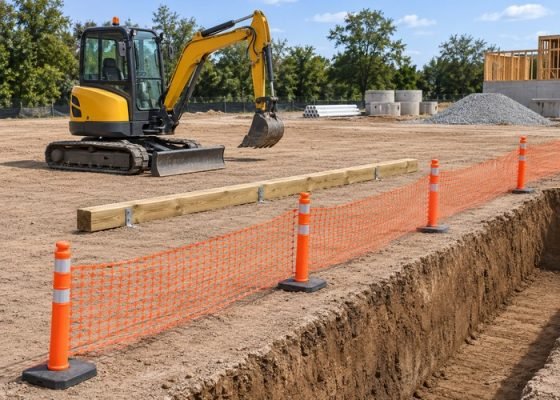
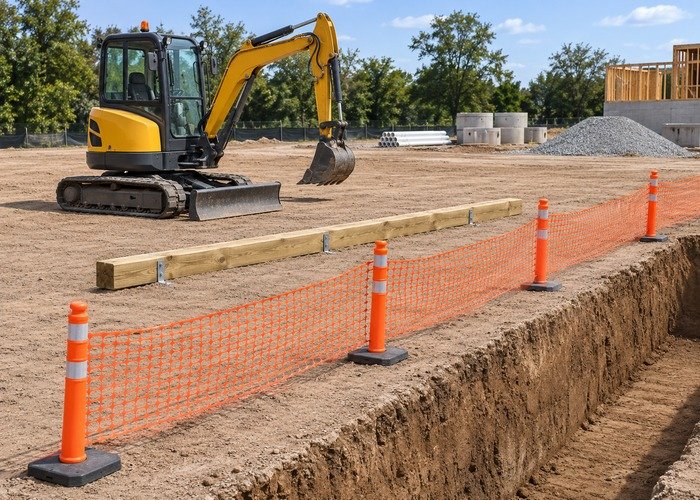
Short answer: A warning system can help an operator recognize when a mini excavator is approaching a trench edge, but it cannot make an unsupported edge safe. Use a stop log or another suitable barrier only when it is selected, positioned, and secured for the machine and site conditions. Set the operating limit through a competent, site-specific assessment, and stop work if the edge, ground, barrier, or warning system cannot be trusted.
Compact machines can feel manageable close to an excavation. Their smaller footprint does not prevent a track from breaking through a weak edge, a machine from sliding on sloping or disturbed ground, or its weight from acting beyond the supported area. Warning devices and stop logs can support a safe operating plan, but neither replaces an assessment of ground conditions, a defined operating limit, competent supervision, or a clear stop-work rule.
An edge warning system gives the operator a cue before the machine reaches a defined operating boundary. Depending on the machine and site, that cue might be a visible ground marker, a physical stop, a proximity alarm, a camera view, or a combination. Its purpose is to help the operator recognize a limit and stop before crossing it.
The boundary must come from a site-specific assessment. A warning system does not calculate whether soil can support the machine, how close tracks may safely approach, or whether the ground could collapse. It also cannot account for changes in soil, weather, trench geometry, machine configuration, load, or movement unless those factors have been considered in the assessment.
In U.S. construction work, OSHA 29 CFR 1926.651(f) addresses mobile equipment operating adjacent to an excavation or approaching its edge when the operator does not have a clear and direct view of the edge. In that situation, the employer must install and use a warning system, such as barricades, hand or mechanical signals, or stop logs. If possible, the grade should be sloped away from the excavation. These are requirements for the stated circumstances under U.S. construction rules; they do not establish a universal safe setback distance for every excavator, trench, or ground condition. Review the full OSHA excavation standard, 29 CFR 1926.651, and OSHA’s Trenching and Excavation eTool when planning U.S. work.
The rule’s warning-system examples address the operator’s view of the edge. A hand signal or mechanical warning can help communicate the limit; a barricade or stop log can make it visible or physical. These options serve different purposes and do not all provide the same degree of restraint. The system should match the site and be understood by the operator before work begins.
For related planning on ground conditions and edge distance, see mini excavator trench working platforms, edge distance, and track support.
A stop log is an obstruction placed to help define a limit or prevent equipment from crossing it. On a particular site, a suitably selected and secured stop may provide a more visible and tangible boundary than a painted line. But a log does not automatically stop a moving excavator. It may roll, shift, crush, be pushed aside, or fail to restrain the machine, depending on its size, material, orientation, anchorage, the soil beneath it, and the force applied.
Before relying on a stop log, establish what it is expected to do. Is it a visual cue intended to prompt a controlled stop, or is it intended to physically restrain the machine? Those are different functions. A visual cue should not be described or treated as mechanical restraint. If physical restraint is needed, a competent person should select and position a suitable barrier for the machine, operating conditions, and ground, following applicable manufacturer and site requirements.
Place the boundary where the machine can stop without reaching unstable ground. The assessment should consider the full machine footprint and movement, not just the bucket tip or front of the tracks. Turning, slewing, traveling, raising a load, or working with an attachment can change where the machine’s weight and forces act. If the machine must work near an edge, its position and permitted movements should be part of the work plan.
Do not assume a log placed parallel to the trench is secure just because it looks substantial. Confirm that it cannot roll or slide under expected contact, and that setting it has not disturbed the edge or created a trip or access hazard. If no reliable arrangement can be established, move the machine farther back or change the method of work.
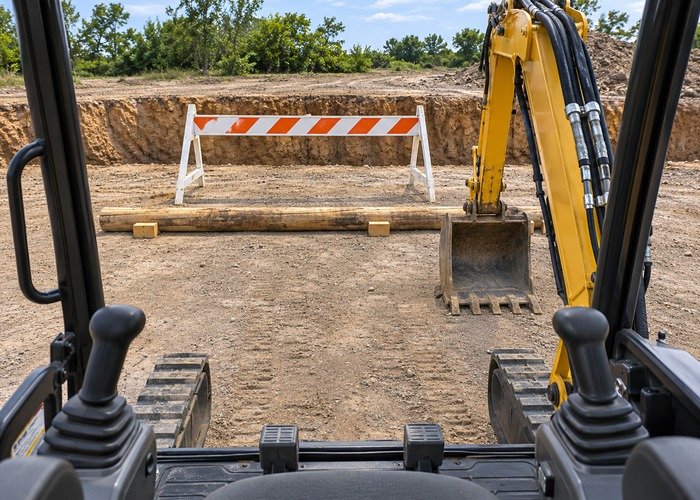
Some excavators have cameras, proximity systems, travel alarms, or other aids. Their presence does not mean they detect trench edges. A camera may show an area but leave blind spots; an alarm may warn of an object without assessing soil strength; a sensor may be affected by mud, vibration, attachment position, or poor calibration. Check the equipment manual and confirm the function before relying on any device.
Where a site uses a visual marker or designated boundary, make it easy to see from the operator’s normal working position. Avoid placing it where spoil, vegetation, glare, shadows, or machine movement will obscure it. If the operator cannot clearly identify the boundary, pause work until the marker is restored or another reliable control is in place.
Before the shift and after any change, check that the warning arrangement remains in place and works as intended. Reassess after rain, thaw, vibration, excavation changes, machine movement, or any sign of cracking, slumping, rutting, or settlement. A boundary that was suitable in the morning may no longer reflect afternoon ground conditions.
A useful stop log is a short, specific record of the operating limit and what to do when conditions change. It should be available to the operator and the people supervising or supporting the task. Keep the content practical rather than relying on a generic statement such as “stay back from the edge.”
Record the machine and attachment covered by the assessment, the location of the trench and operating boundary, the warning method, and the person responsible for checking it. State which movements are allowed near the edge and which require repositioning. Include the conditions that trigger a stop, such as an obscured marker, a shifted barrier, changed ground, unexpected movement, or lost communication.
For example, a site log might say: “Operate only within the marked working area. Do not travel or slew across the boundary. Stop and lower the attachment if the marker is obscured, the stop log moves, the ground cracks or settles, or the spotter is no longer in position. Resume only after the supervisor confirms the boundary and ground have been checked.” Adapt the wording to the actual site and plan; this example is not a substitute for assessing conditions.
Make the stop response unambiguous. The operator should know how to stop the machine safely, lower the attachment if appropriate, and wait for reassessment. Nobody should be expected to improvise a signal or approach a machine in an unsafe position to correct a shifted barrier.
A spotter can help the operator observe the boundary and surrounding activity, but a spotter cannot make unstable ground safe. Agree on the spotter’s position, visibility, communication method, and exact instruction that means stop. If visual contact or communication is lost, the operator should stop until it is restored.
Do not let a spotter stand between the machine and the trench, close to the edge, or where the operator cannot see them clearly. The operator remains responsible for controlling the machine. The spotter should not try to physically block a moving excavator or reposition a stop log while the machine is operating.
Use a site briefing to cover the boundary and stop condition. For communication arrangements, see mini excavator spotter communication. This article addresses the warning boundary and stop decision; it is not a complete excavation plan. For broader task planning, see mini excavator trenching safety, utilities, spoil piles, slopes, and backfill.

Stop work if the machine approaches the limit unexpectedly, the warning cannot be seen or heard, the barrier shifts, or the ground shows signs of movement. Stop if the operator or spotter is uncertain about the boundary, if the machine or attachment changes, or if site conditions differ from those used in the assessment.
Keep people away from the edge and do not approach a machine that may be on unstable ground to inspect or repair the warning arrangement. First make the area safe under the site’s emergency and machine-control procedures. A competent person should reassess conditions and determine whether the machine can be repositioned or the work method needs to change.
OSHA 29 CFR 1926.651 includes requirements beyond the paragraph on mobile equipment warnings. For example, it addresses inspections by a competent person, access and egress, water accumulation, and protection from falling loads. The excavation standard should be read as a whole alongside other applicable requirements; this article focuses on the warning system described in paragraph (f), not on cave-in protection, spoil placement, or utility locating.
OSHA’s compliance directive provides further enforcement guidance on excavation requirements. In the United Kingdom, HSE guidance likewise emphasizes safe systems of work and suitable precautions when using excavators. Local requirements differ, so employers should determine which rules apply to their work and jurisdiction rather than transferring a U.S. rule or manufacturer example elsewhere. See OSHA Directive CPL 02-00-165 and HSE guidance on excavators.
There is no single safe distance that applies to every mini excavator and trench. The appropriate limit depends on factors such as ground strength and condition, trench depth and geometry, machine weight and configuration, track support, movement, and the work being performed. Have a competent person assess the site and set a clear operating boundary. Do not treat a commonly repeated distance as a guarantee of safety.
Only if it has been selected, positioned, and secured as a restraint capable of handling the expected forces and site conditions. A loose log may shift or be pushed aside. Unless its restraint capacity is established, treat it as a visual or operational boundary aid, not a device that will arrest a machine.
For U.S. construction work, when mobile equipment operates adjacent to an excavation or approaches its edge and the operator does not have a clear, direct view of the edge, the employer must install and use a warning system. Examples include barricades, hand or mechanical signals, and stop logs. If possible, the grade should be sloped away from the excavation.
No. Paragraph 1926.651(f) describes a warning-system requirement for the stated mobile-equipment and visibility circumstances; it lists stop logs among examples, along with barricades and hand or mechanical signals. It does not establish a blanket stop-log requirement beside every trench or a universal equipment setback.
Stop work and secure the machine according to the site procedure. Do not continue by estimating the boundary. Resume only after a competent person confirms the operating limit and a reliable warning arrangement is restored.
A spotter may support the operator, but should not be the only control for an unstable edge. Agree on a visible position and stop instruction, and pause if contact is lost. The machine still needs a defined operating limit based on the site assessment.