Telephone/WhatsApp:+86 156 2656 0610

Telephone/WhatsApp:+86 156 2656 0610
Email:info@seekmach.com



Identify the mower and its complete containment arrangement before ordering a discharge guard or flail skirt. A rotary deck deflector, a collection-system component and a flail mower curtain are different parts of different designs. Similar dimensions or a similar photograph do not establish that a replacement will fit, retain correctly or provide the protection intended by the manufacturer.
If a required guard is missing, damaged or insecure, take the machine out of mowing service while the defect is assessed. Start with the model, serial identity, cutting unit and applicable manual. This article is a parts enquiry and work planning guide; it does not supply a universal installation procedure or authorize operation with an incomplete guard system.
Owners often describe everything around a discharge opening as a flap. That description can conceal important differences. A side discharge rotary deck may use a shaped deflector and retention assembly. A flail machine can have front, rear and side guarding elements. A collecting configuration may introduce additional components and conditions stated in its own instructions.
The Toro TimeCutter manual for its listed models provides a specific example: it addresses the grass deflector and warns against operating without the specified discharge protection or collection arrangement. This supports checking the complete approved configuration. Its parts and replacement instructions do not apply automatically to a SeekMach mower or a flail cutting unit.
Write the equipment description in two layers. First identify the power unit or complete mower. Then identify the particular cutting deck or attachment and its configuration. If the attachment has its own plate and manual, include them. A tractor’s identity does not, by itself, identify a separately fitted mower or its guarding components.

A damaged outer piece can draw attention away from its supporting parts. Ask the qualified assessor to consider the relevant mounting arrangement, retainers, hinges, brackets and surrounding structure as defined by the manual. Record what is visibly missing or damaged without declaring that unseen components are serviceable.
Obtain photographs only from a safe position with the machine secured as its instructions require. Do not crawl beneath an unsupported deck, reach into a cutting chamber or run the mower to make the defect more obvious. If useful evidence requires access beyond ordinary operator inspection, have a competent service provider arrange that access.
| Record field | Useful detail | What it cannot establish alone |
|---|---|---|
| Machine identity | Model, serial range and installed cutting unit | Whether an attachment from another revision fits |
| Configuration | Discharge, collection or other approved arrangement | Permission to substitute an improvised cover |
| Visible defect | Location, missing pieces and safely obtained photographs | Condition of inaccessible mounting structure |
| Parts reference | Manual illustration and supplier-confirmed assembly reference | Completed installation or acceptance inspection |
Use the table as an enquiry outline. An unknown entry should stay unknown until someone with the right information resolves it. A precise description such as a missing retainer at the identified assembly is more useful than saying the entire mower is unsafe or claiming that only a rubber flap needs replacement without an assessment.
The UK HSE guidance on machinery impact hazards addresses guarding, operator protection and safe working zones. These controls need to fit the machinery and task. An intact guard does not mean people can stand anywhere nearby, and keeping people away does not justify mowing with required protection removed.
Ask the site planner to consider nearby paths, parked vehicles, public access, animals and other workers. The appropriate arrangements depend on the actual machine instructions and site assessment. This guide does not give a single safe distance for every rotary, flail or remote mower. Do not borrow a distance from an unrelated manual because it is convenient to quote.
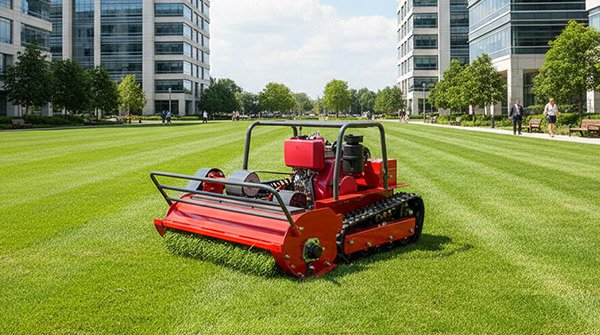
A remote control handset changes where the operator stands; it does not make thrown-object risks disappear. For a remote machine, confirm its particular cutting system, guarding layout and operating instructions. Do not assume that a remote mower, a riding mower and a tractor attachment can share an exclusion arrangement or guard design.
Send one organized request containing the identity evidence, cutting unit description, current configuration, visible defect, relevant manual page and safely obtained photographs. Explain whether the part has been modified or whether the history is unknown. Ask the supplier to identify the approved assembly and any related components needed for that exact configuration.
The lawn mower maintenance checklist provides broader ownership context. For a guard enquiry, keep the request focused on containment identity and condition. Adding an unrelated list of engine service questions can make it harder for a parts specialist to see the information needed to resolve the guard problem.
If the supplier proposes a revised part, request confirmation of the applicable model and serial range, the associated documentation and whether other assembly components must change. Keep that response with the machine record. Do not interpret a familiar trade name or a matching bolt count as written confirmation of compatibility.
Commercially, it also helps to distinguish what is being quoted: one outer guard, a complete assembly, related mounting parts, installation work or assessment of surrounding damage. This prevents a box containing one visible component from being mistaken for a complete repair. No price or lead time should be assumed until the actual supplier confirms it.

A machine may cut unevenly while its guards remain intact, or cut evenly while its guarding is defective. These observations address different questions. Do not decide that a guard is satisfactory because the lawn looks good. Likewise, do not remove a deflector to investigate clipping flow or try a mowing pass to test a suspected containment defect.
For an uneven finish, the guide to uncut strips and cut quality addresses a different diagnostic intent. Refer those symptoms through the normal maintenance process after the machine is safe for inspection. The guard decision still needs its own approved part identification and return-to-service assessment.
The HSE overview of hazards on specific agricultural machines distinguishes mower and flail-related risks among other machinery. It is a useful reminder to select guidance for the equipment actually present rather than treating all grass-cutting machines as mechanically identical.
Agree who will install the assembly using the applicable instructions, what competence and access are needed, and who will confirm that the completed configuration is suitable for return to service. This should be decided before the replacement reaches site, particularly where a contractor supplies the mower but another business maintains it.
The acceptance record should identify the installed part, the instructions used, relevant related defects and the person completing the assessment. Any functional checks must follow the actual manual and a controlled service plan. This article does not prescribe running a machine with exposed moving parts, bypassing an interlock or placing a person in the discharge area.
Keep the removed component history where useful to the assessor. Repeated damage may indicate a wider issue with the task, terrain, machine configuration or maintenance history. Ask the competent assessor to investigate that context rather than repeatedly ordering an outer piece while leaving the cause unexplained.
When comparing a new mower, start with the actual cutting-system documentation. The SM-R1200 product page can begin a product enquiry, but photographs and a product name do not replace the operating manual or parts confirmation for the delivered machine. Ask SeekMach to clarify the supplied configuration and support documentation.
Imagine a contractor discovers a torn skirt before a scheduled mowing visit. The useful handover states the machine identity, the affected assembly, the observed damage and the fact that mowing is on hold. It attaches the available evidence and names the person responsible for obtaining the approved replacement and arranging qualified assessment.
A poor handover says only that a flap has been ordered and expects the next operator to decide whether the machine can run. The missing information is the decision chain: what was damaged, what was supplied, who checked compatibility and who accepted the completed work. Clear ownership reduces pressure on the operator to improvise when the schedule is tight.
Only use a replacement confirmed as suitable for the exact machine and configuration by the relevant manufacturer or authorized technical support. Similar appearance and dimensions do not establish that confirmation.
Do not defeat required protection. Site exclusion and the complete approved guard arrangement address different parts of the risk. Follow the actual manual and resolve the defect before mowing.
Not by assumption. They are elements of particular designs. Ask for the approved assembly reference and applicable instructions instead of selecting a material based on another machine’s photograph.