Telephone/WhatsApp:+86 156 2656 0610

Telephone/WhatsApp:+86 156 2656 0610
Email:info@seekmach.com



Plan the complete machine and site activity before equipment enters the area. Identify overhead lines with the line owner, consider whether the work can be moved away, and establish the required precautions with competent people. Include delivery, travel, digging, slewing, attachments and loading. A small excavator or a brief task does not remove the electrical hazard.
This guide helps contractors assemble a useful planning enquiry. It does not identify line voltage from appearance, provide a universal clearance distance or authorize work beneath a line. The responsible utility and site team must resolve the actual arrangement under applicable local requirements. If that arrangement is uncertain, keep the affected activity stopped.
Record where overhead lines cross or approach the site and proposed access route. Obtain the relevant utility contact and have the line status and precautions clarified through the proper process. Do not decide that wires on a particular kind of pole are harmless or that an unfamiliar line is disconnected.
HSE’s construction guidance on overhead power lines explains the need to plan work and prevent dangerous contact or proximity. It is UK guidance. Use it to frame questions for the utility and responsible planner, rather than copying one example into a clearance rule for every country and line.
Give the utility a clear description of the work, proposed route and equipment. Identify what remains provisional. Ask who must provide or confirm the required information and what actions must be completed before the activity may start. Keep the response with the current site plan, including any conditions or restrictions.
A machine’s parked height is only part of the question. Explain the intended boom and attachment movements, changes in ground level and the positions used for turning or loading. Include a transporter or tipping vehicle if it forms part of the work. The task may introduce a reach or height that was absent during the first site visit.
Provide the actual machine and attachment information to the responsible reviewer. Do not rely on a similar machine’s catalogue or a photograph of the boom folded for transport. Ask the supplier for the documented dimensions and configuration needed for the plan. Reach capability is useful planning information, not permission to work near electricity.

Discuss whether the work, access route or unloading location can be moved so that the activity is kept away from the line. Resolve this before selecting a machine merely because it fits through the available gate. A different work sequence or delivery position may require review by several participants, so allow time for those decisions.
Where work cannot be relocated, obtain the line owner’s and competent planner’s requirements for the actual activity. Any disconnection or other utility action must be arranged and confirmed through the appropriate authorized process. Do not infer isolation because work has stopped nearby or because someone expects the line to be unused.
HSE’s GS6 overhead-line guidance is intended for people planning and controlling this kind of work. It provides established background for prevention arrangements. It does not replace the utility’s information, current local requirements or a plan for the particular machine and site.
| Planning item | Information required | Who confirms it |
|---|---|---|
| Line identity and status | Utility information and applicable restrictions | Line owner through the authorized process |
| Equipment envelope | Actual machine, attachment and delivery configurations | Supplier and responsible planner |
| Travel and working areas | Route, ground levels, turning and loading activity | Site team with required utility input |
| Access controls | Approved boundaries, communication and supervision | Named responsible people |
| Changes and restart | Review conditions and authorization route | People identified in the site plan |
Separate confirmed facts from assumptions. If the working configuration or line information is missing, show that the corresponding decision remains unresolved. A tidy drawing should not hide an open question. Give documents dates and revisions so that the operator and delivery team receive the arrangement currently approved for the activity.
Where the approved arrangement calls for barriers, signs or controlled routes, establish who installs and maintains them. Brief everyone who may bring equipment into the area. A visiting driver or replacement operator may not know why a familiar-looking shortcut is excluded. Include the return journey and the end-of-shift parking arrangement in the briefing.
Where supervision or a designated observer is required, define that person’s role and the communication method in the plan. Resolve visibility, competing duties and what happens if communication is lost. An observer does not make an otherwise unacceptable machine position safe. The arrangement must prevent the dangerous activity, not merely rely on someone noticing it late.
HSE’s general overhead-line information reinforces that precautions are needed even for short work. This is a reason to plan the whole task rather than treating a quick delivery or a final bucket movement as an exception. Check the requirements for the jurisdiction in which the work will actually occur.
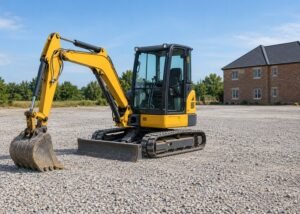
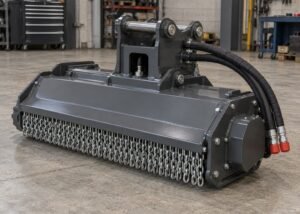
Ask for the actual mini excavator configuration proposed for delivery, including the attachment. Identify which dimensions and documents the responsible planner needs. Confirm the supplied arrangement before use. A model substitution should be reviewed rather than accepted solely because the machine is described as the same weight class.
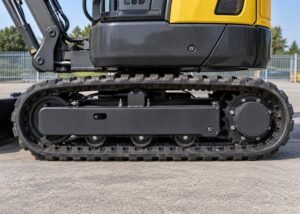
Keep other machine capabilities in their proper context. A side-shift boom changes how an excavator reaches some tasks, but it is not an electrical protective measure. Do not use a reach feature, rubber track description or cab enclosure as proof that work near a line is acceptable.
Likewise, the control-isolation lever addresses defined machine functions. It does not isolate an overhead electrical supply. Keep utility isolation, machine control isolation and maintenance precautions distinct in the briefing so that similar words do not create a false understanding of what has been made safe.
Review the arrangement when work moves, ground levels change or a different attachment is fitted. A loading area may become closer to the line, a stockpile may alter the route or a delivery vehicle may need a different turning position. Refer the changed condition to the responsible people before continuing the affected activity.
Record the change and the resulting decision. Update the plan, brief the participants and identify whether earlier restrictions still apply. Do not rely on a verbal message passed through several people if it leaves uncertainty about the approved route. The person operating the machine needs the current arrangement and a clear contact for questions.
If the required boundaries, supervision or communication cannot be maintained, stop the affected work and resolve the problem. A deadline or an almost-completed task does not establish an alternative control. Keep other people away from the affected area under the site’s arrangements while the responsible team decides what happens next.
The site plan should identify how an electrical incident is reported, how the utility and emergency services are contacted and how people are kept away from danger. Brief the relevant people before work starts. This article does not provide a contact-response or evacuation sequence; use the utility’s and site’s appropriate emergency instructions.
Do not send an untrained person toward a machine, cable or injured person where electrical danger may remain. Emergency planning belongs alongside prevention and needs competent input. Keep contact information available to the crew rather than only in an office that may be locked when the equipment is working.
At a shift or operator change, identify the current route, working positions, restrictions and unresolved questions. Confirm that the incoming operator understands which activity has been approved and what would require another review. A machine handover alone does not transfer the utility’s authorization or establish that site controls are in place.
Keep the records useful after the job too. Preserve the equipment configuration, utility correspondence and relevant plan revisions with the project documents. They show what the decision covered. They should not be reused automatically for another job, because line conditions, equipment and work can be different.
No. Assess the complete equipment and activity, including delivery and raised attachments. Compact size does not remove the hazard.
Do not make that assumption. Obtain the relevant line information through the owner and authorized planning process.
No. Any observer is part of a properly established arrangement and cannot replace the required prevention measures or utility input.
Refer the change to the responsible people and obtain the necessary review before using the changed arrangement.