Telephone/WhatsApp:+86 156 2656 0610
Telephone/WhatsApp:+86 156 2656 0610
Email:info@seekmach.com

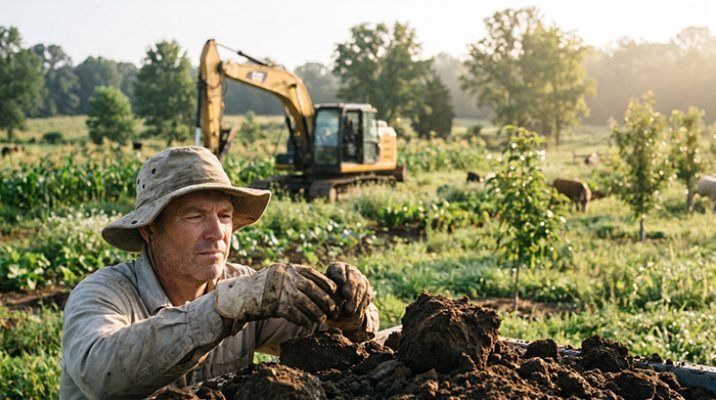
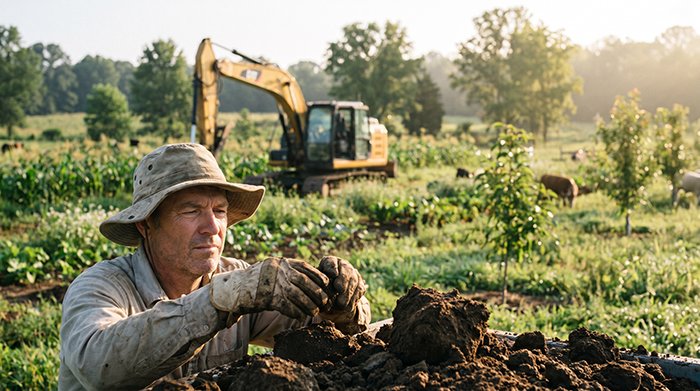
Tractors built modern agriculture — but they’re no longer enough. As regenerative farming demands greater precision, flexibility, and land-reshaping capability, a growing number of progressive farmers are discovering that the excavator deserves a permanent place in their equipment lineup.
Оглавление
ПереключатьThe traditional “tractor-only” mindset carries a real cost. Heavy tractors make repeated passes across the same ground, accelerating compaction mitigation challenges that directly undermine the healthy microbial networks regenerative systems depend on. Compacted soil reduces water infiltration, limits root development, and ultimately cuts into yield potential — problems a standard tractor attachment simply cannot reverse.
“The versatility of the mini-excavator has transformed it from a construction tool into a ‘Swiss Army Knife’ for modern regenerative agriculture.” — Permaculture Research Institute
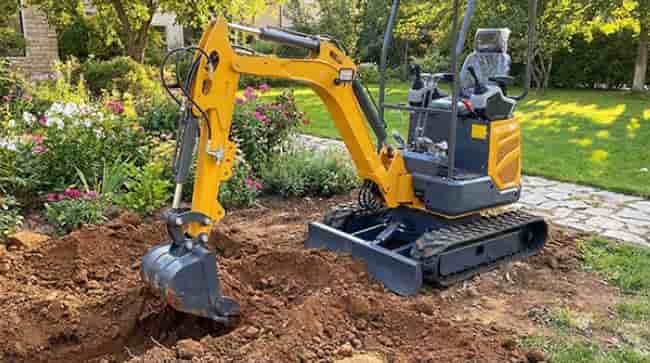
That framing is exactly right. Unlike a tractor, a modern compact excavator offers 360-degree cab rotation, which fundamentally changes how efficiently one operator can reshape terrain, clear obstacles, and reposition without relocating the entire machine. Tasks that once required multiple equipment setups now get handled in a single pass from a fixed position.
According to McKinsey, regenerative practices have measurable balance sheet upside — but capturing that value requires precision earthmoving tools, not just better seeds or cover crops.
The excavator delivers that precision. And nowhere is that clearer than in how farmers are now managing the most critical resource on any property: water.
Water is the single greatest variable a farmer can’t fully control — but smart infrastructure changes that equation. Among the most impactful excavator applications in agriculture, precision water management stands out as a direct path to yield protection. Whether a farm is fighting drought stress or waterlogged root zones, the excavator is doing work no tractor-mounted implement can match.
Building swales, installing drainage, and maintaining ditches aren’t just infrastructure tasks — they’re yield decisions.
Swales and drainage systems solve opposite problems, yet both rely on the same precision digging capability. In arid and semi-arid climates, contour swales slow water runoff and force infiltration into the soil profile, recharging moisture reserves that crops draw from weeks after a rain event. An excavator cuts these on-contour channels with accuracy that hand digging or blade grading simply can’t replicate.
In water-logged fields, the solution runs in the other direction. Installing sub-surface piping — perforated drain tile placed at precise depths — requires clean trench walls, consistent grade, and careful backfill. According to the Extension Foundation (National Ag-Safety Database), utilizing a mini-excavator for farm drainage management can improve crop yields by up to 25% in waterlogged fields. That’s not a marginal gain — that’s the difference between a profitable season and a loss.
| Фактор | Traditional Ditching | Excavator Precision |
|---|---|---|
| Grade consistency | Variable, operator-dependent | Controlled bucket depth |
| Trench wall integrity | Often crumbles | Clean cuts, minimal disturbance |
| Sub-surface pipe placement | Difficult to achieve correct depth | Bucket laser/grade-ready |
| Maintenance access | Requires full equipment repositioning | Long-reach boom maneuverability |
| Time per 100 ft | 3–5 hours | 45–90 minutes |
Drainage work also improves aeration in ways that compound over time. Clean trench edges and minimal surrounding disturbance mean the soil structure adjacent to drainage channels stays intact — preserving the pore space that roots and soil microbes depend on. This is a meaningful distinction from aggressive mechanical tillage approaches.
Maintaining existing drainage ditches for root rot prevention follows the same logic. Sediment accumulation is cleared selectively, without the broad surface disturbance a tractor pass would create. For farms working on sloped terrain, keeping the machine stable during precision work is just as critical as the digging itself.
All of this precision, however, raises an important question: what happens to the soil underneath the equipment doing the work? That’s where the conversation about compaction — and how excavators handle it differently — becomes essential.
Healthy soil isn’t just dirt — it’s a living system that compaction can destroy in a single season. For regenerative agriculture equipment to deliver real results, protecting that underground ecosystem is non-negotiable. This is where the excavator’s unique mechanical design quietly outperforms the traditional tractor in ways that matter most.
A tractor must physically drive over ground to do its work. An excavator doesn’t. Long-reach booms — extending 15 to 20 feet in many compact models — allow operators to work entire planting beds from a fixed position at the edge. According to Farmers Weekly, the 360-degree swing radius allows for precise work in confined spaces without repositioning the entire machine, directly preserving the soil structure beneath active growing zones.
Benefits of reach-based operation:
Full cab rotation is more than a convenience feature — it’s a soil health strategy. By spinning in place rather than turning and reversing, an excavator covers far more ground per stationary position. What typically happens is that a single well-placed machine can service a 30-foot radius without leaving the spot, dramatically shrinking its overall footprint.
Rotational advantages include:
Rubber or steel low-pressure tracks distribute machine weight across a wider surface area than pneumatic tires, reducing psi at soil level. Modern agricultural science consistently links reduced compaction to improved water infiltration and root penetration — both critical metrics in regenerative systems.
Low ground pressure track benefits:
When you pair this footprint advantage with the hydraulic versatility that modern compact excavators offer, the case becomes even stronger. Compaction-free operation isn’t just possible — it’s engineered in. That same precision extends naturally to the more delicate work of silvopasture and orchard management, where protecting existing root systems and tree infrastructure becomes the next critical challenge.
Where swale construction and compaction mitigation demand raw power, silvopasture and orchard work require something more nuanced — controlled, precise movement in environments where one wrong cut can kill a century-old oak or damage a root system that took decades to establish. This is where the excavator truly separates itself from conventional farm equipment.
Selective clearing is the cornerstone of any integrated livestock-forestry system. According to the Forage and Grassland Foundation, thumb-equipped excavators are essential for silvopasture, allowing farmers to selectively clear invasive brush while leaving high-value timber standing. A standard brush hog can’t make that distinction — it levels everything in its path. A skilled operator with a hydraulic thumb can pluck invasive species from between established hardwoods with almost surgical accuracy. Paired with rotary mowing attachments, that same machine handles follow-up vegetation management across pasture lanes without additional equipment on-site.
“The excavator doesn’t just move material — in silvopasture, it thinks about what stays.”
The same precision applies to high-density orchard planting. Auger attachments mounted on an excavator allow farmers to drill consistent, accurate holes even through clay-heavy or compacted subsoil — a task that defeats walk-behind augers on most terrains. And farm drainage management often intersects with orchard work: proper drainage channels installed during planting reduce root rot risk and extend orchard productivity by years.
Fence post installation in rocky terrain is another area where excavators shine. Hydraulic breaker attachments fracture subsurface rock before posts are set, eliminating the guesswork and backbreaking labor of manual driving.
Specialized attachments driving value in this work:
Minimizing root damage during infrastructure upgrades — whether laying water lines or installing drainage tile — is where excavator precision pays real dividends. The ability to work in tight arcs and stop on a dime preserves root zones that a tracked skid steer would otherwise compromise entirely.
These hyper-specific applications illustrate something broader: farm machinery is evolving from blunt instruments into precision tools. That evolution isn’t limited to individual operations — as we’ll explore next, it’s reshaping agricultural infrastructure and rural economies on a genuinely global scale.
The regenerative agriculture movement doesn’t exist in a vacuum. As we’ve seen with compaction mitigation and tools for silvopasture management, the equipment choices farms make ripple outward — affecting economies, supply chains, and even international development policy.
The World Bank has documented extensively how agricultural mechanization serves as a foundational pillar of rural economic reform. Infrastructure investment — drainage systems, access roads, land grading — consistently precedes measurable gains in collective farm productivity and rural household income. Heavy machinery isn’t just a convenience; it’s a catalyst for structural change.
Mechanization and collective economic strength go hand in hand. When rural communities gain access to capable, multi-purpose equipment like excavators, they can undertake landscape-scale improvements that individual hand tools or aging tractors simply can’t accomplish. Water retention earthworks, contour terracing, and habitat corridors all require precision and power delivered together.
The push toward green innovation is reshaping this equation further. Agricultural machinery manufacturers are under growing pressure to reduce carbon footprints — and excavators built for farm use are increasingly designed with emissions-reduction benchmarks in mind. This aligns directly with broader carbon neutrality goals gaining traction across global agricultural policy frameworks.
Internationally, infrastructure-led agricultural development — the kind emphasized in cooperative economic initiatives across developing regions — demonstrates how coordinated mechanization lifts entire farming communities, not just individual operations. Shared access to capable excavators with versatile material-handling capabilities enables land improvements that compound over seasons.
These macro-level trends reinforce what regenerative farmers already know on the ground. The right machine, properly deployed, is a long-term investment in land resilience. The next section puts that principle into vivid practice — showing exactly what modern excavators look like in real farm environments.
[Video Embed: Multi-Functional Attachments for Farm Excavators]
Watch for three key moments in the footage above: how quickly operators swap between auger, thumb, and bucket attachments without leaving the cab; the precision achievable with a mini excavator applications in orchards where root zones demand careful navigation; and how attachment versatility translates directly into fewer machines on the property.
The right attachment lineup is what separates a capable regenerative farm tool from an underperforming one. Multi-functional attachments — ripper teeth, hydraulic thumbs, screening buckets — each solve a distinct land-management problem. As How Modern Innovations Support Regenerative Agriculture notes, equipment adaptability is increasingly central to how farmers manage complexity with fewer resources.
The most versatile machine on a regenerative farm isn’t the one with the most horsepower — it’s the one that never stops working.
Still have questions about which setup fits your operation? The FAQ section ahead addresses the most common decisions farmers face.
Can a mini-excavator replace a tractor on a small farm?
Not entirely — but it can handle a surprising number of tasks a tractor can’t. Mini-excavators excel at precision earthmoving, drainage work, and stump removal, while tractors remain better suited for tillage and large-scale hauling. In practice, many regenerative farms run both, using the excavator for soil restoration projects and the tractor for field management. If budget is limited, compact models built for tight spaces offer strong versatility at a lower entry cost.
What are the best attachments for compaction mitigation?
The ripper tooth and subsoiler attachment are the go-to tools for breaking up hardpan layers without inverting topsoil. A tilting bucket also helps operators reshape compacted swales with greater precision. According to The Science and Tools Behind Regenerative Agriculture, targeted mechanical intervention combined with cover cropping produces the most durable compaction relief.
How does an excavator help with drought-proofing?
Excavators are the primary tool for installing water harvesting infrastructure — swales, detention basins, and keyline channels that slow water movement and maximize infiltration. A well-placed swale system can dramatically reduce runoff and recharge groundwater between rain events.
Are excavators cost-effective for seasonal farm work?
They can be, particularly when rental options are factored in. Owning a unit becomes cost-effective once annual utilization exceeds roughly 200–300 hours. For smaller operations, seasonal rental or contractor hire offers access to the machine’s capabilities without the capital commitment. The right equipment decision ultimately hinges on your land’s specific restoration goals — not just the price tag.
SeekMach is a professional manufacturer and exporter dedicated to the R&D and production of excavators, loaders and tractors. We guarantee to provide you with the best quality service.