Telephone/WhatsApp:+86 156 2656 0610

Telephone/WhatsApp:+86 156 2656 0610
Email:info@seekmach.com

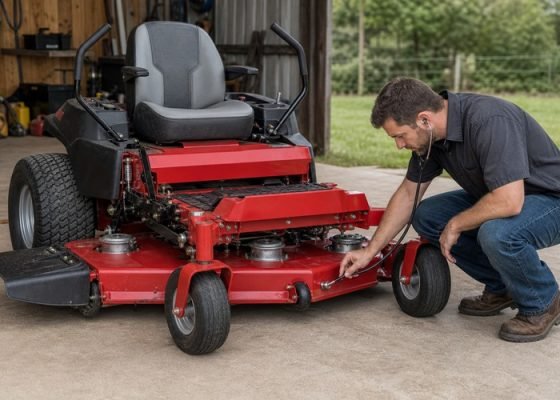
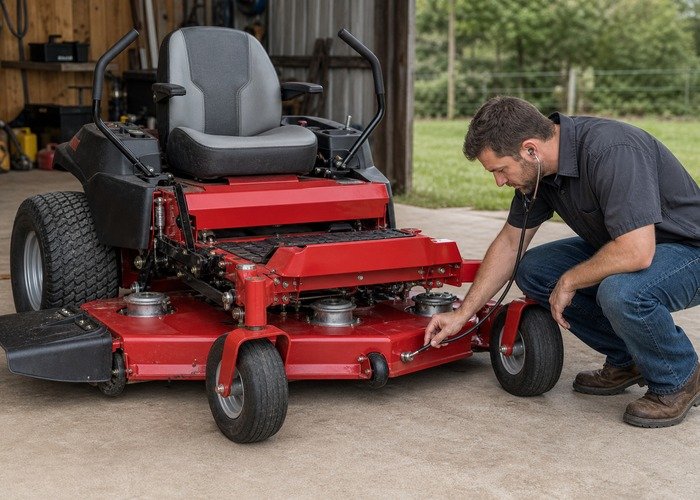
A zero-turn mower spindle bearing can announce trouble with a roar, growl, squeal, vibration, uneven cut, hot pulley, or blade wobble—but the spindle is not the only rotating part under the deck cover. A damaged blade, packed grass, slipping belt, rough idler, loose pulley, cracked deck, or engine clutch can sound similar. Diagnose the source with the engine disabled and stored motion controlled before buying parts.
Park on a firm level surface, disengage the blades, set the brake, lower the deck, stop the engine, remove the key, and follow the manual’s spark-plug or battery isolation procedure. Wait for every part to stop. Never reach beneath a deck, remove a guard, or touch a belt with the engine able to start. Use the manufacturer’s approved lifting and support points if access is required.
This guide moves from sound and vibration observations to belt-off hand tests, spindle-play measurement, deck-mount inspection, and replacement verification. Use it with the zero-turn mower maintenance schedule so the repair fits the machine’s hours and service history.
Note whether the noise occurs at engine idle with blades disengaged, only when the clutch engages, only under grass load, or during turns and travel. A spindle-related sound normally follows blade speed rather than ground speed. A deck that becomes louder in tall or wet grass may be overloaded, packed, or using dull blades even if the bearings are still serviceable.
Observe vibration from the seat without continuing to mow. Stop immediately if the deck shakes, a blade strikes, the belt jumps, a pulley wobbles, or debris is thrown abnormally. A sudden vibration after hitting a stump, rock, wire, or curb can bend a blade or spindle shaft and crack the deck around the mount.
Record which side seems loud, but do not trust hearing alone. Deck shells transmit sound. Use a mechanic’s stethoscope only on stationary guarded areas during a controlled professional test; never place hands or tools near exposed rotating parts.
With the mower fully isolated, inspect beneath the deck using the approved access method. Remove packed grass, string, wire, and debris. Check each blade for bends, cracks, missing material, incorrect installation, and impact marks. Replace damaged blades in matched sets or as directed; do not weld or straighten a cracked blade.
Verify blade bolt torque and adapter condition from the manual. A loose blade can mimic bearing play. Compare blade tip height through rotation only after safe isolation. If one blade changes height relative to a fixed deck reference, the blade, adapter, spindle shaft, or deck mount may be bent.
Uneven cut may also come from tire pressure and deck setup. Confirm those variables with the zero-turn tire-pressure guide e mower deck-leveling guide before replacing a straight, quiet spindle.
Photograph belt routing before removal. Release tension exactly as the manual specifies; springs store energy. Inspect belt glazing, cracks, cord damage, missing chunks, oil contamination, incorrect section, and signs that it rides against a guard. Check tensioner travel and spring anchors.
Spin each spindle pulley and idler slowly by hand. Compare noise, drag, roughness, and coast. A healthy sealed bearing should feel smooth; a greaseable design should follow its lubrication schedule. A rough idler can project sound through the deck and be mistaken for a spindle.
Check pulley runout, loose retaining hardware, damaged keys or splines, and polished contact marks. The manufacturer support note on mower vibration emphasizes damaged or incorrectly installed blade assemblies and loose parts as basic checks.
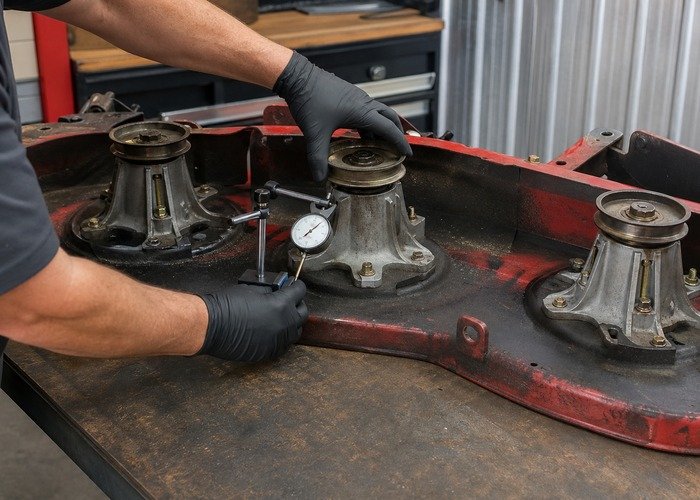
With blade and belt removed where required, grasp the pulley or shaft and check radial and axial movement. Some assemblies have a defined internal clearance, but visible knocking or wobble is not acceptable without comparison to the service limit. Rotate through a full turn because damage can create a rough spot rather than constant drag.
A dial indicator makes the result repeatable. Mount the base rigidly to the deck, place the tip at the specified shaft or pulley location, zero it, and apply gentle alternating force. Repeat three times. If the base moves or the deck flexes, the number is invalid.
Inspect the spindle housing and deck plate for cracks, elongated holes, fretting, missing reinforcement, and distorted metal. A new bearing in a loose or bent mount will not run true. Compare pulley height and alignment across all spindles with a straightedge only when the manual permits.
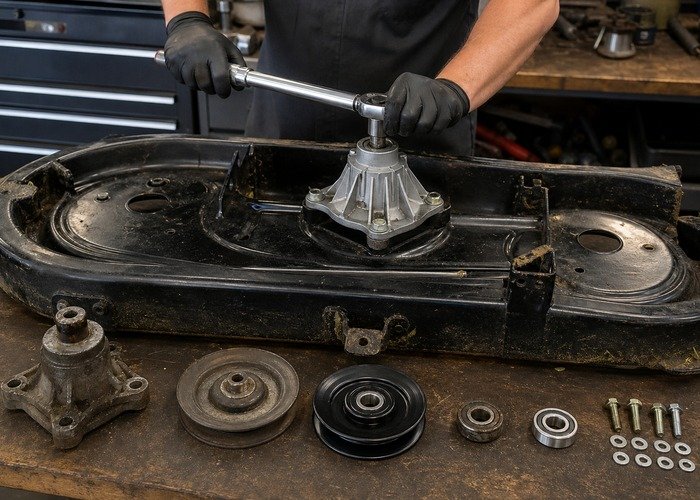
Some spindle housings accept individual bearings and seals; others are serviced as assemblies. The correct decision depends on housing bore condition, shaft wear, pulley fit, deck damage, parts availability, labor, and required press tools. Do not hammer a bearing through a casting or press through the rolling elements.
When replacing bearings, support the correct race, control depth and orientation, and install seals without cutting the lip. When replacing the assembly, verify shaft length, blade mount, bolt pattern, pulley offset, grease fitting, rotation, and hardware grade by model and serial number.
A bearing that failed soon after replacement may have been damaged during pressing, run with incorrect belt tension, received incompatible grease, operated with a bent blade, or sat in a distorted deck. Finding that cause protects the new part.
The following manufacturer video demonstrates lubrication points on a zero-turn mower, including deck spindle maintenance. Use the frequency, grease, quantity, and access method specified for your own mower; sealed spindles may not have grease fittings.
Grease is not a cure for a rough, loose, overheated, or damaged bearing. Pumping excessive grease can displace seals or attract debris. Clean the fitting before connection and stop at the manual’s stated amount.
Rotate the spindle by hand after service while isolated. Smooth movement, correct pulley alignment, and proper belt routing must be confirmed before guards are installed. Account for every tool and fastener.
After reassembly, make the first powered test outdoors in a clear area with all guards fitted and nobody near the discharge zone. Engage at the specified engine speed, listen briefly, disengage, stop, isolate, and inspect again.
| Finding | Likely source | Next check |
|---|---|---|
| Noise with blades disengaged | Engine, clutch bearing, hydrostatic drive | Do not begin with deck spindle replacement |
| Rough pulley with belt removed | Spindle or idler bearing | Compare all pulleys and measure play |
| Blade-tip height changes in rotation | Bent blade, adapter, shaft, or deck | Remove blade and inspect each component |
| Hot pulley, belt dust, squeal | Bearing drag, misalignment, wrong tension | Check runout, belt path, idlers, and housing |
| New spindle loosens quickly | Cracked or elongated deck mount | Inspect and repair deck structure correctly |
| Noise follows travel, not blade speed | Wheel, tire, hydrostatic drive | Use the drive-system diagnostic |
Maintain correct tire pressure, deck pitch, blade balance, belt condition, and cleaning intervals. Avoid striking fixed objects and mowing with heavy packed debris beneath the deck. Use the zero-turn hydrostatic drive diagnostic when noise or heat follows ground speed rather than blade engagement.
Keep a record of hours, blade impacts, grease service, belt replacement, spindle temperature, measured play, and installed parts. A short post-repair check after the first mowing session can catch settling hardware, belt misrouting, or deck contact before further damage.
o U.S. CPSC riding-mower safety guidance reinforces shut-down, thrown-object, slope, child, and blade hazards. Landscaping crews should also use the OSHA landscaping safety resources. For emissions-system context and fuel handling, consult the U.S. EPA small-equipment resource.
Owners of riding mowers can use the riding mower tire-pressure guide for the same cut-quality baseline. A university lawn-mowing practice guide helps match mowing frequency and height to turf health so the deck is not unnecessarily overloaded.
Record mower hours, deck width, blade type, belt part number, recent impact, mowing height, grass condition, and when the noise begins. Note whether it changes with engine speed, blade engagement, deck height, grass load, or travel. A short phone recording from a safe fixed position can help compare before and after, but never place a device near the discharge path or exposed rotation.
After isolation, photograph the belt route, pulley alignment, blade condition, spindle mounts, deck cracks, and debris pattern. Mark each pulley position so hand-spin findings are not confused. Record roughness, drag, play, and dial-indicator setup separately for left, center, and right spindles.
Following repair, repeat the same no-load engagement and a short mowing strip at the same height. Check cut consistency, belt tracking, pulley temperature after shutdown, unusual odor, fastener witness marks, and deck contact. Reinspect after the first full work session because new hardware and belts may settle.
Excessive belt tension loads spindle and idler bearings continuously. A belt that is too loose can slip, heat, and whip. Use the correct belt and tension mechanism rather than altering spring length. Pulley offset must match the original geometry; a part that bolts on can still misalign the belt.
Impact tools can over-tighten blade or pulley hardware and damage threads, keys, washers, or bearings. Use the holding method and torque specified by the manufacturer. Do not grip a blade with an unprotected hand or wedge it against a weak section of deck.
Washing a hot spindle with high-pressure water can drive contamination past seals and cool components unevenly. Let the deck cool, remove debris with the approved method, protect bearing seals and electrical clutch components, and allow the machine to dry before storage.
Finally, replacing only the loud bearing without correcting a bent blade, cracked mount, unbalanced assembly, or seized idler invites repeat failure. The entire load path—blade, adapter, shaft, bearings, housing, deck, pulley, belt, idlers, clutch, and guards—must run true together.
Storage conditions matter too. Park the mower clean and dry, prevent standing water from remaining on the deck, and do not leave wet grass packed around spindle housings. During seasonal storage, follow the manual for belt tension, battery isolation, fuel, lubrication, corrosion protection, and deck position. At the next startup, inspect by hand while isolated before engaging blades. A quiet cold test does not excuse a hot bearing, so complete a short controlled mowing check and compare spindle-area temperatures only after shutdown. Record any change in noise, vibration, belt dust, grease leakage, blade-tip height, or pulley runout before the next long workday.
No. A bearing can seize, damage the belt and deck, or allow dangerous blade movement. Stop, isolate, and diagnose the source.
Only a serviceable dry bearing may improve. Grease cannot restore pitted races, a bent shaft, loose fit, cracked housing, or damaged deck.
With the belt safely removed, spin and compare each pulley. Use feel, sound, play measurement, heat evidence, and the manual rather than location alone.
Replace only verified defective parts unless the manufacturer or condition supports a set. Inspect all spindles, blades, idlers, and the belt while access is open.
Common directions include pressing damage, wrong belt tension, a bent blade or deck, loose mount, misaligned pulley, wrong part, contamination, or lubrication error.