Telephone/WhatsApp:+86 156 2656 0610

Telephone/WhatsApp:+86 156 2656 0610
Email:seekmach@gmail.com

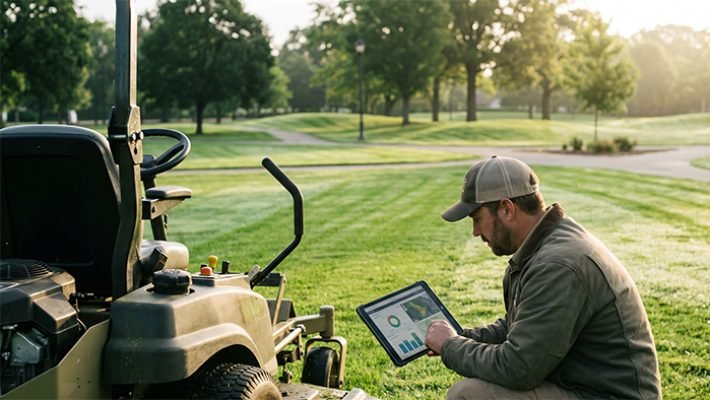

Municipal landscaping budgets are bleeding out quietly — not through dramatic failures, but through the slow, compounding drain of outdated workflows. Fuel costs have surged. Labor markets have tightened. And the machinery that once defined “good enough” is now actively working against the bottom line.
According to the U.S. Environmental Protection Agency, fuel-efficient mower engines can reduce operational costs by up to 30% compared to older, non-optimized models — a gap that translates to tens of thousands of dollars annually for large municipal fleets.

Yet most operations are still running equipment that treats fuel efficiency as a secondary concern and operator productivity as a fixed variable. That mismatch is the core of today’s efficiency crisis.
The problem isn’t just aging hardware. It’s the absence of intelligence around that hardware. A zero-turn mower with no route optimization, no utilization tracking, and no integration with lhttps://seekmach.com/product/lawn-mower-sm500fawn care business software is essentially a liability dressed as a capital investment. It works in isolation — burning fuel, requiring constant oversight, and generating zero operational data.
What’s emerging in response is a concept that’s reshaping how industrial operators evaluate their equipment: the application solution. Rather than viewing a mower as a standalone machine, forward-thinking fleet managers are treating it as one component in a connected system — where commercial-grade mowing platforms pair with scheduling software, fuel monitoring tools, and remote diagnostics to deliver measurable, trackable ROI.
The most resilient landscaping operations in 2025 won’t be defined by the power of their blades — they’ll be defined by the intelligence surrounding them.
This shift from brute force to precision-driven performance is nowhere more visible than in how GPS and autonomous navigation are eliminating the costly inefficiencies that even skilled operators can’t fully avoid.
The problem outlined earlier — compounding inefficiency from outdated workflows — has a direct technical answer. Modern GPS-integrated lawn care app platforms are eliminating the guesswork from large-scale mowing operations, replacing reactive management with data-driven precision.
According to the Association of Equipment Manufacturers (AEM), integrating GPS and autonomous navigation into commercial mowers measurably increases field efficiency by reducing overlap and skipped patches — two of the most persistent sources of wasted labor hours in municipal operations.
Zone pre-mapping transforms how crews approach a property. Rather than relying on operator memory or paper diagrams, supervisors define mowing boundaries digitally — accounting for obstacles, restricted areas, and terrain variations.
Once a zone is mapped, the operational shift is significant. Autonomous navigation systems follow pre-set paths with minimal deviation, eliminating the diagonal drift and inconsistent overlap patterns common with manual steering.
In practice, this means a single operator can monitor multiple machines simultaneously rather than guiding each one. For large municipal campuses — parks, highway medians, public grounds — that represents a fundamental change in labor allocation. Pairing this technology with purpose-built mowing attachment systems further extends what each machine can accomplish per shift.
The real value of GPS integration isn’t just in the machine — it’s in the visibility it gives decision-makers. Fleet managers can track progress across every active site simultaneously, identifying bottlenecks before they become delays.
That operational visibility — knowing exactly what’s done, what isn’t, and why — sets the foundation for something even more compelling: making a single machine do far more than cut grass.
GPS navigation and autonomous routing solve the where problem. But here’s a question worth asking: what happens when a high-powered commercial mower sits idle between mowing cycles? For operations managing large industrial or municipal sites, that dormant machine represents real money left on the table.
The answer lies in rethinking what a heavy-duty mower actually is — not a single-purpose tool, but a versatile power platform built to earn its keep across multiple applications.
As Landscape Management Magazine notes, “the shift toward multi-functional equipment platforms allows contractors to maximize their ROI by using a single power unit for mowing, clearing, and light grading.” That’s the core insight driving some of the most practical innovations in commercial grounds management right now.
Here are five innovative applications that go well beyond cutting grass:
Pairing this versatility with a reliable lawn mower app that tracks attachment usage and scheduling keeps the entire system organized. You can explore how multi-attachment mowing platforms are configured for industrial use to understand just how modular these setups have become.
The most productive commercial mowing operations in 2025 aren’t buying more machines — they’re extracting more value from the ones they already own.
That operational mindset leads directly to the next frontier: the software layer that ties scheduling, maintenance prediction, and procurement decisions together into a single, data-driven workflow.
GPS routing and multi-functional attachments solve critical field-level problems. But without a lawn care management software layer tying operations together, even the most advanced autonomous mower is flying partially blind. The physical machine and the digital platform need to work as one system — and in 2025, that integration is becoming a genuine ROI differentiator.
| Software Feature | Operational Impact | ROI Benefit |
|---|---|---|
| Scheduling & dispatching | Coordinates multiple crews across large construction sites simultaneously | Reduces idle time and fuel waste by optimizing route sequencing |
| Alertas de manutenção preditiva | Monitors engine hours, temperature, and vibration data to flag failure risks early | Prevents costly mid-season breakdowns and unplanned downtime |
| Equipment usage logs | Tracks runtime, fuel consumption, and load cycles per machine | Builds a data-backed case for equipment upgrades or fleet expansion |
| Job costing reports | Ties labor and machine hours to specific contracts | Identifies low-margin accounts and reprices service agreements accurately |
Large-scale construction sites and commercial campuses present a dispatching challenge that spreadsheets simply can’t handle. Modern platforms allow operations managers to assign specific mower units — including brush mower-capable machines used for heavy land clearing — to defined zones with automated scheduling windows. The result is tighter crew coordination and measurable reductions in overlap and wasted movement across multi-acre properties.
Predictive maintenance is arguably where software delivers its most tangible value. Rather than relying on fixed service intervals, modern platforms analyze real-time operational data — engine load cycles, hydraulic pressure, hours since last service — and generate alerts before a failure becomes a repair bill. In practice, a single avoided engine replacement can recoup months of software subscription costs. The commercial lawn mower market is projected to grow at a CAGR of 5.6%, and as fleet sizes scale, proactive maintenance tracking becomes non-negotiable infrastructure.
Software logs also quietly solve a procurement problem: justifying capital expenditure. When usage data shows that a specific mower unit consistently operates at 95% capacity across peak months, the argument for adding another unit writes itself. Decision-makers stop relying on gut instinct and start presenting documented utilization rates to ownership. That shift — from intuition to evidence — is what separates growing operations from plateauing ones.
Entendimento what software can do is one layer of the equation. The next question worth examining is where that equipment comes from — and whether the sourcing model itself is quietly eroding the margins that smart software just helped you build.
The software layer handles scheduling and data. The attachments multiply output. But procurement decisions ultimately hinge on one question that rarely appears in product brochures: how much of your budget disappears before the equipment even ships?
| Traditional Dealer Model | Seekmach Direct Model |
|---|---|
| Regional distributor markup (15–30%) | Factory-direct pricing, no intermediary |
| Standardized inventory; limited customization | OEM/ODM options tailored to your terrain |
| Delayed lead times through distribution chains | Integrated production shipped to 50+ countries |
| Certification documentation varies by reseller | CE and ISO certifications verified at source |
| Generic landscaping scheduling software bundles | Coordination built around your workflow |
In practice, dealer networks add cost without adding value for high-volume B2B buyers. Every tier between the factory floor and your fleet represents a markup, a communication gap, and a potential delay.
Factory-direct procurement eliminates the markup chain while preserving—and often improving—access to certified, customizable industrial equipment built for professional-grade demands.
CE and ISO certifications aren’t paperwork formalities—they’re operational insurance. For procurement officers managing liability, regulatory compliance, and operator safety across multiple sites, certified equipment is non-negotiable. Seekmach Industrial Co., Ltd. maintains rigorous quality certifications across its production line, ensuring standards aren’t diluted through reseller channels.
Flat commercial properties and steep rural slopes don’t share the same equipment requirements. OEM/ODM customization—whether adjusting cutting deck configurations, modifying attachment mounting systems, or adapting chassis geometry—allows procurement teams to specify solutions matched to actual site conditions. That specificity is where long-term ROI gets locked in.
The real-world application questions that follow are worth exploring in detail—and the expert insights ahead address exactly that.
[VIDEO PLACEHOLDER: "Modern Mowing Technology in Action" — Embed YouTube video showcasing industrial mower attachments, GPS routing integration, and factory-direct procurement workflows in real commercial settings.]
The strategies covered throughout this article — from multi-functional attachments and GPS route optimization to management software integration and factory-direct sourcing — converge on a single conclusion: industrial lawn mower application solutions are no longer a support function. They’re a primary driver of fleet profitability in 2025.
Backed by over 15 years of heavy machinery manufacturing expertise and a 50,000 m² production facility, SeekMach demonstrates what’s possible when engineering depth meets direct-to-buyer pricing. The real ROI frontier isn’t found in one upgrade — it’s the compounding effect of smarter equipment, tighter software, and procurement that cuts waste at the source.
How do I integrate my current fleet with new management software?
Most modern platforms use telematics APIs that connect to existing GPS units or OBD ports. Start with a pilot on two to three machines, validate data accuracy, then scale. In practice, full integration typically takes two to four weeks depending on fleet size.
What are the maintenance requirements for CE-certified industrial mowers?
CE certification signals compliance with European safety and performance standards. Routine maintenance still applies: blade inspections every 40–50 operating hours, hydraulic fluid checks monthly, and track tension verification before any uneven-terrain deployment. Always follow the manufacturer’s documented service intervals.
Can I customize mower attachments for specific agricultural needs?
Yes. Factory-direct manufacturers commonly offer configurable cutting widths, tilt angles, and mulching versus side-discharge options. Communicate your terrain profile and crop clearance requirements upfront — customization is far more accessible when there’s no distributor filtering your request.
Operators who treat procurement, technology, and attachment strategy as one integrated decision consistently outperform those managing each in isolation. That’s the 2025 ROI frontier — and it’s yours to capture.