Telephone/WhatsApp:+86 156 2656 0610
Telephone/WhatsApp:+86 156 2656 0610
Email:info@seekmach.com

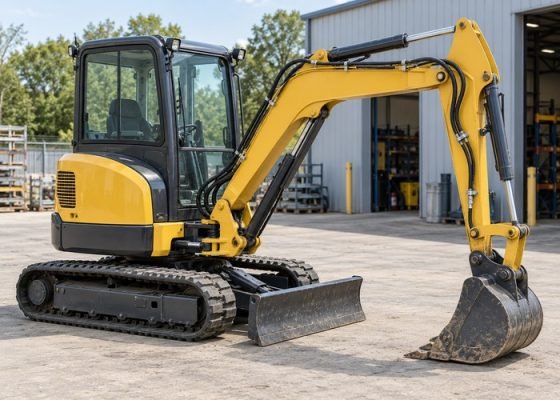
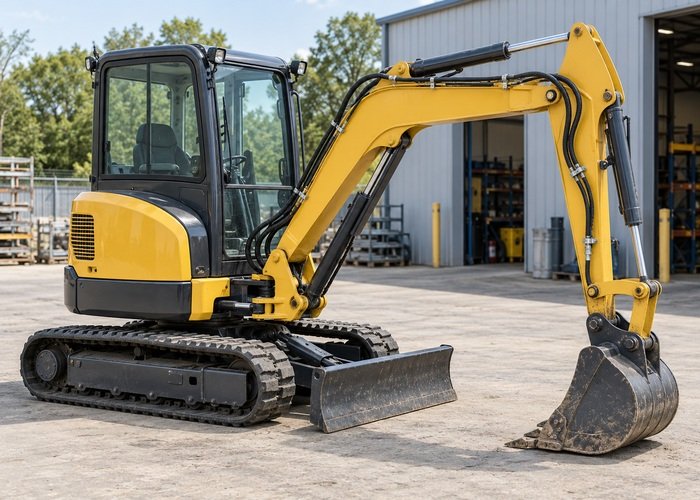
If a mini excavator hydraulic hose shows damage, leakage, bulging, exposed reinforcement or a compromised fitting, stop using the affected machine and arrange qualified assessment. If you notice contact that has not yet visibly damaged the hose, record the location and ask a technician to check routing and clearance. Do not hide an uncertain defect with a sleeve or tape and continue working.
A hose inspection is a condition and routing decision, not a repair procedure. The exact machine manual, hose manufacturer’s requirements and your site’s isolation rules control maintenance. This guide helps an owner describe the problem accurately, distinguish recurring abrasion from unrelated hydraulic symptoms and prepare a useful replacement request.
Park in the designated safe area, lower the attachment and follow the machine’s shutdown, isolation and pressure-release instructions. The procedure depends on the circuit, attachment and stored-energy sources. A stopped engine does not prove that every hydraulic line is depressurised. Avoid loosening a fitting to discover whether pressure remains.
Keep hands and other body parts away from suspected leaks. HSE’s hydraulic injection safety alert explains that pressurised fluid can penetrate skin and that suspected injection requires urgent professional medical attention. A small visible wound can conceal serious injury. Tell emergency personnel that hydraulic injection may have occurred and identify the fluid if that information is available.
Do not perform improvised pressure testing or attempt to reproduce a leak with someone beside the hose. HSE guidance on pressure testing discusses stored-energy hazards and the need for controlled testing. That is specialist work. The owner’s contribution is a clear symptom record and safe access for the qualified person.
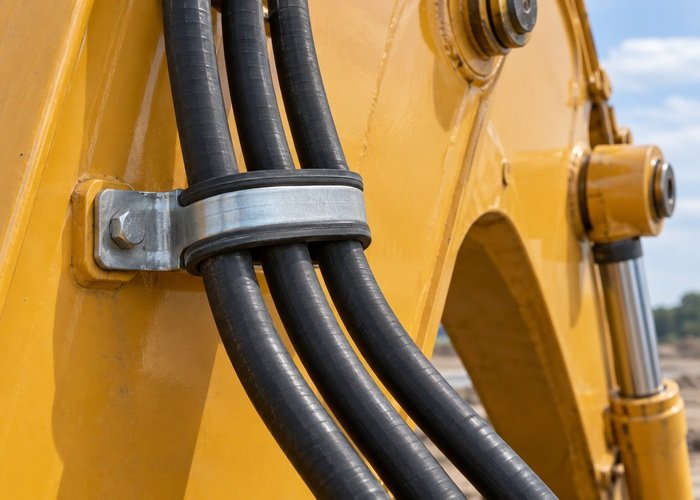
Describe what you can actually see from a safe position. A shiny contact patch, a cut, a cracked cover, a blister and a leaking connection are different observations. Photograph the wider route as well as the close view. Include the nearby bracket, clamp, panel or moving linkage that could explain repeated contact.
| Observation | Decision to raise | Useful information |
|---|---|---|
| Cover rubbing or flattened contact patch | Check whether the assembly is serviceable and why contact occurs | Location, surrounding parts and when rubbing was first noticed |
| Exposed reinforcement, deep cut or blister | Stop use and arrange qualified replacement assessment | Clear photographs and hose identification if legible |
| Leakage or fitting movement | Isolate and escalate; do not tighten by guesswork | Which connection, reported symptoms and recent work |
| Hardening, cracking or heat damage | Assess the assembly and local heat exposure | Nearby heat sources and maintenance history |
| Repeated damage in the same place | Review the route and installation, not only the hose | Previous assembly records and consistent photo angles |
These observations are escalation categories, not remaining-life estimates. The absence of an obvious leak does not establish that a damaged hose is safe. Conversely, a hydraulic complaint does not prove that abrasion caused it. Keep physical findings separate from reports of weak performance, unusual heat or slow movement.
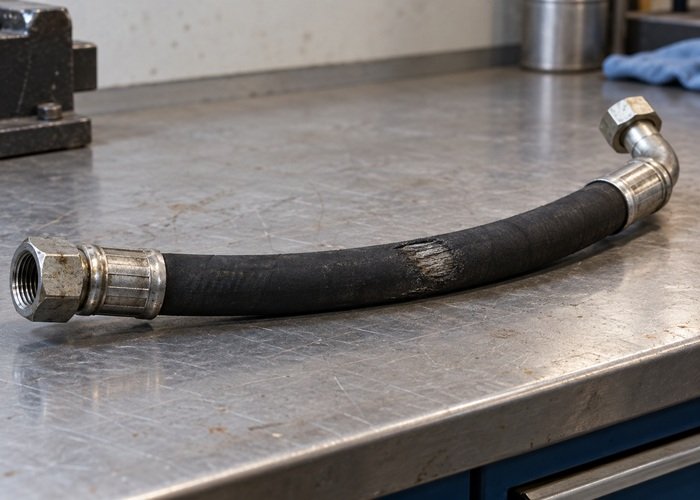
A close photograph of the worn cover rarely explains the entire problem. Record where the hose begins and ends, how it is supported and what surrounds the damaged point. A missing clamp, shifted bracket, replacement panel or previous attachment change may be relevant. Do not remove supports or protective covers simply to produce a better photograph.
Ask the technician to compare routing with the original configuration. Relevant questions include whether the hose can touch a sharp edge, whether it is trapped by a closing panel, whether a clamp allows unwanted movement and whether the route changes after an attachment is exchanged. An alteration made to solve one interference can create another elsewhere.
Movement-related clearance requires a controlled professional check. Nobody should stand in a pinch zone while the boom, arm or attachment is moved. The HSE excavator safety overview provides broader guidance on competent operation and keeping people clear of excavator movement. Use the exact machine procedure to organise any functional check.
Ask the hose supplier for the minimum bend radius and installation requirements of the proposed assembly. There is no universal bend radius for every mini excavator hose. Diameter, construction and product family matter. A replacement that is easy to connect can still be installed with an unsuitable bend or an unsupported section.
Record fitting orientation and the route before the old assembly is removed, once the technician has made access safe. A hose should not be installed by forcing it into position. The professional installer needs to consider movement, strain at fittings and whether the hose twists during operation. Length alone is not a complete specification.
Supports should maintain the intended routing without crushing the hose or obstructing necessary movement. Ask who will approve any bracket, clamp or sleeve change. An owner-added cable tie may appear to prevent rubbing while pulling the hose toward another hazard. Changes should be documented and checked by someone qualified for the system.
Begin with the carrier model, serial number and parts documentation. Where available, identify the original assembly part number and the relevant hydraulic circuit. Include the operating environment and the attachment arrangement if the affected hose serves auxiliary equipment. A photograph of the machine gives useful context but cannot substitute for identification.
A replacement request should address working pressure, fluid compatibility, temperature limits, size, fitting type, orientation and installation requirements. Let the qualified supplier establish the assembly using compatible components and its approved process. Do not assume that two fittings that appear to mate form a suitable or leak-free connection.
Keep burst-pressure figures separate from permissible working pressure. Avoid selecting a hose solely by its exterior appearance or by a seller’s claim that it is stronger. Request the relevant technical documentation and a record of the supplied assembly. The mini excavator spare parts ordering guide explains how serial numbers, photographs and parts references improve an enquiry.
Ask whether adjacent assemblies need inspection. A damaged hose may be the first visible sign of a wider routing problem, especially after previous repairs or attachment changes. Replacing only the obvious assembly can leave another line rubbing against the same bracket.
A correctly specified sleeve or guard may be part of an approved abrasion-control design. It does not restore damaged reinforcement, repair a leaking fitting or verify the condition of the hose beneath it. The technician should first establish whether replacement is required and why the contact occurred.
Ask how protected sections will be inspected later. If a cover prevents a clear view, the maintenance instructions should explain the appropriate inspection method. Record the protection type, location and any changed supports in the job report. Photograph the completed route from an angle that can be repeated during future inspections.
A successful repair addresses both the affected assembly and its surroundings. If the underlying route is unchanged, the new hose may rub in the same place. If the route is altered, check that the change has not introduced excessive bending, heat exposure or another contact point.
Write down the date, hour-meter reading, affected circuit and the circumstances in which the issue was noticed. Was rubbing found during a routine walkaround, after an attachment exchange or following another repair? Include the sequence. A technician can use that history to decide which checks are necessary.
Separate observations from interpretations. For example, “cover worn where the line meets the bracket” is more useful than “the hydraulic pump is failing.” If the operator also reported slow movement or a warning, record those facts in their own fields. Do not present them as proof that the worn hose caused the complaint.
Keep the removed assembly identification, new assembly specification, technician’s findings and authorised routing changes in the maintenance record. The mini excavator maintenance checklist can help place the repair within a broader inspection routine. It cannot determine a hose’s serviceability from a description.
The qualified technician should carry out the manufacturer’s required installation and functional checks in a controlled area. The job record should identify any restriction that remains, the approved configuration and who released the machine. An owner should not substitute an informal leak check for a specified commissioning process.
Arrange a follow-up inspection at the interval agreed by the service provider or manual. Use the same photo angle and location descriptions to assess whether contact has returned. Include hose condition in the daily inspection checklist, while keeping the actual schedule aligned with the machine’s instructions.
If the cause remains uncertain, keep that uncertainty visible. A machine released with an unresolved interference risk needs a clear professional decision, not a reassuring label in the owner’s log. A repeat incident should trigger review of the earlier diagnosis and repair rather than an automatic identical replacement.
Provide the machine model and serial number, the relevant parts page, wider routing photographs, close images of the isolated assembly and the recent maintenance history. Ask for the correct parts identification and the applicable procedure. Availability, compatibility and any service recommendation should be confirmed for the specific machine; this article does not promise that a generic hose is an approved replacement.
Tape does not establish the assembly’s safety or repair structural damage. Have the hose assessed and replace it where required. Do not conceal a defect to keep the machine operating.
First determine its condition and the cause of contact. A sleeve may be suitable in an approved design, but it is not a substitute for replacement or correct routing.
Length is only one requirement. The replacement must also match the circuit, fittings, orientation and installation limits. A qualified supplier should verify the complete assembly.
The underlying interference may remain. Compare routing, supports, adjacent components and movement with the prior repair record. Ask the technician to address the cause as well as the damaged assembly.