Telephone/WhatsApp:+86 156 2656 0610
Telephone/WhatsApp:+86 156 2656 0610
Email:info@seekmach.com

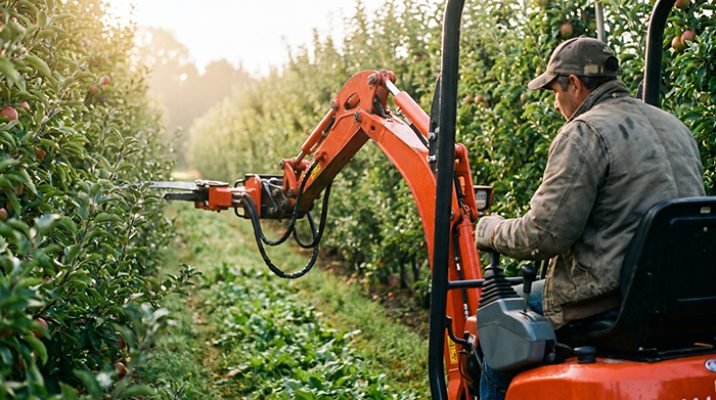
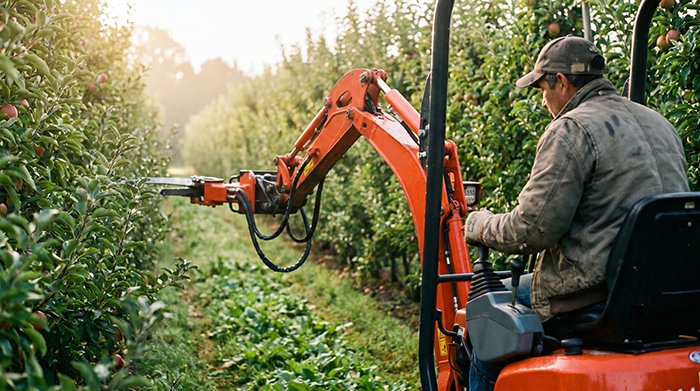
High-density orchards are rewriting the rulebook on farm equipment — and traditional tractors are struggling to keep up with what modern fruit production actually demands.
The gap between conventional machinery and today’s orchard reality is widening fast. As growers transition from low-tree-count, industrial-scale blocks to tightly planted, high-value systems — some orchards now running 1,500 to 3,000 trees per acre — the wide footprint and blunt functionality of a standard tractor becomes a genuine liability. Row widths shrink. Root zones crowd closer to the surface. The margin for error on every machine pass gets thinner.
Traditional tractors were engineered for open fields and broad-acre row crops. In a high-density apple or cherry block, that design heritage shows its limits quickly. Turning radius, chassis width, and the sheer weight of conventional equipment create real problems in confined inter-row spaces and on the slopes that many premium orchards occupy. Growers are increasingly discovering that a machine optimized for grain farming simply can’t serve the nuanced demands of intensive fruit production — and no attachment list changes that fundamental mismatch.
This is where agricultural excavators are entering the conversation in a serious way. Modern agriculture is moving toward what researchers describe as embodied intelligence — giving machinery the ability to sense, adapt, and act across complex environments. Equipment selection is no longer just about horsepower; it’s about matching machine geometry, ground pressure, and functional range to the specific biology and layout of a crop. The compact, articulated design of a purpose-built excavator, particularly zero tail swing configurations proven in tight urban worksites, translates directly into orchard-ready maneuverability.
Factory-direct sourcing is also making these purpose-built machines more accessible. Growers who once faced steep price premiums for advanced compact equipment now have viable procurement paths that don’t require going through multiple distributor markups. That accessibility shift is accelerating adoption — and it’s pushing the conversation toward a more fundamental question: what can the ground beneath your trees actually tolerate?
Soil compaction is one of the most damaging — and least visible — threats to long-term orchard productivity, and the equipment you drive between your rows is either part of the solution or part of the problem.
Ground pressure is the core metric that separates a tool that helps your orchard from one that silently destroys it. When heavy machinery rolls over soil, it collapses pore spaces — the microscopic air and water channels that roots depend on for oxygen uptake and nutrient absorption. A conventional tractor with pneumatic tires can exert 15 to 30 PSI on the soil surface. Rubber-tracked machines tell a very different story. Specialized rubber tracks distribute weight across a much larger footprint, reducing ground pressure to as low as 3.5 to 4.5 PSI, according to the Extension Foundation — a figure that keeps sensitive root zones structurally intact.
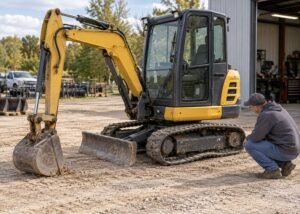
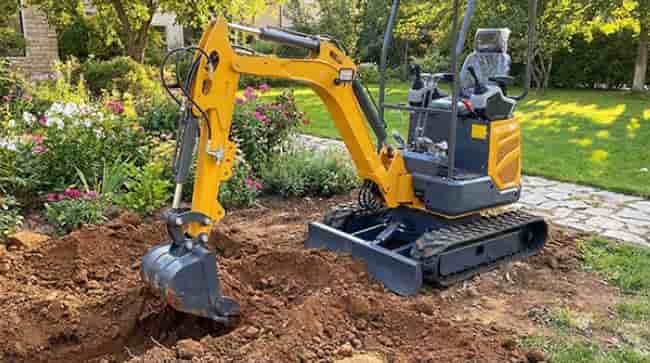
This is exactly why the adoption of mini excavators in orchards has accelerated alongside the shift toward high-density planting systems. Modern compact excavator designs combine low machine weight with wide rubber track pads, producing a contact footprint that’s genuinely orchard-safe. In practice, operators can maneuver through row spacings as tight as 10 feet without triggering the compaction cascade that steals yield potential over time.
The wet-weather advantage is equally significant. After rain events — precisely when soil porosity is most vulnerable — traditional tractor tires create deep ruts that sever lateral drainage channels. Rubber tracks spread the load dynamically, allowing work to continue in conditions that would otherwise demand a full halt. Maintaining that drainage infrastructure matters: compacted soils can reduce water infiltration rates by up to 80%, directly suppressing root development and fruit set in subsequent seasons. The cumulative yield benefit of consistent low-PSI operation isn’t theoretical — it compounds with every passing year of protected soil structure.
That same hydraulic-powered platform also opens the door to something more than just careful movement through a row — it becomes a genuinely versatile workstation.
Modern agricultural excavators aren’t just digging machines — they’re mobile power platforms capable of transforming an orchard’s maintenance workflow with a single tool change.
As covered earlier, soil health and root zone protection drive equipment choices in high-density orchards. But the excavator’s real competitive edge goes beyond its low ground pressure. The ability to swap attachments in minutes — without leaving the cab — turns one machine into an entire equipment fleet. According to Mundo dos Equipamentos, “the versatility of the mini excavator in agriculture stems from its ability to serve as a multi-tool carrier, transitioning from a trenching tool to a precision planter in minutes.”
Quick-coupler systems are the catalyst for this transformation. Modern hydraulic quick-couplers allow operators to switch between attachments in under two minutes, eliminating the downtime that once made multi-task deployment impractical. For remote orchard blocks far from equipment storage, that matters enormously.
The most productive attachment combinations in orchard environments include:
This attachment-ready approach is particularly valuable when sourcing equipment from factory-direct heavy machinery suppliers, where hydraulic flow specs — including working pressure — are matched to powered attachment requirements from the start.
Reducing fleet size is the downstream payoff. Growers who once maintained separate machines for mowing, drilling, and planting are consolidating around one versatile platform. The excavator becomes a mobile power unit, particularly useful in remote orchard blocks where running multiple machines isn’t economical. That consolidation also simplifies maintenance, training, and parts inventory — real operational savings over a growing season.
The same hydraulic versatility that makes excavators indispensable on flat orchard floors becomes even more critical when the terrain tilts — which is where the next challenge begins.
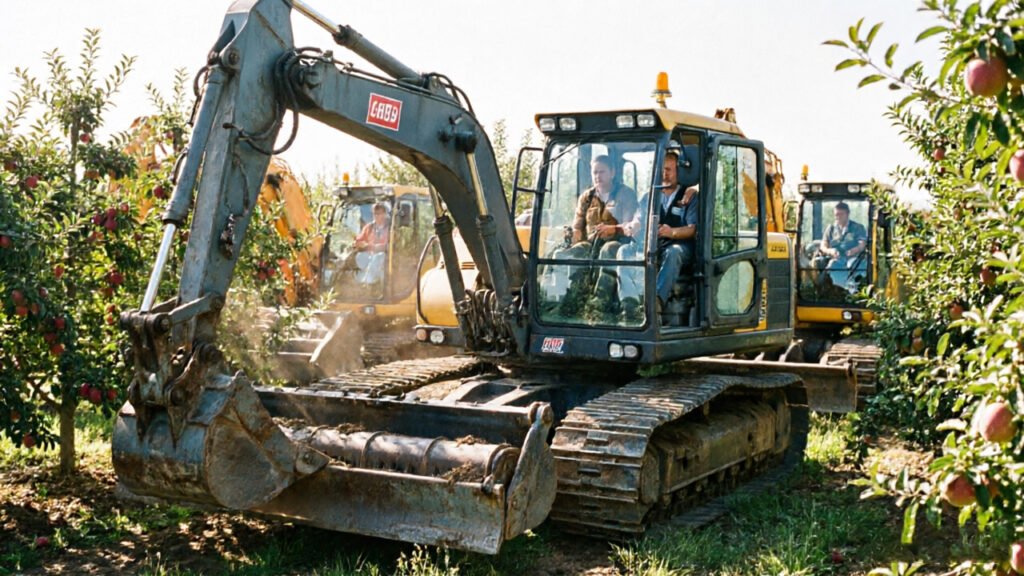
Hillside orchards demand precision agriculture equipment that can hold its ground — literally — while working in spaces most machines simply cannot enter.
Slope stability starts with geometry. A low center of gravity is the foundational advantage compact agricultural excavators carry into hilly terrain. Where a conventional tractor risks tipping on grades steeper than 15 degrees, a purpose-built mini excavator distributes weight closer to the ground and uses its boom as a counterbalance when needed. This makes operations like stump removal, drainage trenching, and soil amendment on steep hillsides far safer — and far more practical — without requiring operators to bench or terrace slopes first.
The zero-tail-swing design changes what’s possible in tight rows. As noted by Growing Produce / American Fruit Grower, zero-tail-swing capability allows these machines to navigate rows narrower than 3 meters — removing diseased or deadwood trees without encroaching on neighboring canopies. In high-density planting systems where trees may be spaced as little as 1.5 meters apart, that precision is non-negotiable. A swinging counterweight would clip healthy limbs, undo years of canopy training, and potentially introduce new disease vectors through fresh wound sites. The 2.5-ton class machines built around this profile can pivot freely within the row without any margin lost to tail overhang.
Safety Focus: Operator safety in rugged terrain improves significantly with zero-tail-swing design. The reduced overhang eliminates a common rollover risk factor on hillside pivots, while reinforced cab structures and improved sight lines give operators clearer visibility of slope edges. Taken together, these features reduce the physical and cognitive load on operators working long hours across uneven ground.
That same capacity for surgical, row-confined work translates directly into faster installation projects — which is exactly where the efficiency gains in planting and infrastructure setup come into focus.
Switching to mechanized orchard establishment doesn’t just save time — it fundamentally transforms the economics of large-scale planting operations.
Automated tree-hole digging, when paired with multi-tool excavator attachments, increases planting efficiency by up to 70% and delivers a 15–20% higher sapling survival rate, according to FAO Agricultural Mechanization Reports. Those aren’t marginal gains. In a 50-acre high-density apple installation, that survival rate improvement alone can translate to thousands of dollars in avoided replanting costs.
Consistency is the hidden variable that manual crews simply can’t match at scale. When an excavator-mounted auger drills every hole to an identical depth and diameter, root placement becomes uniform across the entire block. Uniform root depth means consistent moisture access, consistent fertilizer uptake, and predictable canopy development — all of which compound into measurable yield advantages by years two and three. Manual digging introduces depth variance that stresses young root systems in ways that often don’t become visible until it’s too late to correct.
Single-pass infrastructure installation is where the efficiency story gets genuinely compelling. Modern compact excavators — particularly 1.2-ton class machines built for tight row spacing — can dig the planting hole, trench the irrigation line, and set trellis anchor posts in a coordinated sequence without repositioning equipment between tasks. What traditionally required three separate contractor visits now resolves in one mobilization.
ROI Spotlight: For a regional distributor supplying equipment to a 100-acre orchard conversion project, the math is straightforward. Reducing labor inputs by 70% on hole-digging alone — assuming a crew rate of $18–$22/hour across a 10-person team — recovers a significant portion of equipment acquisition cost within the first planting season. Add reduced sapling replacement costs and compressed installation timelines, and the business case for mechanized establishment becomes difficult to argue against.
As orchards continue integrating precision planting data into their operations, the next logical evolution is connecting these efficiency gains to sensor-driven technology — which is exactly where the industry is heading.
Agricultural excavators are rapidly crossing a threshold — from mechanical workhorses into data-driven precision platforms that reshape how orchards are built and maintained.
Corteva Agriscience and other agri-technology leaders have consistently noted that the high-tech content of modern agriculture is expanding to include advanced sensing and automated operation across all machinery categories. Excavators are no exception. What was once a machine defined solely by its bucket and boom is now increasingly paired with GPS receivers, depth sensors, and telematics dashboards that deliver real-time feedback to operators and farm managers alike.
GPS and depth-sensor integration represent the most immediately practical leap forward. In precision drainage applications — a critical concern for high-density orchards managing water runoff across uneven terrain — GPS-guided grade control allows operators to hit exact elevation targets without manual surveying between passes. Depth sensors validate trench consistency in real time, reducing rework and ensuring drainage infrastructure performs as engineered from day one. For hillside agricultural machinery operating on slopes where grade errors compound quickly, this level of sensor-driven accuracy isn’t a luxury; it’s an operational necessity.
Looking further ahead, the trajectory points clearly toward semi-autonomous and fully autonomous mini excavators. Industry analysts tracking the mini excavator market identify autonomy, electrification, and remote operation as the defining trends shaping the next generation of compact excavation equipment. In orchard environments — where repetitive tasks like row drainage, post-hole digging, and root zone management follow predictable patterns — autonomous operation has a compelling use case.
Certification standards matter enormously when technology enters the equation. CE and ISO certifications aren’t bureaucratic checkboxes; they validate that sensor systems, hydraulic interfaces, and electronic controls meet internationally recognized safety and performance benchmarks. For distributors importing tech-integrated equipment into regulated markets, these standards serve as the foundational proof of reliability. As excavators evolve into precision platforms, certification becomes inseparable from market access.
Understanding where the technology is heading naturally raises the next question: where should serious buyers and distributors source these increasingly sophisticated machines?
Factory-direct sourcing is increasingly the sharpest competitive lever available to distributors supplying agricultural excavators for high-density orchard projects at scale.
Eliminating middleman markups is the most immediate benefit. When municipalities and large orchard operations procure equipment through multi-tier distribution chains, each layer adds 8–20% in margin before the machine reaches the end user. By sourcing directly from an integrated manufacturer, distributors compress that cost structure significantly — freeing up budget that can be redirected toward attachments, operator training, or soil preparation work that directly drives yield outcomes.
ODM customization is where factory-direct relationships become genuinely strategic. Regional agricultural conditions vary enormously — a drip-irrigation install in an arid California valley demands different boom geometry and trench profiles than a root-barrier project in the Pacific Northwest. Working directly with a manufacturer unlocks specification-level customization that off-the-shelf catalog sourcing simply can’t match. For distributors serving niche regional markets, this flexibility is a durable differentiator.
Quality assurance is non-negotiable when machinery is crossing international borders and entering demanding field environments. Integrated production systems and ISO 9001 standards are critical for ensuring reliability in global heavy machinery supply chains — covering everything from steel sourcing to final QC inspection. CE certification adds a further layer of compliance confidence for distributors operating in regulated markets.
Manufacturing depth matters too. A supplier with 15+ years of production history brings more than a product catalog — it brings refined tooling, tested supplier relationships, and institutional knowledge about what fails in the field and why. That experience translates into lower warranty claim rates and more dependable lead times.
When evaluating factory-direct suppliers, use this checklist before committing:
As you move toward procurement decisions, it’s worth stepping back to synthesize these sourcing, technology, and efficiency considerations into a unified acquisition strategy — which is exactly where the next section focuses.
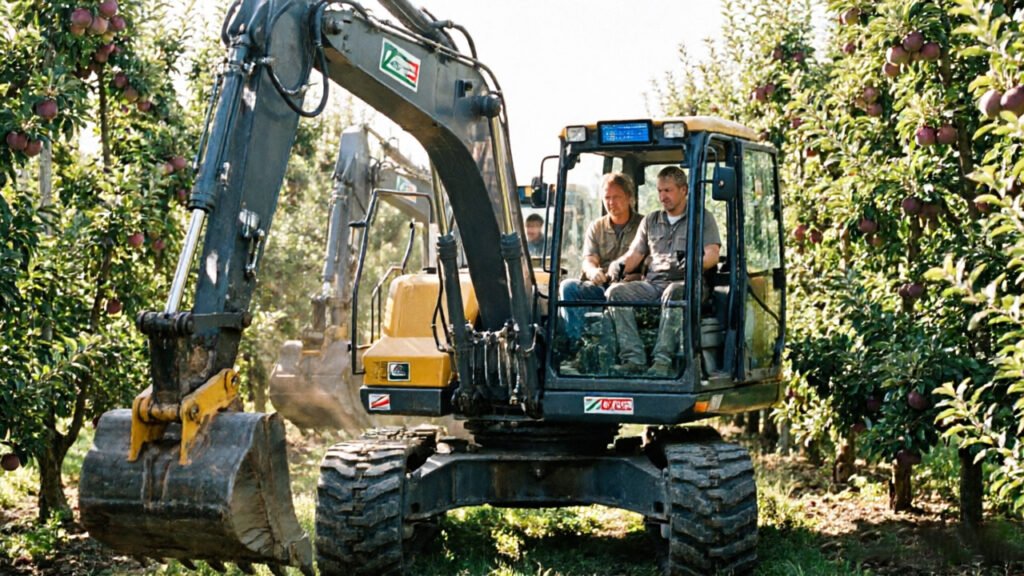
Smart procurement decisions in high-density orchards come down to one principle: every machine on the property should earn its keep across multiple tasks, not just one.
As the FAO notes, agricultural mechanization is the core driver of labor productivity in modern farming systems — and that productivity multiplier only compounds when equipment is genuinely versatile. An agricultural excavator that digs irrigation trenches in spring, transplants rootstock in summer, and clears drainage channels in fall isn’t a line-item cost. It’s a yield-generating asset.
Versatility over single-use machinery is the single most impactful procurement shift an orchard operation can make. When evaluating any new machine purchase, the question shouldn’t be “what does it do?” but “how many things can it do, and how well?”
If questions remain about which specifications, attachment combinations, or sourcing models best fit your operation, the next section addresses the most common decision points directly.
Agricultural excavators have earned their place among the top ten most advanced agricultural machines for efficiency — and that status raises real questions from orchard operators evaluating their first or next machine. Here are the answers that matter most.
Can a mini excavator replace a tractor for all orchard tasks?
Not entirely. A mini excavator excels at drainage trenching, root pruning, post-hole digging, and stump removal — tasks where a tractor struggles. However, tractors remain better suited for mowing, spraying, and broad-acre tillage. The practical answer is complementary deployment: a compact excavator handles precision groundwork while a 35 HP tractor covers repetitive row-crop operations.
What is the ideal PSI for orchard soil protection?
Ground pressure below 4.5 PSI is the widely accepted benchmark for sensitive orchard soils. Rubber-tracked mini excavators typically operate between 2.8 and 4.2 PSI — well within safe limits. Steel tracks on the same terrain can exceed 7 PSI, causing compaction damage that costs yields for multiple seasons.
How do I choose between hydraulic attachments?
Match attachment to task frequency. Augers and thumb clamps justify permanent mounting; grapples and tilting buckets suit seasonal needs and shared machines. A solid starting point is reviewing hydraulic attachment compatibility before purchasing, since auxiliary hydraulic flow ratings determine which tools will actually perform at spec.
Are factory-direct machines CE-certified for international use?
Reputable factory-direct manufacturers supply CE-certified machines as standard for export to European and many international markets. Always request documentation upfront — conformity declarations, operator manuals, and parts traceability records.
For a broader visual overview of where agricultural excavators fit in modern farming, this overview of advanced farm machines is worth your time.
The orchard floor is too valuable to leave to chance. Request a factory-direct spec sheet, confirm your soil pressure requirements, and put the right machine to work this season.