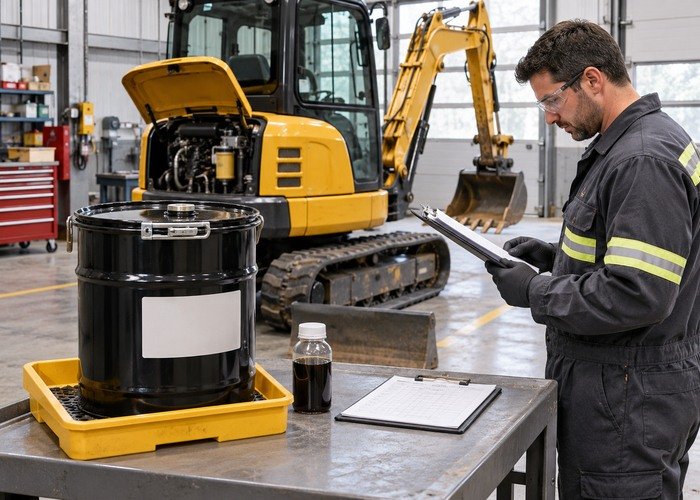















































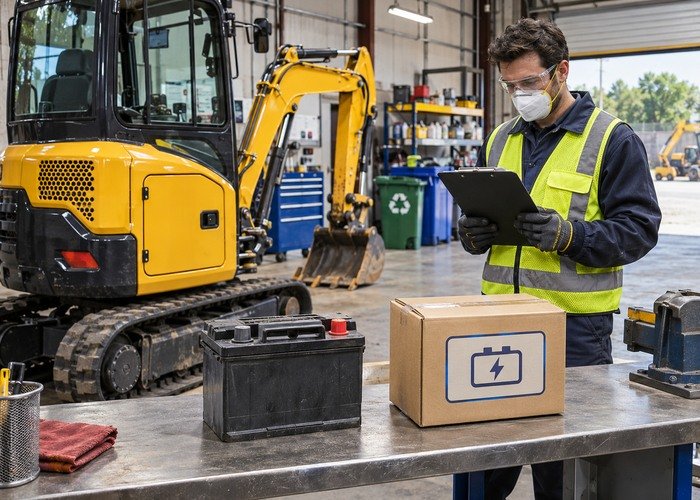
When a mini excavator battery reaches end of life, identify its chemistry and condition before choosing a receiver. A conventional lead-acid starter battery and a lithium-ion traction battery do not necessarily follow the same recycling route. Record the label and source equipment, keep the battery intact, and ask an authorized local handler how it must be accepted and transferred. Do not place an unknown machine battery into general scrap or a household collection route without confirming acceptance.
This guide concerns end-of-life handover, not fitting a replacement. For installation compatibility, see how to check mini excavator battery replacement fit. A battery issue can also involve the machine’s fuse or seasonal readiness, discussed in the fuse-rating guide and winter preparation. Do not use those maintenance articles as disposal instructions.
Identify what is being retired
First determine whether the item is an ordinary starter battery, an auxiliary battery or a traction battery in an electric machine. Do not assume that all compact equipment uses the same chemistry or that appearance alone identifies it. Use the manufacturer’s documentation, part number, product label or fleet records. If the label is missing or unreadable, keep the chemistry recorded as unknown and ask the machine maker or qualified service provider to identify the item before selecting a route.
Record the machine and battery identifiers, chemistry if confirmed, number of batteries, service or retirement date, and condition as observed. Note whether the battery is intact, leaking, swollen, cracked, visibly damaged or subject to a recall. Do not open the case to determine chemistry. A label or manufacturer record is safer and more reliable than examining the inside.
Starter batteries and larger traction packs have different sizes, hazards, transport arrangements and receiver capabilities. A shop that accepts lead-acid batteries may not be equipped for a high-voltage lithium-ion pack. Ask the manufacturer or a specialist recycler for the correct contact when the battery is part of an electrified machine.
Keep the battery intact and route by condition
Do not open, drain, crush, puncture, dismantle, charge or improvise a repair on an end-of-life battery for disposal. Keep it in the condition required by the manufacturer, qualified handler and local rules. The correct isolation, terminal protection, packaging and transport instructions depend on battery chemistry, size, state of charge, damage and applicable dangerous-goods requirements. This article intentionally does not prescribe a universal packaging method.
If a battery is damaged, leaking, unusually hot, swollen, recalled or otherwise suspect, do not treat it as routine intact scrap. Keep people away as directed by the site plan and contact the equipment manufacturer, trained battery professional or emergency/environmental lead for instructions. Do not put a damaged battery into a collection box intended for intact consumer cells. The EPA’s lithium-ion guidance contains separate questions on damaged, defective or recalled batteries because their management may differ.

For routine intact batteries, use a receiver that confirms it accepts the chemistry and business source. Ask whether a commercial generator can use the same route as a household customer; household drop-off programs may limit size, quantity or source. Confirm whether the receiver wants batteries sorted by chemistry, whether it accepts unknown or mixed types, and what records or shipping documents it will issue.
Understand the U.S. federal routes without overgeneralizing
In the United States, spent batteries may be managed under more than one regulatory pathway. EPA’s universal-waste rules in 40 CFR Part 273 can cover qualifying batteries, including many lithium-ion batteries, but the rules are not a blanket label for every battery and every situation. The EPA says businesses are responsible for determining which requirements apply, and state universal-waste programs can differ.
Spent lead-acid batteries sent for reclamation have a separate pathway in 40 CFR Part 266, Subpart G. EPA’s universal-waste FAQ directly addresses whether generators must use that pathway or Part 273. The answer depends on the management route and applicable conditions; do not tell a fleet that all lead-acid batteries must always be managed under a single part. Ask the state environmental agency or a qualified compliance professional to confirm which option fits the operation.
Lithium-ion batteries also require careful determination. EPA explains that many lithium batteries discarded in the United States may exhibit hazardous characteristics and that a generator is responsible for determining whether the waste is hazardous, subject to applicable rules and household exceptions. A business should not assume the household collection advice is its compliance route. The receiver’s technical acceptance and legal status need to be verified for the specific battery.
Useful primary references include the EPA universal-waste FAQ, the EPA lithium-ion battery recycling FAQ, and the EPA used lithium-ion battery guidance. These are U.S. resources. Other countries may classify, label and transport batteries differently.
Prepare a clear recycler handover
Before collection, provide the recycler with the battery type or the fact that it is unknown, quantity, source equipment, condition and any known damage or recall status. Share the manufacturer identification when available. Ask whether the provider accepts batteries from commercial mini excavators and whether a traction pack needs a specialist appointment. Obtain the accepted handling instructions before moving or packaging the item.
Confirm who is responsible for transport and which documents accompany the handover. Depending on chemistry and jurisdiction, transport rules may apply even where the recycling program accepts the battery. Do not assume that the buyer, scrap dealer or carrier has made the generator’s waste determination. Record the receiver’s name, destination facility and acceptance reference.

At transfer, record the date, battery count, chemistry as confirmed, condition, provider, carrier if applicable, destination, shipment or receipt number and any exception. If a receiver rejects a unit because its label is missing or condition is outside the program, record the reason and ask for the next authorized route. Do not send it to another destination without confirming that it can accept that specific item.
What to capture in the fleet record
A short record can connect the end-of-life battery to the equipment and the final destination. Include machine ID, battery part number or manufacturer label, chemistry and evidence used to identify it, quantity, date removed, condition, recall information if known, temporary storage location, classification or compliance contact, provider acceptance, transfer date and supporting documents. Keep the information with the machine’s service and asset-disposal records.
Separate unconfirmed batteries from confirmed streams until the handler tells you how to proceed. If several units are accumulated, use the provider’s approved system to keep count and avoid mixing chemistries. Never replace a missing label with a guess. A record that says “chemistry unverified; OEM identification requested” is more useful than a false designation.
When a battery is repaired, reused or sent for evaluation rather than discarded, document that purpose and the receiving party. The EPA distinguishes certain batteries sent for reuse or evaluation from batteries being discarded. The company should keep evidence of the actual intended route and not describe a waste shipment as reuse merely to avoid a different requirement.
Choose a capable recipient, not just a convenient one
Ask whether the recycler accepts the battery’s chemistry, capacity class, condition and commercial source. Request its handling and transport requirements in writing. For an electric mini excavator traction battery, contact the equipment manufacturer and specialist battery recycler before scheduling removal or shipment. A generic scrap yard may not have the authorization or capability to manage a large lithium pack.
Check whether the provider issues a receipt with item count and destination and whether the site must retain separate transport records. For cross-border fleets, review the rules at origin, during transit and at destination. A recycling route allowed in one state or country does not automatically satisfy the rules in another.
Do not assume a “recycling” label proves that the battery was accepted into the intended process. The handover confirmation should name the receiver and the destination route as far as the provider’s documentation allows. Maintain a contact for rejected or damaged batteries so that staff know whom to call rather than placing the item in ordinary waste.
Common battery handover errors
- Assuming a lead-acid starter battery and lithium-ion traction pack use the same route.
- Inferring chemistry from shape, color, connector or the age of the machine.
- Using a household drop-off program for commercial batteries without checking source and quantity limits.
- Opening, draining, crushing or modifying a battery to make it easier to ship.
- Treating damaged or recalled batteries as routine intact recyclables.
- Keeping no record of the destination, receipt or exception after collection.
Frequently asked questions
Can every mini excavator battery be handled as universal waste?
No. U.S. Part 273 may be available for qualifying batteries, but there are other pathways, state differences and generator duties. Spent lead-acid batteries destined for reclamation may use the separate Part 266 Subpart G option. Confirm the applicable route with the regulator or a qualified professional.
Can I send a damaged lithium battery with the normal recycling pickup?
Do not assume so. Contact the manufacturer, trained battery handler and local environmental contact for the instructions that match its condition and jurisdiction. Follow the site emergency process if there is an immediate hazard.
What if I cannot read the battery label?
Keep the chemistry unverified, record the machine and any part or serial numbers, and contact the manufacturer or service provider. Do not open the battery or guess from its shape.
What proof should the fleet retain?
Keep the identity and condition record, receiver acceptance, transfer date, destination and receipt or transport papers required locally. Save the manufacturer or compliance advice used to select the route.
In short: identify chemistry and condition, keep the unit intact, verify a qualified receiver and record the destination. This chemistry-first handover helps a mini excavator fleet avoid sending a specialized or damaged battery into the wrong collection stream.