Telephone/WhatsApp:+86 156 2656 0610
Telephone/WhatsApp:+86 156 2656 0610
Email:info@seekmach.com

When compact tractor power steering becomes hard only after the machine warms up, the fault is usually revealed by comparison rather than guesswork. First decide whether the front axle and linkage are physically resisting movement, or whether hot hydraulic oil is exposing a loss of steering flow or pressure. Do not keep forcing the wheel: reduced steering assist is a control problem that can become dangerous around slopes, roads, loaders, buildings, and people.
Begin with the operator’s manual for the model and serial number. Some tractors share hydraulic oil between steering, transmission, loader, and three-point hitch; others use a separate steering reservoir or priority circuit. The correct oil, level procedure, filter, test ports, relief settings, and towing rules differ. Park on firm level ground, lower implements, set the brake, stop the engine, and release stored pressure before inspection.
This diagnostic sequence starts with conditions that can be checked without opening the circuit, then moves to temperature, flow, and pressure evidence. If the whole system is running hot, use the companion tractor hydraulic oil overheating guide before condemning the steering unit.
Write down when the steering changes: minutes after start, oil temperature, engine speed, loader load, travel speed, direction of turn, four-wheel-drive status, and whether another hydraulic function is moving. “Hard when hot” can mean steady increased effort in both directions, intermittent grabbing, slow wheel response, a steering wheel that keeps turning without tire movement, or loss of assist only at idle. Those symptoms lead to different tests.
Compare cold and warm operation on the same level surface with the same tire pressure and front-axle load. Use low speed and a clear exclusion zone. Do not hold the steering against its stop; continuous relief flow creates heat and can damage the system. Note whether increasing engine speed briefly restores assist. That may indicate marginal flow, but it is not proof that the pump alone is faulty.
Ask whether the problem began after a fluid change, hose replacement, loader installation, front-tire change, pressure washing, collision, or long storage. Air entry, an incorrect fluid, a kinked load-sensing line, a reversed hose, excessive front load, or dry linkage can appear immediately after those events.
Check cold front-tire pressure against the tractor and tire instructions. Low pressure increases scrub and steering effort; unequal pressure can make one direction feel worse. Inspect tire size, construction, wear, wheel offset, loose hardware, and evidence that a tire contacts the loader frame or body at full lock.
Lower or remove a heavy front load and repeat the controlled check. A front axle loaded beyond its permitted rating can feel hard even when the hydraulic circuit is healthy. Correct rear ballast improves stability but does not increase the rated capacity of the axle, tires, loader, or steering components. Follow the compact tractor loader ballast guide when reproducing the complaint safely.
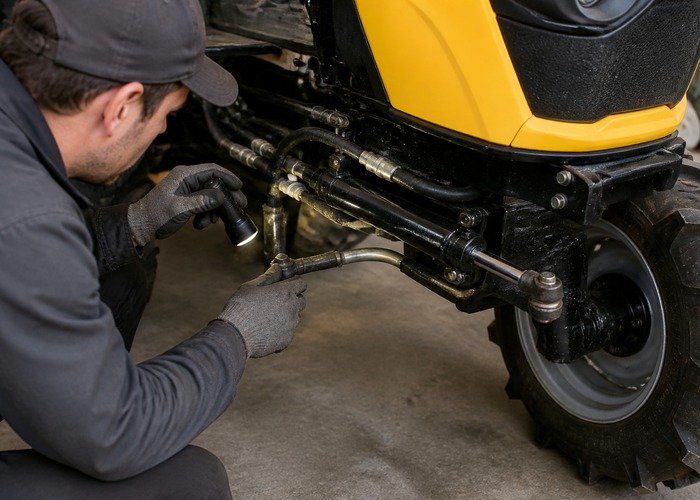
With the engine stopped and the tractor secured according to the manual, inspect tie-rod ends, steering-cylinder pins, axle pivots, kingpins, stops, and wheel bearings. Look for dry joints, bent rods, shifted brackets, torn boots, rust, or fresh metal. The front axle and loader inspection provides a useful companion checklist.
If the manual permits safely unloading the front wheels with rated support equipment, compare linkage movement without tire load. Never work under a loader or tractor held only by hydraulics or a jack. Binding that remains with hydraulic pressure removed must be corrected before pressure testing.
Use the specified parking position and wait time to check oil. Too little fluid may draw air; too much can foam. Milky fluid suggests water, persistent bubbles suggest aeration, and burnt odor supports a heat problem. Dark color alone does not identify failure. Confirm the exact product used at the last service because viscosity and additive compatibility affect hot steering response.
Inspect the correct hydraulic or transmission filter and any serviceable suction screen at the prescribed interval. A restricted inlet, collapsed hose, loose clamp, hardened seal, or cracked tube can starve a pump. Suction leaks may pull air without showing an external oil leak. Foaming, pump noise, and jerky steering strengthen that direction.
The troubleshooting table in a compact tractor workshop manual lists overload, low tire pressure, oil leaks, wrong or insufficient fluid, air entry, relief faults, linkage binding, pump faults, and steering-controller faults as separate causes. Use it as a framework, not as specifications for another machine.
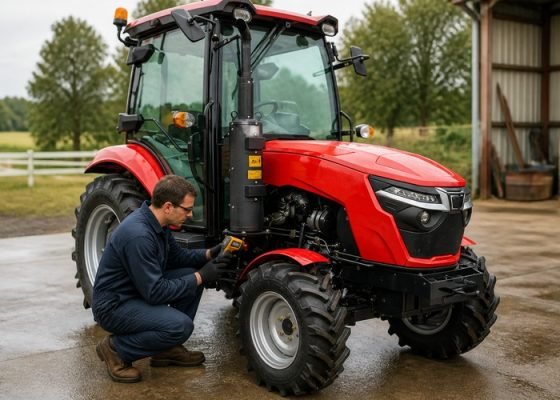
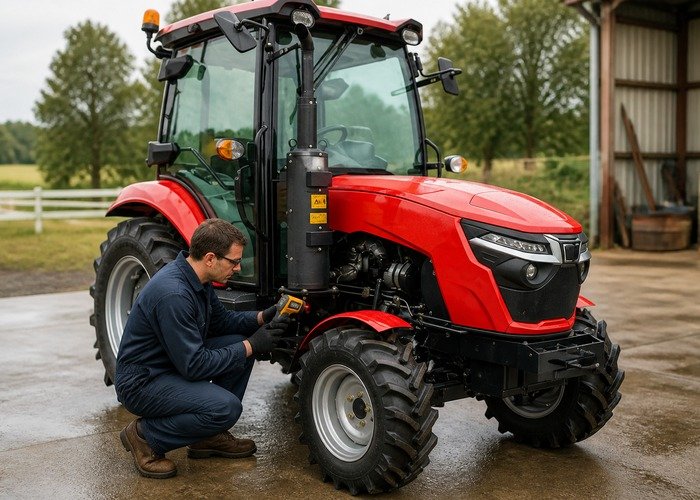
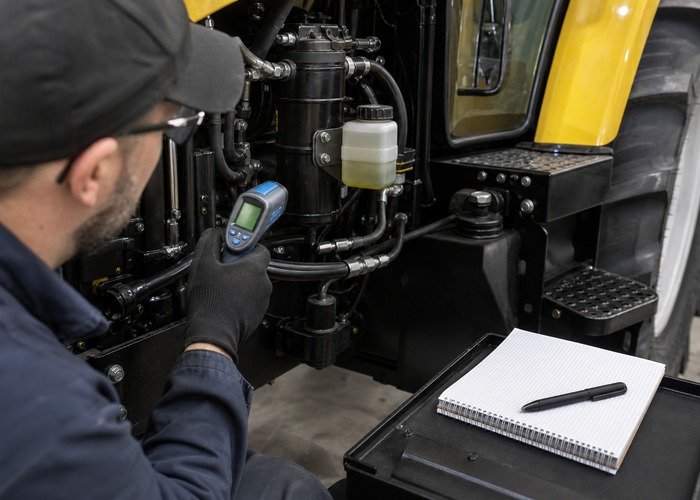
An infrared thermometer is best for repeatable comparisons on clean, non-reflective surfaces. Measure the reservoir, pump supply, steering inlet, steering return, cylinder lines, and nearby valve body at the same marked points cold and warm. Do not touch hoses while the system is pressurized and never search for a pinhole leak with a hand.
If the complete hydraulic system is hot, restore cooler airflow and correct continuous relief flow first. If the steering return becomes much hotter than nearby circuits while no steering command is applied, the steering control unit or priority circuit may be leaking internally. One hot hose or fitting can indicate a restriction, but the pattern must be confirmed with the hydraulic diagram.
Record ambient temperature and the work cycle. A tractor tested during heavy loader work on a hot day cannot be compared directly with an unloaded cold-morning test. Temperature evidence becomes useful only when the same load, rpm, duration, and measurement points are repeated after repair.
Steering needs both adequate flow and enough pressure to overcome tire and axle resistance. Low flow produces slow response, especially at idle. Low maximum pressure produces weak assist under load. A worn pump can lose volumetric efficiency as oil thins, but a leaking steering unit, priority valve, cylinder piston seal, or relief valve can create the same hot symptom.
Observe other functions without combining unsafe movements. If steering weakens while the loader and hitch remain strong, focus on the steering priority branch, controller, cylinder, and signal lines. If every function weakens hot, investigate shared pump supply, inlet restriction, filter, oil, temperature, and system-wide leakage. Review valve architecture in the tractor hydraulic valve guide.
Pressure and flow tests require rated gauges, correct adapters, guarded hoses, known test ports, and the service procedure. Do not tee a general-purpose gauge into an unknown line or adjust a relief valve to “see if it improves.” Incorrect settings can overload the steering cylinder, axle, hoses, and pump.
External cylinder leaks are visible, but piston-seal leakage can bypass internally and reduce assist without dripping oil. A qualified technician can isolate the cylinder using the manufacturer’s method. Do not cap a line or deadhead a cylinder casually; trapped pressure and unexpected wheel movement create hazards.
A hydrostatic steering control unit meters oil as the wheel turns. Wear can cause drift, excessive wheel rotation, inconsistent centering, or greater leakage when hot. Before replacement, verify supply flow, priority pressure, signal-line condition, cylinder integrity, and mechanical freedom. Replacing the controller first can leave the real restriction untouched.
Use clean caps and plugs whenever a line is opened. One piece of grit can damage metering surfaces. The NIOSH hydraulic safety guidance explains why injection injuries and stored pressure require disciplined procedures.
The following field repair video shows a practical heavy-steering investigation. It is useful for visual context, but its machine, language, component design, and repair choices do not replace the SeekMach tractor’s service information or qualified testing.
Before copying any repair, identify whether the tractor uses a dedicated pump, shared pump, priority valve, open-center circuit, or load-sensing circuit. Similar symptoms can come from different components in those architectures.
Use the video to improve observation: watch how the operator distinguishes mechanical drag from loss of hydraulic assist. Then return to measurements from the correct manual—oil condition, temperature pattern, inlet vacuum if specified, steering pressure, flow, and cylinder leakage.
After one verified correction, repeat the original cold-to-hot work cycle. Do not make several unrecorded changes at once. A repeatable test is the only way to know whether the steering is truly restored.
| Observation | Likely direction | Next evidence |
|---|---|---|
| Hard cold and hot, engine off or running | Tires, load, linkage, axle pivot | Pressure, front load, joint and support inspection |
| Good cold, weak hot in both directions | Internal leakage, thin/wrong oil, marginal pump | Repeatable temperature, hot flow and pressure test |
| Weak only at idle | Marginal flow or inlet restriction | Filter, suction path, air, specified pump-flow test |
| One direction harder | Cylinder, linkage geometry, hose, controller section | Mechanical comparison and model test procedure |
| Steering and all hydraulics weaken hot | Shared supply, heat, filter, pump wear | System-wide hot pressure and flow |
| Wheel turns but tires respond late | Air, internal leakage, worn controller or cylinder | Bleeding procedure and leakage test |
When buying a used tractor, reproduce the test long enough for the oil to reach operating condition; a short cold drive may hide the fault. Add the result to the used compact tractor inspection checklist. Dispose of drained oil using the U.S. EPA used-oil guidance and local requirements.
A transport-industry steering bulletin also emphasizes understanding the exact complaint, axle load, mechanical binding, hose restriction, and temperature before parts replacement. That diagnostic principle is broadly useful even though the NHTSA-hosted steering bulletin covers different vehicles.
A defensible diagnosis includes more than “it got hard after an hour.” Record the tractor model, serial number, engine hours, oil and filter identification, last service date, front-tire pressure, ballast, loader attachment, front load, and ambient temperature. Note engine rpm and whether four-wheel drive was engaged. Photograph the steering linkage, tire contact, hose routing, and exact infrared measurement points.
Use a repeatable work cycle that stays within rated limits. For example, operate an empty loader through a defined number of lift and curl cycles, drive a fixed level route, then perform gentle left and right steering checks in the same location. Record the time and temperature when effort changes. Never create a stall or hold the steering on its stop merely to heat the oil.
Separate subjective effort from observable response. Count steering-wheel turns between reference positions, measure time for tire movement at a stated rpm, note any chatter or delay, and compare both directions. If a technician performs pressure or flow testing, attach the gauge identification, test port, oil temperature, rpm, load, and specified limit to the record.
After repair, repeat the exact cycle. A result that feels better cold but still loses assist at the previous temperature is not complete. Keep the baseline with the machine so future changes can be detected earlier. For hydraulic maintenance principles, the Machinery Lubrication hydraulic-fluid overview helps connect viscosity, contamination, temperature, and component wear.
Hot oil is thinner, so wear or internal leakage may bypass more flow. Heat can also soften a damaged suction hose or expose a marginal pump, valve, controller, or cylinder seal.
Do not substitute viscosity. Unapproved oil may harm cold flow, filtration, lubrication, and other shared systems. Use the tractor’s specified product and diagnose the loss.
Yes. Low or unequal pressure increases scrub and steering effort, especially with a loader. Correct it before hydraulic testing.
Only through the model-specific service procedure with calibrated equipment. Random adjustment can overload components and conceal the real fault.
Stop when steering response is unpredictable, assist is lost, a hose leaks, the pump cavitates, oil overheats, or safe directional control cannot be maintained.