Telephone/WhatsApp:+86 156 2656 0610

Telephone/WhatsApp:+86 156 2656 0610
Email:seekmach@gmail.com

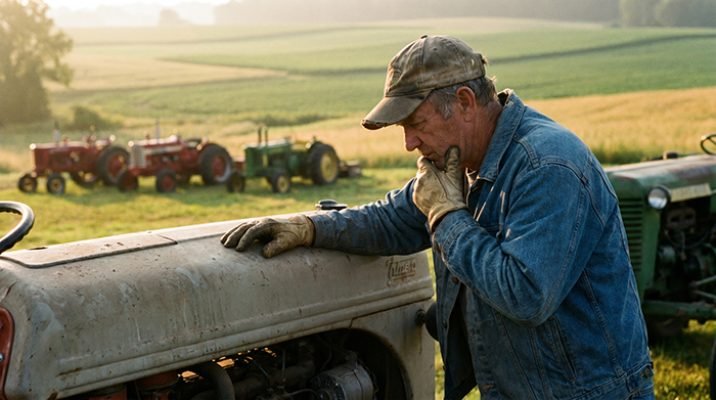
Choosing between a 35hp vs 90hp tractor based purely on land size is one of the most expensive mistakes a buyer can make — and it happens constantly.
Walk into any dealership and describe your property. The first question is almost always “How many acres?” That single number drives the recommendation, the sale, and often, years of regret. The acreage myth is deeply embedded in how tractors get bought and sold — but land size is only context, not a decision driver.
The real question isn’t how much land you own. It’s what you’re asking the machine to do.
This shift from land-based to task-based selection changes everything. A 20-acre property running a commercial hay operation has fundamentally different power demands than a 200-acre recreational plot used for trail maintenance and light mowing. Matching the machine to the workload — not the map — is what determines whether your investment earns its keep or sits struggling.
According to the University of Missouri Extension, the 35hp category defines the standard for lifestyle farming — precision tasks, property maintenance, and light implements. The 90hp range crosses into utility territory, where demanding implements, heavy draft loads, and multi-implement operation become routine. These aren’t just different points on a power scale; they represent entirely different machines built for different jobs.
Itu sub-compact and compact tractor segment has grown sharply as buyers discover that task-matched equipment consistently outperforms oversized or undersized alternatives.
Understanding where your work actually falls on that spectrum, however, requires looking past the engine sticker. The metric that truly determines implement compatibility isn’t advertised horsepower — it’s what happens to that power before it ever reaches your attachment.
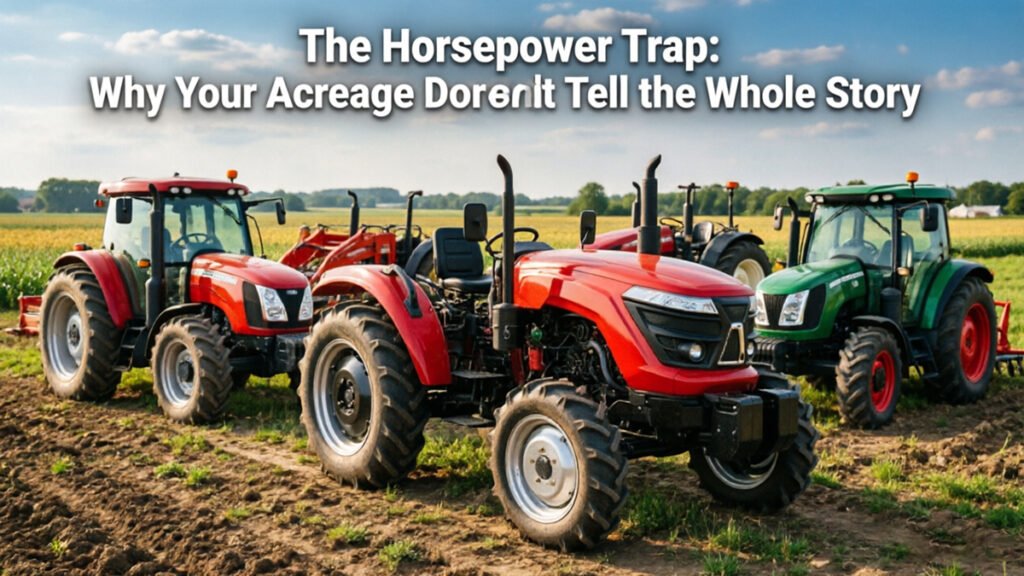
Engine horsepower is a marketing number — PTO horsepower is what actually does the work. Understanding this distinction is the real answer hiding inside the question “what size tractor do I need for 10 acres.”
Daya Lepas Landas (PTO) is the rotating shaft at the rear of a tractor that transfers mechanical power from the engine directly to attached implements — mowers, balers, augers, and more. As explained in our guide to PTO-driven implement matching, this number routinely runs 15–25% below the engine’s gross output due to friction losses through the transmission, hydraulics, and drivetrain.
According to data from the Nebraska Tractor Test Laboratory, a 90hp tractor typically delivers 75–80hp to the PTO shaft, while a 35hp tractor produces roughly 25–28hp at the PTO. That gap defines everything.
| Engine HP | Estimated PTO HP | Compatible Tools |
|---|---|---|
| 35hp | 25–28hp | Finishing mowers, small loaders, light augers, box blades |
| 60hp | 48–52hp | Mid-size round balers, tillers, post-hole diggers |
| 90hp | 75–80hp | Full-size balers, large rotary cutters, grain drills |
A 35hp engine cannot reliably run a standard round baler. Most entry-level balers require a minimum of 35–40 PTO horsepower — meaning the engine itself must produce closer to 45–50hp just to meet that threshold at the shaft. Pushing a 35hp tractor beyond its PTO ceiling causes overheating, premature clutch wear, and stalled equipment mid-field.
On the other hand, a 90hp tractor handles high-demand attachments with power to spare, which protects the drivetrain and extends equipment life. This reserve capacity matters far more than raw acreage numbers.
With the real power equation in focus, it’s worth examining exactly where a 35hp compact genuinely shines — and the specific scenarios where its lighter footprint becomes a serious advantage.
The 35hp compact tractor earns its place not through raw power, but through precision — it fits where larger machines simply can’t go, and it protects ground that heavy iron would destroy.
Kemampuan manuver is the defining advantage here. Tight barn alleys, orchard rows, and fenced paddocks all punish oversized equipment. A compact 35hp unit typically weighs between 2,500–3,500 lbs, allowing it to pivot in spaces that would stop a larger utility tractor cold. That low weight also matters on established turf: according to PennState Extension, a 35hp tractor is light enough for use on sensitive soil without causing deep rutting — a real concern for anyone maintaining pastures or manicured grounds.
The homesteading sweet spot for this class sits around 5–8 acres. On that footprint, a 35hp compact handles the full range of daily chores efficiently, without the fuel cost and depreciation drag of a machine that’s chronically overpowered for the task. (Buyers frequently searching what size tractor do I need for 50 acres will find the answer points them elsewhere — but for plots under 15 acres with moderate workloads, the 35hp delivers real value.)
Best-fit tasks for a 35hp compact tractor:
Memahami how PTO ratings govern implement compatibility keeps this class performing reliably across that task list. However, once acreage climbs past 20 acres — or primary tillage and hay production enter the picture — the 35hp compact starts showing its limits fast.
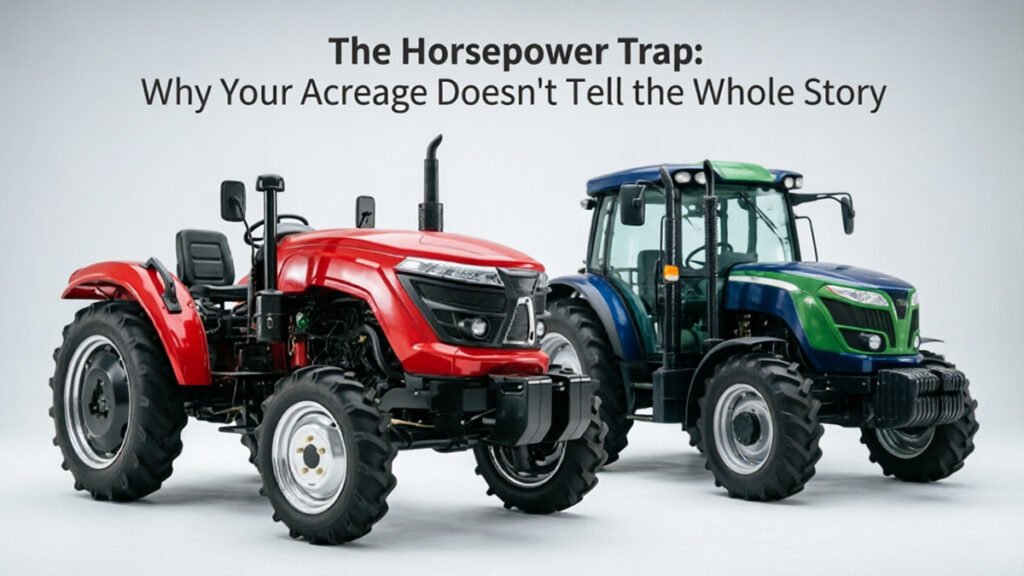
When operations shift from maintenance to production, the compact tractor vs utility tractor debate resolves itself quickly — raw capability wins every time.
At 50 or more acres, the work fundamentally changes in character. You’re no longer mowing lanes and spot-tilling garden beds. You’re running deep subsoilers through compacted clay, cutting and baling hundreds of round bales per season, and potentially grading access roads or moving substantial quantities of material. That’s a different category of demand entirely.
“A 90hp tractor provides the hydraulic flow rates necessary for modern high-speed planters and heavy loaders.” — Successful Farming (Agriculture.com)
Hydraulic flow is a defining limit — and it’s one most buyers overlook until they’re already committed. High-speed planters and large-frame front loaders don’t just need lift capacity; they need sustained gallons-per-minute flow to operate their actuators at rated speed. Underpowered hydraulics create bottlenecks that slow your entire planting window.
Primary tillage is similarly unforgiving. A single-pass disc ripper or five-bottom moldboard plow operating at proper depth demands consistent drawbar pull that a 35hp machine simply cannot sustain over long runs. In practice, attempting heavy tillage with an undersized tractor accelerates clutch and drivetrain wear while delivering inconsistent furrow depth.
Three scenarios that consistently demand 90hp utility-class equipment:
Of course, greater output doesn’t come without trade-offs. The additional machine weight that delivers this pulling authority creates its own set of challenges for your land — something worth examining closely before signing a purchase order.
Over-sizing your tractor doesn’t just waste money — it can silently degrade the land you’re working season after season.
Any serious tractor horsepower comparison must account for operating weight, not just engine output. A typical 35hp compact tractor weighs between 2,500 and 3,500 lbs. A 90hp utility tractor? Easily 8,000 to 10,000 lbs or more — three to four times heavier. That weight difference doesn’t disappear once the field work is done.
Compaction matters because compressed soil restricts root development, reduces water infiltration, and can measurably cut crop yields. According to PennState Extension, soil compaction risks increase significantly with 90hp-class tractors compared to their compact counterparts, precisely because of that operating weight gap. In practice, a single wet-season pass with a heavy machine can create compaction layers that persist for multiple growing seasons — a cost that never shows up on the invoice.
For 90hp operations, dual-rear-wheel (DRW) configurations are a practical mitigation strategy. Spreading the machine’s footprint across a wider contact area reduces pounds-per-square-inch on the soil surface. It’s not a complete solution, but it meaningfully lowers compaction risk on row crop and hay ground alike.
Tire ballast management is equally critical. Overinflated tires concentrate pressure at the center of the contact patch, worsening compaction. Underinflated tires risk sidewall damage and traction loss. Larger tractors require ongoing ballast adjustment as implement loads change throughout the season.
Pro-Tip: On 90hp tractors, check tire pressure every 30 operating hours and adjust ballast when switching between heavy tillage and lighter finish work. Even modest pressure changes — 4 to 6 PSI — can make a measurable difference in compaction depth.
These land-health considerations tie directly into implement selection. Understanding how 35hp machines handle real-world loads can help calibrate expectations before committing to a larger machine — a framework explored in the next section.
The single most reliable answer to “what horsepower tractor should I get” isn’t found on an acreage chart — it’s found on your implement spec sheet.
As Successful Farming notes, “matching the tractor to the implement is more important than matching the tractor to the land size alone.” That insight cuts through most buying confusion immediately. Here’s a practical framework to apply it:
Step 1: List your implements first. Before comparing tractors, catalog every attachment you plan to run — loader, rotary cutter, tiller, baler, or auger. Each has minimum PTO and hydraulic demands.
Step 2: Read the spec sheet, not the marketing copy. Every implement lists required PTO horsepower (not engine HP), hydraulic flow rate (GPM), and lift capacity. Cross-reference these numbers against the tractor’s rear PTO output and hydraulic pump specs. A mismatch here costs more than any price difference between models.
Step 3: Account for quick-change versatility. A tractor’s three-point hitch category determines which attachments physically connect. Category I fits most compact implements; Category II opens the door to heavier commercial tools. As outlined in our guide to the 25-50HP range, the PTO and hitch system is what makes one machine genuinely multi-purpose.
Step 4: Factor in OEM customization. Off-the-shelf configurations rarely match every operational need perfectly.
OEM/ODM manufacturing enables buyers to specify hydraulic flow rates, PTO configurations, and hitch categories before production — eliminating costly post-purchase retrofits.
This is where factory-direct sourcing creates a measurable advantage. Rather than adapting a standard machine to fit your implements, the right manufacturing partner builds to your spec — a value chain that begins well before the tractor leaves the factory floor.
Buying through a traditional dealer network means paying for every layer between the factory floor and your farm — and those layers add up fast.
In the conventional supply chain, a tractor passes through an importer, a regional distributor, and a local dealer before it reaches the buyer. Each stop adds margin. What typically happens is that end-users pay 20–35% above the actual production cost simply to fund that chain. For a $40,000 machine, that’s potentially $8,000–$14,000 in markup that adds zero mechanical value.
Factory-direct sourcing eliminates those layers entirely, connecting buyers to the manufacturer’s price rather than the dealer’s price.
| Faktor | Traditional Dealer | Factory-Direct (Seekmach) |
|---|---|---|
| Harga | Retail + distributor margin | Ex-factory pricing |
| Spec flexibility | Stock units only | Configurable to buyer needs |
| Certification transparency | Dealer-provided docs | ISO 9001 + CE directly from source |
| Lead time accountability | Third-party logistics | Manufacturer-controlled shipping |
| After-sale support | Dealer dependent | Direct engineering contact |
Certifications matter here more than most buyers realize. CE marking confirms compliance with European safety and environmental directives — a meaningful benchmark even for US buyers evaluating build quality. ISO 9001 certification signals that quality management systems are independently audited, not self-reported. Seekmach operates from a 50,000 m² manufacturing facility, supplying ISO 9001-certified tractors and equipment directly to 50+ countries — a production scale that supports consistent quality across high-volume orders.
Over 15 years of manufacturing expertise also means engineering refinements are baked into the product, not discovered by the buyer in the field. That institutional knowledge is rarely accessible through a regional dealer — but it’s the foundation of every machine that ships factory-direct.
When you strip away the markup and the middlemen, the remaining question is simpler: which specifications actually match your operation? That’s where the real decision framework comes together.
Choosing the right tractor comes down to three technical realities: implement requirements, hydraulic demand, and ground conditions — not acreage alone.
After working through the buyer’s framework and factory-direct sourcing options covered earlier, the decision criteria become clear. Here’s what to carry forward:
Still have specific sizing questions? The next section tackles the most common head-scratchers buyers face — from hobby farm dilemmas to implement compatibility.
Tractor sizing questions come down to one consistent truth: acreage tells you very little without knowing what implements you plan to run.
What size tractor do I need for 10 acres vs. 50 acres?
Acreage alone is misleading, but as a rough baseline, most sizing guides suggest 25–35hp for properties under 20 acres and 45–60hp for operations approaching 50 acres. The real driver is task intensity — a 10-acre property running a ground-engaging subsoiler may need more power than a 50-acre property used primarily for mowing.
Can a 35hp tractor run a hay baler?
In practice, it depends on the baler type. Small square balers typically require 35–45 PTO hp at minimum. A 35hp tractor sits right at the edge — workable for light-duty square balers on flat ground, but genuinely undersized for round balers or hilly terrain. Users on TractorByNet consistently flag this as the task that exposes the limits of the 35hp class fastest.
Is a 90hp tractor too big for a hobby farm?
Often, yes — financially and practically. The r/homestead community regularly debates whether jumping past 35hp is even necessary for small acreage tasks. A 90hp machine costs more to purchase, more to fuel, and more to maintain, while spending most of its time throttled down. That’s idle investment, not working capital. The growing momentum behind sub-100hp machines reflects exactly this rethinking.
What is the difference between a compact and utility tractor?
Compact tractors typically range from 20–50hp and prioritize maneuverability and loader work. Utility tractors — generally 45–100hp — are built for sustained PTO-driven implement work and heavier ground engagement. According to Trigreen Equipment, the crossover zone between 45–60hp is where most working farms find their best all-around fit.