Telephone/WhatsApp:+86 156 2656 0610
Telephone/WhatsApp:+86 156 2656 0610
Email:seekmach@gmail.com

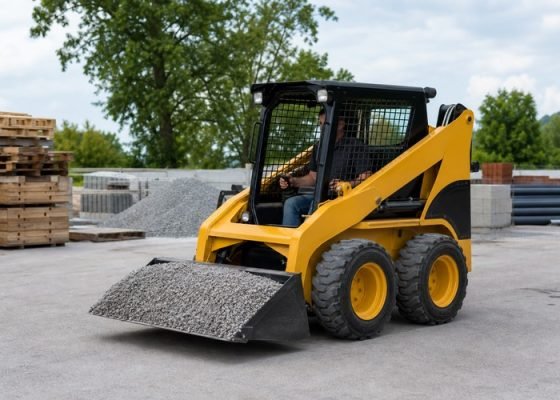
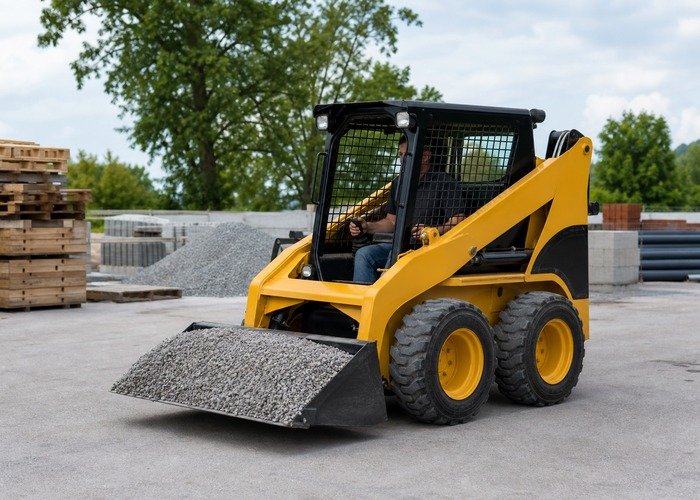
Rated operating capacity is one of the first numbers buyers notice on a skid steer loader, but it is not a promise that every object below that number can be lifted, carried, or placed in every condition. The published rating is determined under defined test conditions with a particular machine configuration. Real work adds attachment weight, an offset load center, turning forces, slopes, soft ground, tire condition, and an operator who may need to see around the load.
The useful question is not simply, “How much can this skid steer lift?” It is, “Can this configured machine control this specific load through the full work cycle on this site?” That cycle includes approaching the material, engaging it, breaking it free, curling, backing away, traveling, turning, raising, placing, and returning with the attachment empty.
If you are comparing machines, begin with the SeekMach skid steer loader category and obtain the operator manual and official specification sheet for the exact configuration. Treat the data plate and manual as controlling sources. Similar model names can have different tires, counterweights, lift geometry, cabs, and approved attachments.
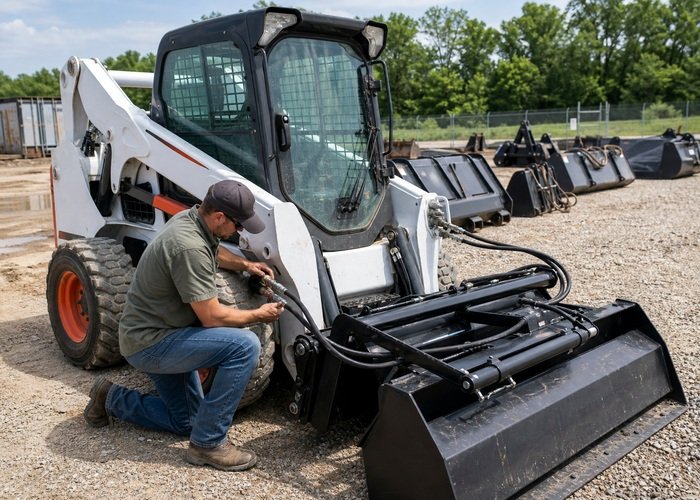
Rated operating capacity, commonly shortened to ROC, is a standardized working-load figure derived from a machine’s tipping load under specified conditions. The percentage used can depend on machine type and the applicable standard, so do not apply a remembered fraction across all machines. Read the manufacturer’s definition on the specification sheet.
Tipping load is also a test value, not a normal working target. It represents a point where stability is lost in the defined test configuration. It does not include the margin needed for bumps, braking, steering, an uneven load, wind on a bulky object, material stuck in the ground, or a change in surface slope.
The distinction matters because operators often use the words lift capacity, ROC, and tipping load as if they are interchangeable. They are not. A machine may have enough hydraulic force to move the lift arms while lacking safe stability or structural margin for the same load in travel.
For basic terminology, the skid-steer loader overview is a useful starting point, but purchasing and operating decisions should rely on the machine manufacturer’s current documents.
Collect the rated operating capacity, tipping load, and attachment weight before estimating useful payload. Also collect the rating conditions: standard bucket or fork configuration, tire type, counterweight package, lift height, and whether the figure applies to a wheeled skid steer or compact track loader.
Attachment weight reduces what is available for material. A fork frame and long tines may weigh substantially more than a light bucket. A grapple adds steel, cylinders, hoses, and often material carried farther forward. A large snow pusher may be light relative to its volume, yet wind and packed snow create different forces.
Do not subtract attachment weight from ROC and assume the remainder is always safe payload. That arithmetic is a screening step only. Load center and operating conditions still matter.
| Article | What to record | Why it changes the decision |
|---|---|---|
| Machine | Exact model, tires or tracks, counterweights | Establishes the tested configuration |
| Pièce jointe | Type, weight, width, approved interface | Uses capacity and changes leverage |
| Matériel | Verified weight or conservative estimate | Prevents guessing from appearance |
| Load center | Distance from attachment pivot or fork face | Farther forward increases overturning moment |
| Route | Grade, bumps, soil, width, overhead clearance | Determines travel stability and control |
| Placement | Required height and reach | High placement reduces margin and visibility |
| Environment | Wind, rain, ice, bystanders, traffic | Adds forces and operating constraints |
A compact load carried close to the machine behaves differently from the same weight extending several feet forward. Palletized material, logs, pipe, brush, and suspended loads shift the center of gravity away from the loader. The farther the load center moves forward, the more overturning moment it produces.
Fork ratings often state a load center, such as a distance from the fork face. The machine rating may use a different reference point. Confirm both definitions rather than matching two numbers that were measured differently. Place heavy material against the fork frame when possible and keep irregular loads secured by an approved method.
Never add people to a bucket, forks, or an improvised platform. Personnel lifting requires equipment and procedures approved for that purpose. General workplace requirements and training expectations can be reviewed through OSHA construction safety resources.
Breakout force describes the ability to curl or lift material from a pile or surface. It helps a bucket enter compacted soil or a grapple pull a root mass, but it does not tell you how much the machine can safely carry. A bucket may break material loose and suddenly fill with more weight than expected. Wet soil and crushed stone can make a modest-looking bucket extremely heavy.
When dense material is involved, use partial buckets and repeatable passes. The few seconds saved by heaping a bucket disappear if the machine becomes unstable, spills material, damages tires, or forces the operator to travel with poor visibility.
This is also why material density matters more than bucket volume. A high-capacity bucket intended for snow or mulch should not be treated as a full bucket for wet clay or stone unless the specifications support that use.
Vertical-lift machines generally keep the load closer to the machine through more of the lift path and often provide useful forward reach near full height. They are commonly favored for truck loading and repeated high placement. Radial-lift machines move the load in an arc and may provide strong reach at mid-height, which can suit digging, grading, and loading over lower obstacles.
Neither path is automatically safer or better. Job fit depends on where the load needs to be at each height, machine size, visibility, attachment, and site. Compare the published lift-path diagram with the actual receiving height. A machine that reaches a truck easily may not be the best choice for another task that occurs near ground level all day.
Watch the attachment through a slow, unloaded lift cycle before handling material. Confirm clearance at the cab, tires, arms, couplers, and receiving container. The SeekMach machinery overview can help buyers compare loader tasks with tractor or excavator work rather than selecting by one specification alone.
ROC testing does not make mud, side slopes, curbs, holes, or frozen ruts disappear. Tire pressure and tire type influence ride, traction, and machine attitude. Tracks spread ground pressure and improve traction in many soft conditions but do not create unlimited side-slope stability. Mud packed unevenly in an undercarriage can also affect control.
Inspect the route with the machine parked. Remove loose debris, mark drop-offs, and identify places where one side will rise. A load carried safely on level concrete may be unsuitable for a rutted approach. Keep the travel load as low as practical, avoid sudden steering inputs, and reduce speed before turning.
Le NIOSH construction program provides broader research and prevention resources. Site-specific controls and the operator manual should govern the work plan.
A skid steer turns by changing wheel speed from side to side. That maneuver creates scrub and can shift a load. Fast turns with a raised or forward load reduce the stability margin. Turning downhill or crossing a side slope can combine weight transfer with uneven ground.
Plan a route that minimizes turns and allows the machine to approach the destination squarely. If a turn is unavoidable, lower the load and turn slowly on the most level available surface. Do not rely on instinct about the machine’s tipping point; by the time the rear wheels become light, the safe margin has already been consumed.
Avoid working beneath raised lift arms. Use the approved lift-arm support device and follow lockout procedures before service. OSHA lockout/tagout information explains the general principle of controlling stored energy, while the machine manual provides the exact support and shutdown procedure.
Approved counterweights can change rated performance, but they also increase total machine weight, axle or tire loading, transport weight, and the force carried into the ground. They are not permission to exceed a published rating or substitute for a larger machine.
Configuration changes must be documented. If one shift uses counterweights and another removes them for transport, the team needs the correct capacity information for each state. Tires, tracks, buckets, cabs, and guarding can also change machine weight and balance.
Before buying a machine around a marginal load case, test the exact configuration with a dealer or qualified supplier. Use a known load and a controlled site, not an unknown pile or improvised suspended weight.
The coupler must be fully engaged and visually verified. Hydraulic attachments must match flow, pressure, return path, and case-drain requirements. Hoses should clear tires and linkage through the full range of motion. A heavy attachment that fits the coupler can still be wrong for the machine.
For powered tools, review the principles in SeekMach’s skid steer hydraulic flow guide. Hydraulic compatibility affects tool performance, heat, and reliability, while ROC determines only part of the material-handling decision.
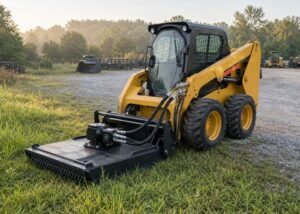
Long or wide attachments also affect visibility and turning clearance. A brush cutter, broom, snow pusher, or trencher changes the machine envelope. Mark that envelope during operator familiarization and inspect work areas for people, structures, utilities, and overhead hazards.
Suppose a pallet has a verified gross weight below the machine’s ROC. The fork frame and tines still consume capacity. The pallet may be deep, placing its center farther forward than the rating reference. The load may be uneven, with most weight on one side. The route may include a ramp and a tight turn, and the final shelf may require full-height placement.
The correct decision considers every stage. Check fork and machine ratings at the stated load center. Keep the pallet against the backrest. Travel low and square to the route. Stop before the placement zone, inspect overhead clearance, then raise only on level ground. If the machine feels light, the load shifts, or visibility is inadequate, lower it and change the plan.
For repeated pallet work, a vertical-lift machine with good high-lift reach and clear fork visibility may be a better fit than choosing solely by a larger ROC number.
Loose material rarely arrives with a weight label. Estimate density conservatively and begin with a partial bucket. Observe steering, rear-wheel contact, tire deflection, and braking response while remaining well inside the manual’s limits. Do not use a momentary successful lift as proof that a heaped bucket is acceptable.
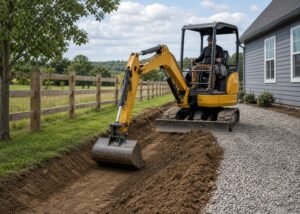
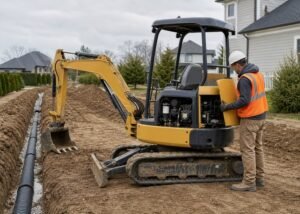
Keep people away from the loading and travel zone. Approach piles squarely, avoid undercut faces that can collapse, and do not ram compacted material at speed. If the task is primarily excavation below grade or controlled trenching, the excavator application guide may point to a machine better suited to the work.
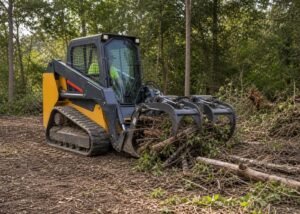
Irregular material can roll, pivot, catch on structures, or extend beyond the machine. A grapple may control it better than forks, but attachment weight and forward reach remain important. Cut or rearrange oversized material into stable units rather than relying on hydraulic clamping force alone.
Never travel with a suspended load swinging from a chain unless the machine, attachment, rigging, and procedure are approved for lifting that way. Suspended loads behave dynamically and can move the center of gravity with little warning. Rigging should be selected and inspected by competent personnel.
If the operator cannot see the route, the load may be too high, too wide, or carried on the wrong attachment even when its weight is acceptable. Use a spotter under a clear communication plan when site rules permit, but do not allow the spotter into the machine’s path or crush zone.
Clean windows, cameras, mirrors, lights, and restraint systems before the shift. Maintain three points of contact when entering. Fasten the restraint and seat belt before starting, and keep limbs inside the cab. A related skid steer operating video helps new operators visualize control movements, entry, travel posture, and attachment handling before supervised practice.
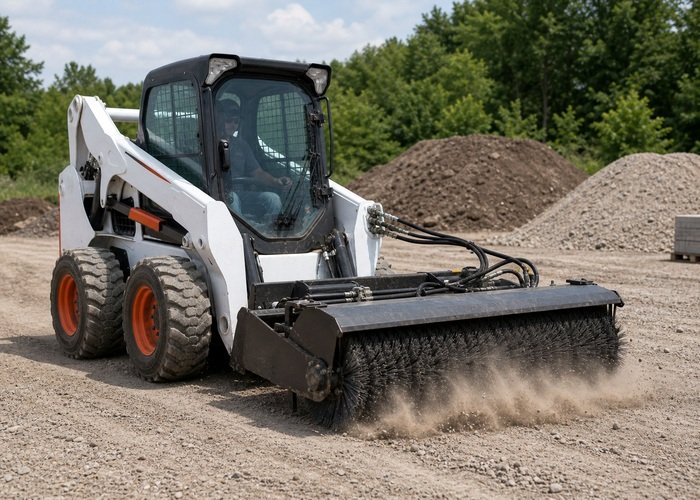
The first mistake is treating ROC as material payload without accounting for attachment weight. The second is comparing ratings measured under different standards or configurations. The third is ignoring load center. The fourth is testing capacity on a slope or rough route. The fifth is raising during travel to see beneath the load. The sixth is using breakout force as evidence of safe carrying capacity.
Another common error is choosing a machine that handles the heaviest rare load but is oversized for every daily task. Consider renting or using a different machine for occasional extremes. SeekMach’s application solutions can help organize equipment selection around the work sequence instead of one impressive number.
No. It is a standardized working rating based on defined test conditions. It is not a guarantee for every attachment, load center, height, route, or surface. Follow the exact machine documentation.
That subtraction is only an initial screen. You must also compare the stated load centers, fork-frame rating, machine configuration, placement height, ground condition, and travel route.
No. Vertical lift describes geometry, not a universal capacity advantage. Compare exact ratings and reach at the height your job requires.
No. Use only approved counterweights and the rating that applies to that configuration. Counterweights change total machine and transport weight and do not remove limits imposed by structure, hydraulics, tires, attachments, or terrain.
Hydraulic breakout or curl force and machine stability are different limits. The loader may move material while the machine lacks safe margin for travel, turning, or raising.
Choose the skid steer whose documented capacity, lift path, visibility, attachment compatibility, and ground performance fit the complete routine cycle with margin. Verify unusual loads rather than guessing. Keep loads low in travel, raise only on prepared ground, and stop when control or visibility changes. Rated operating capacity becomes useful when it is treated as one input in a disciplined work plan, not as a dare to find the tipping point.