Telephone/WhatsApp:+86 156 2656 0610

Telephone/WhatsApp:+86 156 2656 0610
Email:seekmach@gmail.com

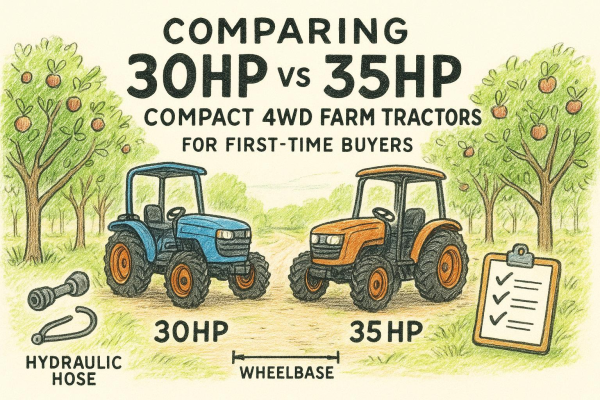
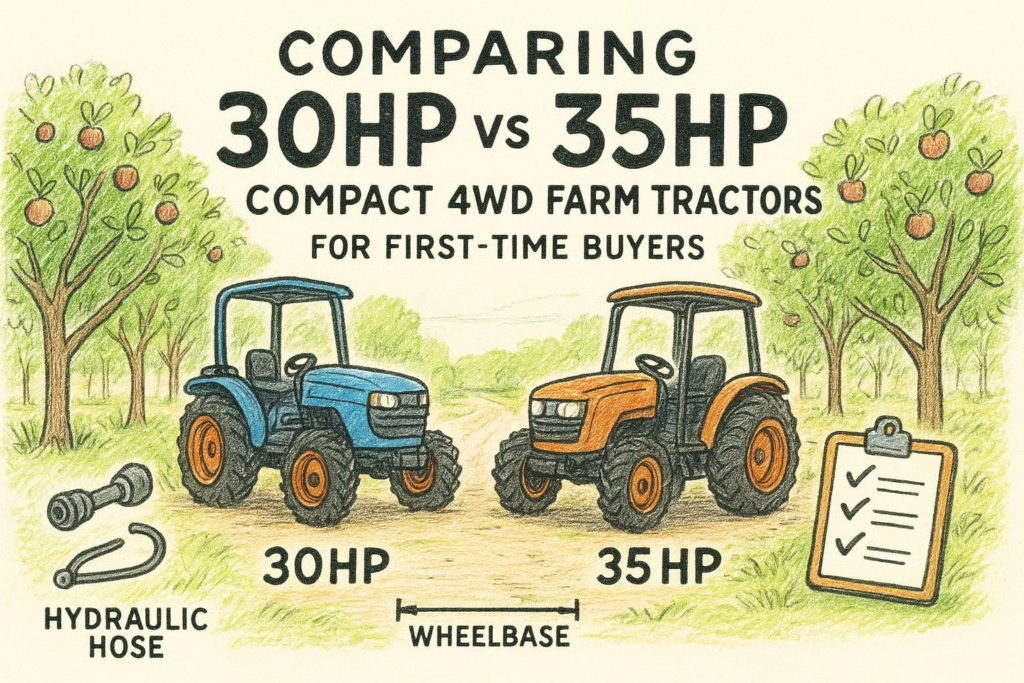
Buying your first compact tractor is less about chasing a bigger number and more about avoiding two regrets:
Below is a spec-first comparison—no pricing talk, no hype.
| Spec (from product pages) | OEM 30HP Tractor SM-304Y | China 35HP Tractor SM-354Y | Why it matters |
|---|---|---|---|
| Puissance du moteur | 30 CV | 35 CV | Extra headroom matters most when conditions are tougher than “normal” (denser grass, heavier loads, mild grades) |
| Modèle de moteur | Yangdong YD390T | LAIDONG 4L22BT | Two different engine families; consider service familiarity and parts planning |
| Drive | 4x4 | 4x4 | Traction consistency in soft spots and orchard lanes |
| Transmission | 8+2 | 8+2 | Similar control over ground speed |
| PTO speeds | 540 / 720 tr/min | 540 / 720 tr/min | Common interface for many PTO implements |
| Structural weight | 1380 kg | 1410 kg | Weight influences traction and “planted” feel; also affects transport planning |
| Empattement | 1745 mm | 1780 mm | Longer wheelbase can feel steadier; shorter can feel a bit more nimble |
| Overall size (L×W×H) | 3350×1400×2000 mm | 3350×1400×2000 mm | Same footprint for tight-space work |
| Pneus | 6.5-16 / 11.2-24 | 6.5-16 / 11.2-24 | Same tire sizes listed |
| Sortie hydraulique | 1 group | 1 group | Basic compatibility for hydraulic implements |
Key Takeaway: These two tractors share the same footprint and many core interfaces. For most first-time buyers, the decision is about power margin vs. a slightly lighter, slightly shorter-wheelbase feel.
If you’ll run PTO-driven implements, you need to understand PTO first. A power take-off (PTO) is the system that transfers power from the tractor to an implement through a rotating shaft (definition: Power take-off (PTO)).
Practical move: list your top 2–3 PTO implements (mower, tiller, etc.), then check the implement manufacturer’s PTO requirement.
New operators tend to learn stability the hard way—usually when a load is raised, the ground is uneven, or the turn is sharper than expected.
Penn State Extension breaks down how center of gravity, turning forces, and attachments affect rollover risk in “Tractor Stability and Instability” (2025).
⚠️ Warning: The highest-risk combo for beginners is often turning + slope + raised load. Make stability your “non-negotiable.”
Both tractors list 4WD. In practice, that can mean fewer “stuck moments” in soft soil and less wheelspin when conditions get marginal.
Both models list the same overall dimensions (3350×1400×2000 mm), so your decision won’t force a bigger footprint. The difference is mostly feel: SM-354Y lists slightly more weight and wheelbase; SM-304Y lists slightly less.
For mixed tasks (mowing + light ground work + transport), your fit comes down to whether you expect to regularly push the machine near its limit. Extension guidance is clear: match implement size to real tractor capability and field conditions (see “Match Implement Size to Tractor to Save Fuel”).
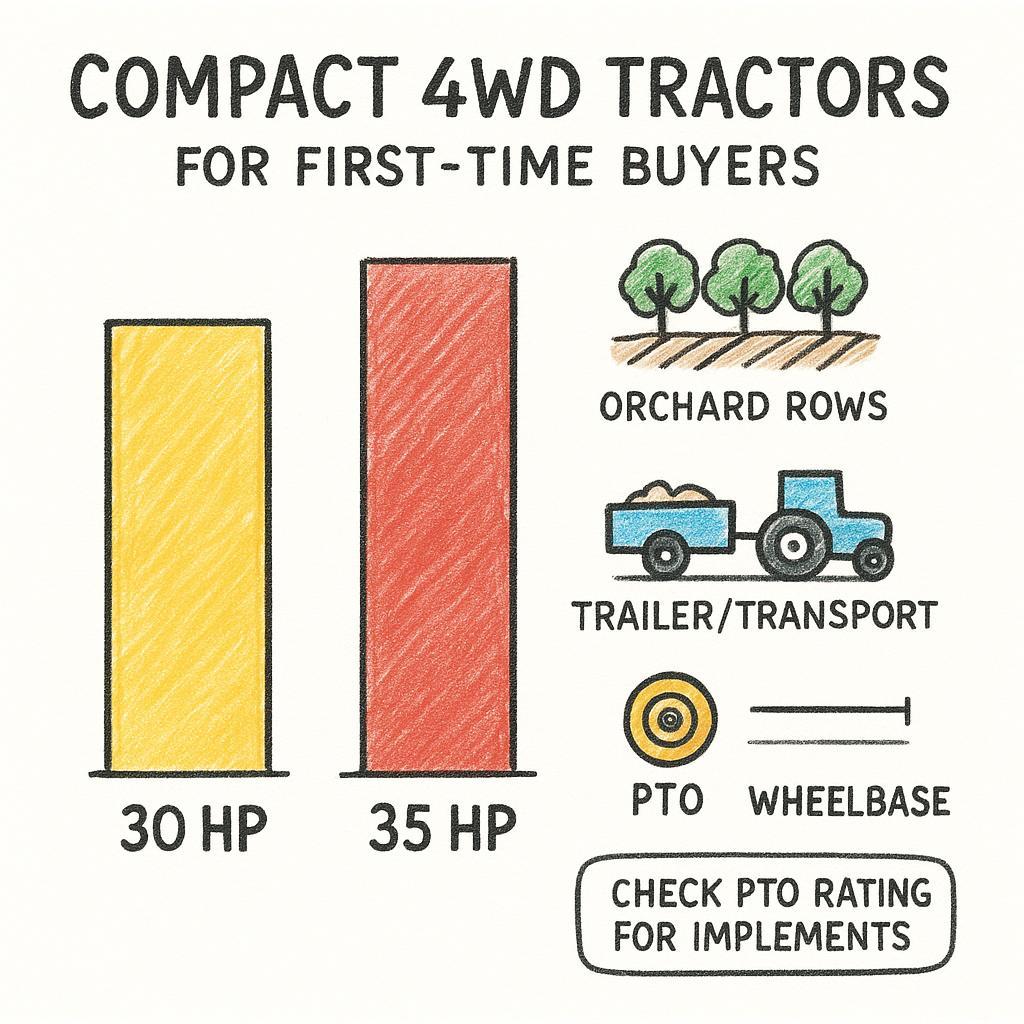
The bars visualize puissance du moteur. Confirm your implement PTO requirement before you decide.
No. If your implements and conditions don’t demand more, the “better” tractor is the one that fits your space and stays stable and predictable while you build seat time.
Your top implements (and their PTO requirements), your tightest working spaces (gates, row width), and how often you’ll operate on uneven ground.
It means the PTO speed options are common, but compatibility still depends on the implement’s required PTO speed, driveline setup, and the tractor’s ability to supply enough power for that implement.
Keep loads low while moving and slow down before turning—especially on uneven ground or slopes. If you want a deeper explanation, look up Penn State Extension’s 2025 breakdown of stability mechanics.
Start with About SeekMach.
Start with footprint (overall dimensions), PTO interface (PTO speeds), and stability clues (weight + wheelbase). Then map those to your tightest spaces and your top implements.