Telephone/WhatsApp:+86 156 2656 0610

Telephone/WhatsApp:+86 156 2656 0610
Email:info@seekmach.com



A CE-certified excavator isn’t simply carrying a regulatory sticker — it’s carrying documented proof that it was designed, tested, and manufactured to protect the people who operate it every day.
The CE mark is a mandatory legal passport for any excavator entering the European Economic Area (EEA), as designated by the European Commission. Without it, a machine cannot be legally sold, leased, or put into service across EEA member states. That’s a hard line, not a suggestion.
But framing CE certification purely as a legal hurdle misses the point entirely — and it’s a framing that costs equipment buyers dearly. The mark signals verified compliance with essential health, safety, and environmental protection standards. These aren’t abstract benchmarks. They govern whether a machine’s hydraulic systems, operator controls, noise emissions, and structural integrity have been independently validated against defined criteria. When that validation is absent or falsified — a more common problem than the industry acknowledges, according to TUV Rheinland — the consequences fall squarely on the owner, the operator, and the worksite.
The primary framework governing this entire process is the Machinery Directive 2006/42/EC. This directive sets out the essential health and safety requirements that excavators must meet before CE marking is applied. It requires manufacturers to compile a Technical File, issue a Declaration of Conformity, and in many cases, engage a notified third-party body to verify compliance. The directive transforms CE certification from a checkbox into a structured engineering commitment.
For global buyers sourcing equipment outside the EEA, this distinction matters enormously. A machine built to satisfy the Machinery Directive 2006/42/EC has been held to a rigorous international standard — and that standard starts with the structural engineering of the operator’s cab, which is precisely where the next layer of scrutiny begins.
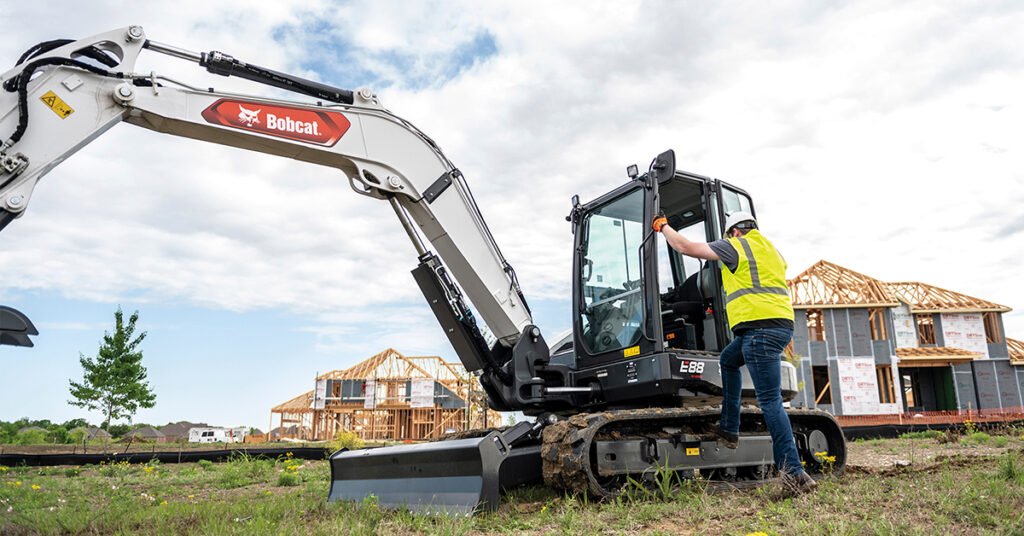
CE-certified excavators carry more than a compliance label — they carry documented proof of structural survival testing that directly determines whether an operator walks away from a serious incident.
The Technical File is the backbone of EU machinery directive compliance. According to the Health and Safety Executive (HSE) UK, CE certification requires manufacturers to compile a Technical File that documents every critical design decision, including materials specifications, risk assessments, and the results of ROPS and FOPS testing. Without this file, no legitimate Declaration of Conformity can be issued — and without that declaration, the CE mark itself is meaningless.
ROPS and FOPS: What the Testing Actually Demands
ROPS — Roll-Over Protective Structures — are engineered to prevent the cab from collapsing if the machine tips or rolls. Testing applies controlled static or dynamic loads to simulate real rollover forces. The structure must deform within defined limits while maintaining a protected survival zone around the operator. Understanding what rollover protection actually absorbs helps clarify why cab geometry and weld quality aren’t cosmetic concerns — they’re life-safety variables.
FOPS — Falling Object Protective Structures — are tested against impact loads from objects dropped at specified heights and weights. Excavators operating near demolition zones, rock faces, or elevated worksites face real overhead hazards, and FOPS testing verifies that the cab roof can absorb those loads without penetrating the operator zone.
Both standards require verification of:
The operator benefit is significant: a certified cab structure isn’t just tested for normal operating conditions — it’s proven to protect in the worst-case scenario. That assurance extends beyond physical safety into productivity, since operators working in verified, compliant cabs consistently report higher confidence on demanding job sites.
These structural benchmarks don’t exist in isolation. As excavators increasingly move into urban environments — tighter sites, closer bystanders, more regulatory oversight — another layer of compliance becomes equally critical: the machine’s acoustic footprint.
Understanding why CE certification is important for excavators goes well beyond structural safety — noise regulation is a compliance dimension that directly shapes where and when a machine can legally operate.
Noise emissions on job sites aren’t just a comfort issue; they’re a legal threshold with real procurement consequences.
the Directive 2000/14/EC establishes binding noise limits for outdoor equipment sold in European markets, including earth-moving machinery. For excavators, the permitted sound power levels range from 96dB to 106dB depending on net installed power — limits that manufacturers must verify through standardized acoustic testing before a machine can legally carry the CE mark. These aren’t advisory guidelines. Exceeding them disqualifies the equipment from sale or deployment across the EU and in any jurisdiction that mirrors these standards.
For urban contractors, this matters considerably. Municipal procurement teams routinely specify noise compliance thresholds before approving equipment for residential developments, hospital construction zones, or city infrastructure projects. A machine that fails acoustic standards — even if structurally sound — becomes a liability the moment work begins near noise-sensitive areas. Job site shutdowns, fines, and contract penalties are the practical consequences of deploying non-compliant equipment on tight urban schedules.
What’s less obvious is how acoustic testing improves overall machine quality. Achieving consistent decibel limits requires manufacturers to address vibration damping, engine enclosure design, and hydraulic system refinement. A machine built to pass noise testing is, almost by definition, a more refined machine overall — with tighter tolerances, better component integration, and fewer operational inefficiencies.
This connection between compliance and engineering quality extends beyond noise. As the next section explores, meeting European benchmarks isn’t an advantage reserved for European manufacturers — it’s a standard that quality-focused producers worldwide are increasingly engineering toward.
CE marking and European construction equipment safety standards are widely misunderstood — the most persistent myth being that the “CE” stands for “Made in Europe.” It doesn’t.
As Your Europe makes clear:
“The CE marking does not mean that a product was made in the EU, but rather that the product is assessed before being placed on the market and thus satisfies the legislative requirements.”
CE certification concerns what a product proves, not where it was built. Any manufacturer, anywhere in the world, can earn CE compliance by meeting the same rigorous assessment criteria applied to European factories. The benchmark is the standard itself — not the address on a shipping label.
This distinction carries real weight for contractors evaluating equipment purchases. A machine assembled in Asia that has passed documented safety and emissions assessments is, by definition, more compliant than a locally assembled unit that bypassed that process entirely. In practice, international manufacturers who pursue CE compliance often invest heavily in quality infrastructure precisely because the certification process demands it. Comprehensive production environments — encompassing fabrication, testing, and quality control under one roof — are better positioned to maintain the consistency that CE assessors expect across every unit produced.
Factory-direct CE machinery frequently represents a stronger value proposition than unverified alternatives, offering documented compliance at a competitive price point. What buyers are paying for isn’t geography — it’s the paper trail, the tested structure, and the manufacturing discipline behind the mark.
That manufacturing discipline, however, doesn’t exist in isolation. It operates within a specific legal and regulatory framework that governs how CE certification is granted, verified, and enforced. Understanding the directive at the heart of that framework — and what it actually demands from excavator manufacturers — is the next critical piece of this picture.
los the Machinery Directive 2006/42/EC is the legal backbone of construction equipment safety across Europe — and increasingly, the global benchmark buyers reference when importing CE certified mini excavators from factory direct suppliers.
The directive doesn’t just set limits — it defines a complete safety philosophy for machine design and manufacturing.
Core requirements under 2006/42/EC are broad but specific in their intent. Manufacturers must demonstrate that every machine is designed and built to eliminate or minimize foreseeable hazards — from stability failures and hydraulic leaks to rollover events and crush injuries. Per the European Commission, the directive is the primary regulatory framework ensuring machines are engineered with risk reduction as the starting point, not an afterthought.
Declaration of Conformity is the document at the center of this process. Before a CE mark can be affixed, the manufacturer must compile a technical file and issue a signed declaration confirming the equipment meets all applicable directives and harmonized standards. This document travels with the machine — it’s legally required at point of sale and is the first thing customs authorities and workplace inspectors request.
Notified Bodies add a critical layer of independent verification. These are third-party organizations — accredited by national authorities — that assess whether high-risk machinery genuinely meets directive requirements. For excavators that fall under Annex IV categories, Notified Body involvement isn’t optional. Their audit trail provides documented assurance that no shortcuts were taken during design or testing.
Mini excavators receive particular scrutiny under the directive due to their physical characteristics. Compact machines operating in uneven terrain carry a disproportionate rollover risk. Structural protections like certified rollover safety structures are evaluated as part of the overall compliance assessment — not treated as optional accessories.
Understanding this framework sets the stage for a harder question: what actually happens when a machine enters the market without it?
Skipping CE certification to cut upfront costs is one of the most expensive mistakes an equipment buyer can make — the downstream consequences far outweigh any initial savings.
Non-certified heavy machinery can be seized at the border before it ever reaches a jobsite. According to the European Commission, non-compliant equipment can be confiscated by customs or banned from operation across all 30 European Economic Area countries. That means a machine purchased for $60,000–$100,000 could be impounded indefinitely, leaving buyers with both the loss of the asset and ongoing import violation penalties. There’s no appeals shortcut — the machine either carries a valid CE mark or it doesn’t.
Liability exposure is equally serious. If an uncertified mini excavator causes an accident on a worksite, the contractor operating it faces a compounded legal problem. Not only is the machine non-compliant with the Machinery Directive, but the operator may also have violated local health and safety regulations by deploying it. Protections like certified rollover structures are built into CE compliance frameworks precisely to prevent fatal incidents — and skipping certification means skipping those safeguards entirely.
Insurance companies have taken an equally hard line. In practice, most commercial liability and equipment policies contain clauses that void coverage for non-compliant machinery. If a non-CE-certified excavator causes property damage or injury, the insurer can deny the claim outright — leaving the contractor personally exposed to litigation costs that can run into the hundreds of thousands of dollars.
The pattern is consistent: manufacturers who misrepresent CE compliance pass the real risk entirely onto the buyer. That cheap uncertified import rarely stays cheap for long. Understanding how to verify genuine certification before purchase is the logical next step — and it’s more straightforward than most buyers assume.
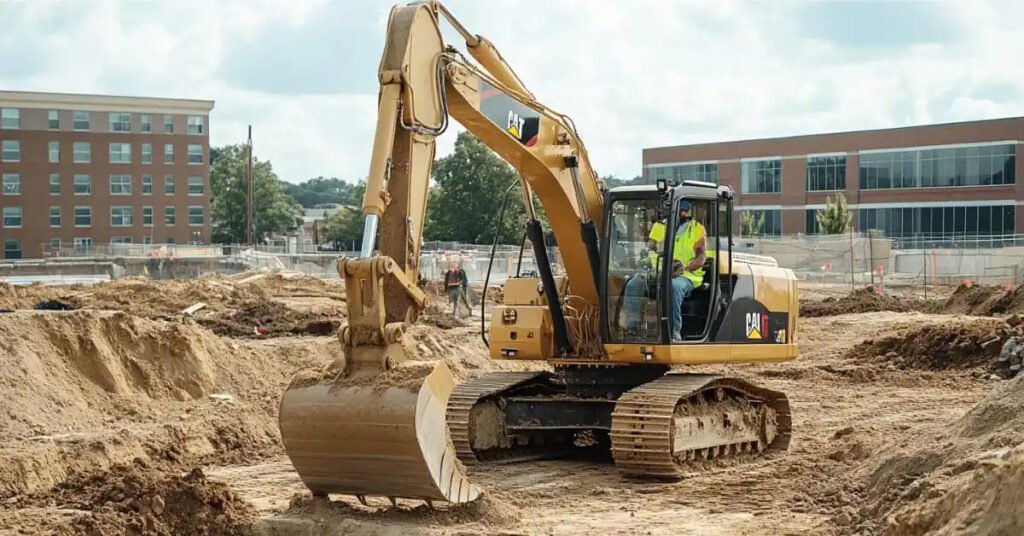
Knowing how to spot a genuine CE certification before you sign a purchase order is the single most practical skill a savvy equipment buyer can develop. With fraudulent markings more common than many buyers realize — TUV Rheinland has documented the many ways manufacturers misrepresent CE status — doing your own due diligence isn’t optional, it’s essential.
Start at the data plate. Every compliant mini excavator must carry a permanently affixed plate showing the manufacturer’s name and address, model designation, serial number, year of manufacture, and the CE mark itself. If the plate is missing, adhesive rather than stamped, or lacks a serial number, treat it as an immediate red flag. The serial number matters because a valid CE certificate must be accompanied by a Declaration of Conformity signed by the manufacturer, linking that specific serial number to the relevant directive — in this case, the Machinery Directive 2006/42/EC.
Request the Declaration of Conformity in writing. A legitimate factory-direct supplier will provide this document without hesitation. When you receive it, verify that it names the correct directive, lists the harmonized standards used (such as EN ISO 11694 for noise), includes the manufacturer’s authorized signature, and matches the serial number on the machine. Vague language, missing standards references, or a signature from an unrelated third party are all warning signs worth pressing on.
Evaluate the manufacturer’s credentials holistically. Years of certified production, ISO quality management accreditation, and documented export history to regulated markets like the EU and UK all signal a supplier who treats compliance as a core commitment rather than a checkbox. A supplier with 15+ years of CE-certified manufacturing and established ISO credentials brings verifiable accountability that a newer or unverified importer simply cannot match.
Watch for these red flags in documentation:
Once you’ve confirmed authentic certification, you’re in a strong position to assess the full value of a factory-direct purchase — which is exactly what the bottom line comes down to.
CE certification isn’t just a regulatory checkbox — it’s a reliable proxy for engineering discipline, safety rigor, and long-term fleet value.
After working through the risks of non-compliance, the anatomy of fraudulent marks, and the practical steps to verify a supplier’s documentation, one conclusion stands out clearly: cutting corners on CE certification costs far more than the upfront savings ever justify.
The smartest procurement decision is one that treats compliance as a core cost driver, not an afterthought. A machine that arrives without valid CE documentation may look like a bargain on the invoice, but the downstream exposure — in liability, downtime, and lost contracts — routinely exceeds the price difference many times over.
On the other hand, a certified machine from a reputable factory-direct supplier arrives ready to work, ready to insure, and ready to resell. That’s a return on investment that compounds over the life of every unit in your fleet.
If you still have questions about what CE certification actually means in practice — including some persistent myths about where machines must be manufactured or which equipment categories are exempt — the answers are coming up next.
CE certification is one of the most misunderstood marks in heavy equipment — these answers clear up the confusion that costs buyers money and safety.
Does a CE mark mean the excavator was made in Europe?
No — and this is one of the most persistent myths in equipment procurement. The CE mark indicates that a machine meets European Union safety, health, and environmental standards, regardless of where it was manufactured. Excavators built in China, the US, or anywhere else can legitimately carry a CE mark, provided they’ve been tested and certified to the relevant EU directives. Origin and compliance are entirely separate questions.
Is CE certification required for mini excavators used on private land?
In most EU member states and many markets that mirror EU standards, CE certification applies to the machine at the point of sale — not exclusively to commercial job sites. Even on private land, if an operator is employed and the machine presents a risk of injury, workplace safety regulations typically still apply. The safest assumption is that CE compliance is always required if you’re operating machinery that could injure a person.
What is the difference between CE and ISO for heavy machinery?
These two marks are often confused but serve distinct functions. As the International Organization for Standardization makes clear, ISO focuses on quality management systems — the processes and consistency of a manufacturer’s operations — while CE addresses the specific safety and compliance of the product itself. A factory can hold ISO 9001 certification while still producing a non-CE-compliant machine. Both matter; neither substitutes for the other.
How do I check if a Chinese manufacturer’s CE certificate is authentic?
TUV Rheinland warns that fraudulent CE documentation is a known risk. Verify authenticity by requesting the full Declaration of Conformity, identifying the notified body by name and registration number, then cross-referencing that body against the EU’s official NANDO database. A legitimate certificate will always trace back to a verifiable third-party testing authority — without exception.