














































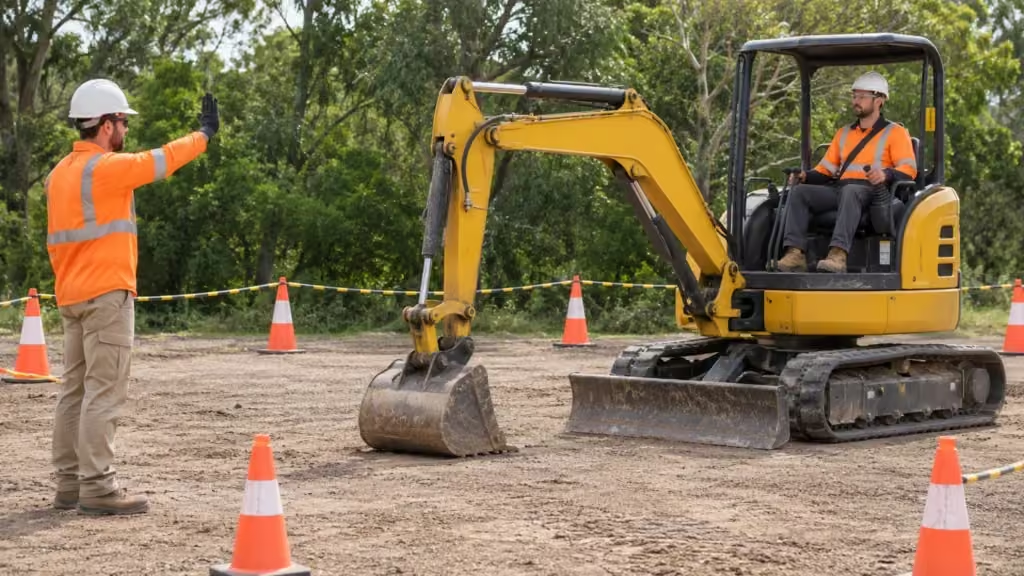
Before a mini excavator moves near people, the operator and ground worker should agree who is directing the movement, where that person will stand, which signals mean move or stop, and what happens if visual or radio contact is lost. Keep pedestrians outside the machine’s working area wherever possible; a spotter is a limited control for a defined task, not permission for people to enter the swing radius or a substitute for a separated route.
This practical brief helps a site team create a short operator-to-spotter protocol for controlled onsite maneuvering. Requirements differ by country, worksite, machine classification, and task. Follow local law, the machine manual, the site traffic plan, and the responsible person’s instructions.
Start with separation, not signals
First ask whether the maneuver can be planned so that people do not share space with moving plant. Establish pedestrian routes, exclusion zones, barriers, and a clear machine route before relying on a person to guide movement. The UK Health and Safety Executive (HSE) advises separating pedestrians from moving vehicles and positioning a vehicle marshaller safely when one is used. Its excavator guidance is UK guidance, but the planning principle is useful elsewhere: remove exposure before adding a communication layer.
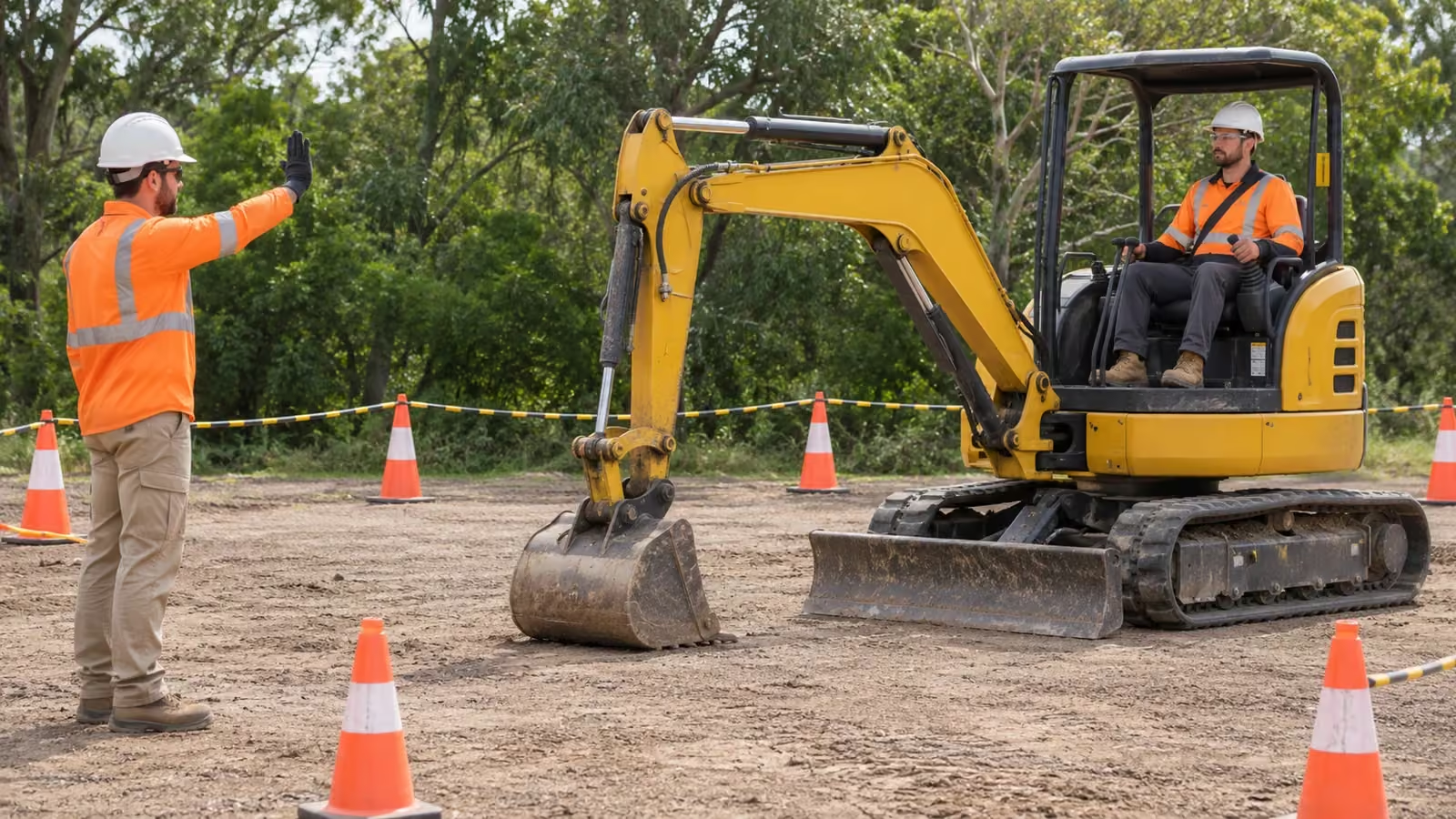
A spotter may be struck, trapped, or placed in the machine’s blind area. The spotter should remain outside the excavator’s travel path, counterweight swing, attachment reach, and any pinch point between the machine and a fixed object. Do not direct someone to stand beside a trench edge, beneath a suspended load, between the counterweight and a wall, or where escape is blocked. If no safe position gives the spotter a useful view, change the layout or method instead of proceeding with an unsafe position.
Consider whether reversing can be avoided by turning around in a clear area, changing the loading position, or moving the pedestrian route. A camera, mirror, alarm, or proximity system can help, but the operator still needs a task-specific plan and must follow the manufacturer’s instructions. Do not assume a warning device makes an occupied blind zone safe.
Map the actual blind and swing areas
Blind areas change with machine size, cab or canopy, boom position, attachment, terrain, lighting, and the observer’s height. A generic diagram cannot show every site condition. Before work, use the exact machine’s manual and visibility aids where available; then walk the planned route from the ground and identify what the operator cannot see. CDC/NIOSH visibility diagrams provide construction-equipment blind-area diagrams at several viewing heights and a manual method for understanding visibility limits. Use these as planning aids, not as a replacement for checking the machine and location in front of you.
Mark the machine’s travel route and operating boundary. Include the counterweight tail-swing area and the attachment’s full range, not just the tracks. Consider uneven ground, raised loads, parked vehicles, stacked materials, temporary fencing, and changes in elevation that may hide a person. Keep nonessential workers outside the controlled area, and tell nearby crews when the excavator will move.
Name one spotter and agree the protocol
Choose one person who understands the maneuver and can communicate clearly. The spotter should not be given an unrelated task while guiding movement. Before the engine or travel movement begins, the operator and spotter should confirm the route, destination, hazards, safe standing position, communication method, and an unmistakable stop signal. Where more than one person is present, identify who has authority to direct the maneuver so competing signals do not arise.
Use hand signals that both people understand, or a tested radio channel with short, unambiguous commands. If the site uses standard signals, verify them together rather than assuming everyone learned the same version. Confirm radios work in the actual area, set the channel, and agree how to identify the machine and spotter. Avoid relying on a phone call or text while the equipment is moving. OSHA’s backover prevention guidance recommends that spotters and drivers agree on signals, maintain visual contact, and stop backing immediately if the spotter is no longer visible. OSHA labels this page as informational solutions; it should not be read as a universal legal requirement for every excavator movement.
| Before movement | Agreement to confirm | Record or check |
|---|---|---|
| Route and boundary | Where the machine will travel; where pedestrians must remain; swing and attachment limits | Walk-through or marked site sketch |
| People and roles | One named spotter; operator identity; who can call an emergency stop | Pre-start brief and crew acknowledgement |
| Communication | Hand signals or tested radio; channel; clear stop command; backup if radio fails | Signal check before the machine moves |
| Spotter position | Visible to the operator, outside travel/swing/pinch zones, with an escape route | Confirm from the operator’s view |
| Restart conditions | What must be rechecked after a pause, lost contact, or layout change | Operator acknowledgement before movement resumes |
Use a simple move–stop–confirm rhythm
Keep each instruction short and tied to one action. The operator should acknowledge the spotter before beginning a guided maneuver. Move slowly enough for the operator to stop within the clear route, while respecting the equipment manual and conditions. The spotter should watch the route and the people at risk, not walk backward into an unknown area or become distracted by another job.
Agree in advance that the operator stops if the spotter disappears from view, the radio fails, a signal is unclear, another person enters the controlled area, the planned route becomes blocked, or ground conditions change. If a warning horn or stop signal is used by the site, define its meaning so it cannot be mistaken for an ordinary alert. Anyone who sees immediate danger should be able to call for a stop; only the designated spotter should give movement directions during that maneuver.
Once stopped, secure the machine as the manufacturer’s instructions and site procedure require. Do not ask the spotter to approach the attachment, tracks, or counterweight to explain a signal while the machine could move. Re-establish communication from a safe location, identify the problem, clear people from the hazard area, and agree whether to continue, reposition, or change the method. An alarm or radio message is not proof that a person is clear.
Restart only after the situation is rechecked
A restart is a fresh decision, not an automatic continuation. The operator should confirm the spotter is in the agreed safe position, the route is clear, all exposed workers are accounted for, and the intended signal is understood. If the spotter changed position or another person took over, pause and repeat the brief. Do the same after a break, equipment change, attachment change, visibility change, or material shift that affects the route or working boundary.
At shift handover, tell the incoming crew about the machine route, blind areas, barriers, communication channel, designated spotter, and any temporary restrictions. Record material changes and unresolved hazards using the site’s normal handover or permit process. If the job begins to involve public-road controls, use a separate traffic-management plan; see our roadside traffic and pedestrian handover guide. For low-light work, see the mini excavator night-work lighting and route guide.
Keep the spotter outside the hazard
Never place the spotter between the machine and a wall, vehicle, trench edge, or other object that could trap them. The person should not enter the swing area to inspect the bucket or cross close to the tracks without first communicating with the operator and following the site isolation procedure. When a repair or access task requires work near controls or moving components, use the machine’s prescribed shutdown and isolation steps; our safety-lock lever and defect guide covers those checks separately.
OSHA’s rules are jurisdiction- and equipment-specific. In the United States, 29 CFR 1926.602(a)(9)(ii) addresses certain earthmoving or compacting equipment with an obstructed rear view when operated in reverse, including an alarm or an employee signaling that it is safe to do so. Applicability depends on the equipment category and circumstances; consult the current regulation and competent safety advice. Do not generalize this provision into a rule that every excavator task worldwide requires a spotter.
Frequently asked questions
Does every mini excavator job require a spotter?
No single rule can be stated for every country, machine, and task. Applicable regulations and site rules may require specific controls in defined situations. Assess the actual visibility and hazards, follow local requirements and the manufacturer’s manual, and prioritize separation of people and moving plant. A spotter is used when the risk assessment and work plan call for one and a safe position is available.
What should happen if the operator loses sight of the spotter?
Agree before work that movement stops when contact is lost. The operator should stop the maneuver, secure the machine as required, and wait until communication and the spotter’s safe position are re-established. Do not continue based on an assumption that the spotter is still clear.
Can a radio replace visual contact?
A radio can support communication, but it does not remove blind spots or keep the spotter out of danger. The crew should define a tested radio protocol and failure response. If the task needs visual confirmation or the radio connection becomes unreliable, stop and revise the method.
Can the spotter do another job at the same time?
During a guided maneuver, keep the spotter focused on the movement and people at risk. OSHA recommends not assigning additional duties while a spotter is acting in that role. Other local requirements may differ, but divided attention undermines the purpose of the role.
What belongs in a handover note?
Record the machine and attachment, planned route and boundary, designated spotter, agreed signals or radio channel, stop conditions, current barriers, known visibility limits, and any changes or unresolved hazards. Follow the site’s required forms and local rules.
About SeekMach: SeekMach shares practical equipment planning information for buyers, owners, and operators. Always follow the machine-specific manual, site procedures, and applicable local safety requirements.