Telephone/WhatsApp:+86 156 2656 0610
Telephone/WhatsApp:+86 156 2656 0610
Email:info@seekmach.com



We thoroughly tested tractor loader attachments to help you make an informed decision. Most tractor owners think of their loader as a scoop — a glorified bucket for moving dirt and gravel. That framing is costing them thousands of dollars in productivity every single year.
Tractor loader attachments can increase a tractor’s operational utility by over 300% across different seasonal applications, according to data from Farm Equipment Magazine / AgEquipment Intelligence. That number only becomes real, however, when operators stop treating the loader as a fixed implement and start treating it as a modular power interface — a front-mounted workstation that accepts purpose-built tools for virtually any task.
The shift from pulling to mounting is the conceptual breakthrough. Traditional tractor work centered on rear-mounted, PTO-driven implements: tillers, mowers, spreaders. The front-end loader changes the geometry of the machine entirely, placing hydraulic power and mechanical reach at the operator’s fingertips. The key that unlocks this potential is the universal skid steer quick-attach (SSQA) coupler — a standardized mounting plate that allows a single tractor to swap between a bucket, pallet forks, grapples, snow pushers, and bale spears in under two minutes, without tools.
Factory-direct sourcing compounds this advantage. When attachments are purchased through a direct channel rather than a regional dealer chain, the margin layers — warehouse, distributor, retail — are eliminated. On a $1,200 set of heavy-duty pallet forks, that “middleman tax” can represent $200 to $400 in avoidable cost. For compact tractor operations running on tight margins, that savings meaningfully accelerates ROI.
The loader is more than a scooper; it’s a platform. And the first attachment that proves it is the pallet fork.
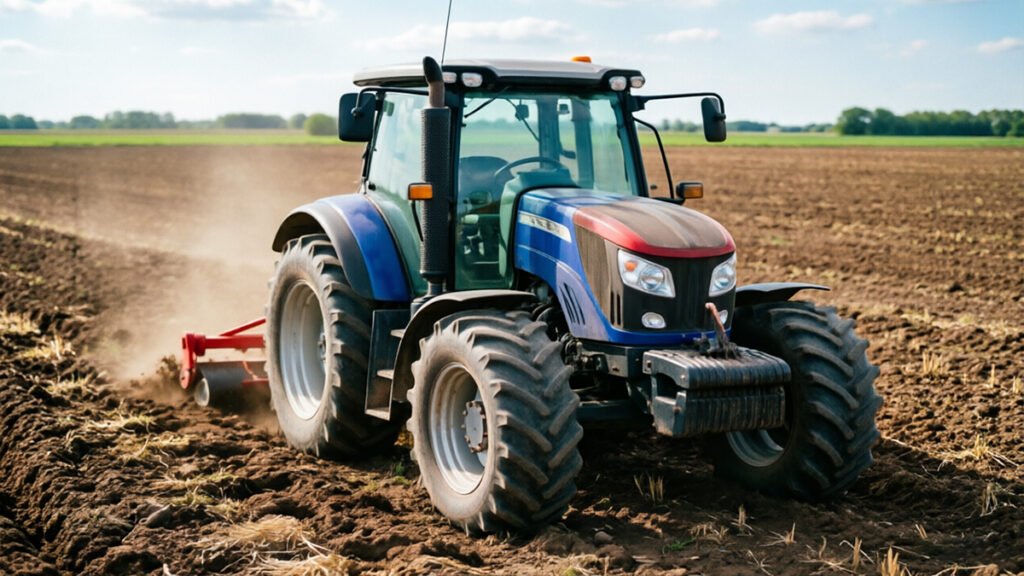
Pallet forks transform a basic front-end loader into a precision logistics hub — making them the single most impactful upgrade for farms and job sites alike. If you’re asking what are the most versatile tractor loader tools for small farms, the answer almost always starts here. According to Equipment World, pallet forks are consistently ranked as an essential non-bucket attachment for small-to-midsize tractor owners — and the reasoning is hard to argue with.
The bucket excels at bulk material movement, but it’s a poor fit for anything that needs to stay intact, level, or accounted for. Forks handle those jobs cleanly:
Pallet forks often pay for themselves quickly because they eliminate the manual labor workarounds that slow every operation down.
The 35HP to 90HP range is the practical sweet spot for fork-based work — enough hydraulic capacity to handle real working loads without the overhead costs of full-size equipment. However, raw horsepower only gets you so far. To move beyond static fork work into dynamic, powered attachments like grapples and log processors, your loader needs something most standard setups don’t have out of the box.
Advanced loader attachments are only as capable as the hydraulic system feeding them — and most stock loaders simply aren’t built for the job.
Standard loader circuits only supply two hydraulic functions: lift and tilt. That’s enough to operate a basic bucket, but the moment you bolt on powered attachments — grapples with closing jaws, 4-in-1 buckets, or hydraulic thumbs — you need a dedicated third circuit to control them independently. Without it, you’re left with a static attachment that can’t use its core functionality.
As the TractorLife.com Editorial Team notes, “the integration of hydraulic third-function kits is the critical upgrade that unlocks high-performance attachments like grapples and 4-in-1 buckets.” That’s not a luxury — it’s a prerequisite.
This distinction matters enormously for forestry clearing and precision demolition, where operators need simultaneous, responsive control. Speaking of forestry work, many landowners ask whether a 50HP tractor can run a heavy duty brush cutter attachment — and the honest answer hinges largely on hydraulic flow capacity, not just engine output.
Pro Tip — Hydraulic Flow Compatibility: Before purchasing any powered attachment, verify your tractor’s hydraulic flow rate (measured in GPM). Most third-function kits require a minimum of 8–12 GPM. Mismatched flow leads to sluggish performance or premature component wear.
That flow question becomes even more critical when you move into full-scale land clearing — which is exactly where the right front-mounted tools can transform what’s possible.
Land clearing is where tractor attachments face their most demanding test — and where the right front-mounted tools can dramatically compress your timeline.
A properly configured 50HP tractor can effectively run a heavy-duty brush cutter — but hydraulic capacity is the deciding factor. As covered in the previous section, stock hydraulic systems often fall short. Brush cutters demand consistent flow and pressure, and an underpowered setup will bog down mid-cut, defeating the efficiency gains entirely.
When comparing loader-mounted cutters to standard rear-mounted brush hogs, visibility is a significant advantage. Operators using front-mounted units can see exactly where the cutting head tracks, reducing missed passes and preventing costly contact with hidden obstacles — stumps, boulders, or drainage infrastructure. Rear-mounted hogs work well on open pasture, but on a variable, obstacle-dense clearing site, front-mounted tools simply perform more predictably.
Root grapples add another layer of efficiency during site preparation. Where a bucket struggles — gripping irregular debris, tangled root masses, or mixed slash — a root grapple applies controlled hydraulic pressure to grab and sort material precisely. According to the Association of Equipment Manufacturers (AEM), modern front-end loaders use standardized mounting systems that allow operators to swap between attachments in under a minute — meaning a single machine can transition from cutting to gripping to piling without leaving the cab for tool changes.
The result is a measurable reduction in site prep hours. What might require a dedicated skid steer crew and a separate brush cutting pass can often be consolidated into one machine working a logical sequence.
Of course, land clearing is only one corner of what these platforms handle. Agricultural operations present an equally compelling case — from winter feeding logistics to daily barn management.
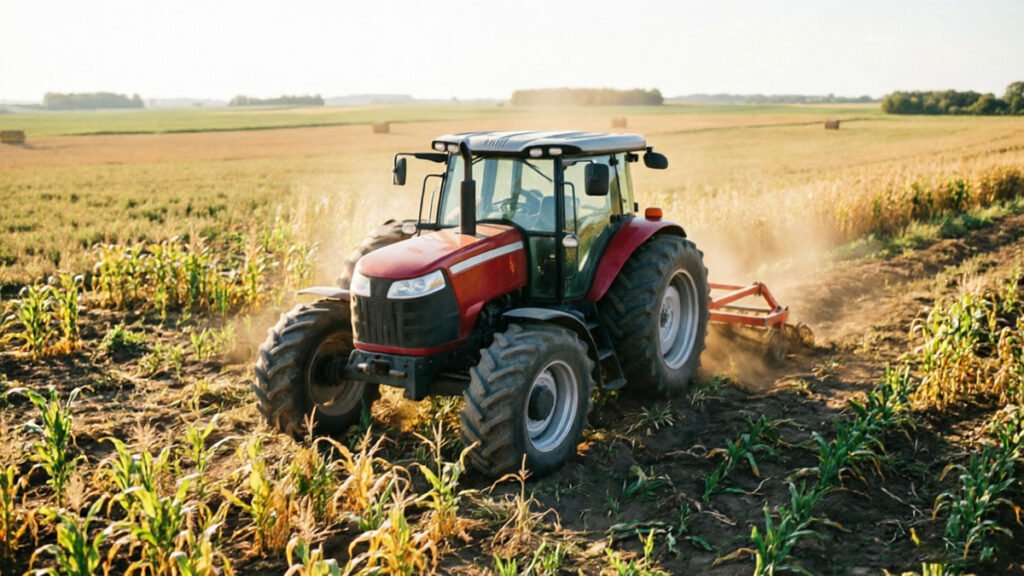
Among the top 10 tractor front end loader attachments, the agricultural suite delivers some of the highest daily-use ROI — especially on mixed operations where one tractor must serve both field and barn.
The compounding ROI of running one tractor across field prep, feeding, and stall maintenance is substantial — and it sets the stage for understanding how the same machine can serve equally demanding construction and site prep tasks.
For construction project leads, the tractor loader’s true value emerges when a single machine handles grading, digging, and material placement across a shifting daily workload.
A 4-in-1 bucket is the single most versatile attachment a site-prep crew can carry. Unlike a standard bucket, it combines four discrete functions — dozing soil, scraping a rough surface flat, clamshell-dumping loose material, and gripping irregular objects like rocks or debris. On a typical morning, an operator might use the dozing function to redistribute spoil from a utility trench, pivot to scraping a gravel pad level before a concrete pour, then clamp a pile of scrap lumber for removal. That range of capability cuts equipment staging time significantly on mid-scale commercial projects.
Leveling bars extend that precision further. Mounted in place of the bucket, a leveling bar drags and floats final grades to tolerances that bucket work simply can’t match. For site leads prepping pad foundations or parking areas, getting within a quarter-inch across a long run means fewer passes from a grading crew and tighter compliance with drainage specs.
Auger attachments round out the construction suite. Post-hole augers driven by the loader’s auxiliary hydraulics handle fencing, sign installation, and even foundation piers for small structures. Notably, standardized SSQA couplers allow tractors to share attachments across skid steer equipment in a mixed fleet, as noted by Equipment World, reducing per-unit ownership cost.
One critical caveat: on commercial job sites, CE-certified attachments are non-negotiable. Liability exposure and site insurance requirements mean that uncertified hardware can halt a project entirely.
Knowing which attachments to specify is one challenge — knowing where to source them reliably is another, and that’s where procurement strategy becomes the deciding factor.
Sourcing attachments factory-direct eliminates retail markup, ensures precise fitment, and delivers industrial-grade durability that third-party resellers rarely match.
The fitment problem with resellers is straightforward: a middleman sources from multiple manufacturers, meaning hydraulic tolerances and mounting points often vary batch to batch. According to Seekmach Industrial Research, integrated production systems ensure that hydraulic tolerances and mounting points meet strict industrial-grade performance standards — a consistency that’s nearly impossible to guarantee through a multi-vendor supply chain.
OEM/ODM customization matters more than most buyers realize. Tractor loader geometry differs meaningfully across brands and model years. A factory with genuine OEM/ODM capability engineers attachment geometry to your specific machine’s lift arm spread, pin diameter, and hydraulic flow rate — not a generic universal spec that fits everything adequately and nothing perfectly.
Manufacturing tenure is a reliable durability proxy. Suppliers with 15 or more years of attachment production have refined their weld schedules, steel-grade selections, and heat-treatment processes through real-world field feedback. That institutional knowledge simply cannot be replicated by newer fabricators competing on price alone.
When evaluating a factory-direct supplier, verify these criteria before committing:
Choosing the right supplier is ultimately an equipment strategy decision. The next section pulls everything together — from coupler standards to upgrade sequencing — so every dollar invested in your loader ecosystem delivers maximum return.
A tractor loader configured with the right attachments stops being a single-purpose machine and becomes the most cost-efficient workhorse on any property or jobsite.
The core principle is simple: one machine, configured strategically, outperforms several underequipped ones. Following this four-step framework turns a stock loader into a multi-tool platform that pays for itself across seasons. If you still have questions about compatibility, capacity trade-offs, or maintenance specifics, the next section addresses the most common practical concerns head-on.
Smart attachment decisions start with honest answers to the questions operators ask most — here are four that directly affect safety, performance, and uptime.
Can I use skid steer attachments on my tractor loader? In many cases, yes — provided your tractor loader uses a universal skid steer quick-attach plate. However, the hydraulic flow requirements differ significantly between machine types. Always verify that your tractor’s hydraulic output matches the attachment’s demand before purchasing. Mismatched flow rates reduce performance and can damage auxiliary circuits over time.
What is the lift capacity trade-off when using a grapple? A grapple adds structural weight to the front of the machine, which directly reduces your net lifting capacity. In practice, operators typically lose 150–300 lbs of usable lift capacity depending on the grapple’s size and construction. Factor that offset into any load calculation before attempting to move heavy materials. If you’re comparing grapple types for different jobs, matching the design to your material type preserves as much net capacity as possible.
Do I need a rear counterweight for heavy loader attachments?Yes — rear ballast is non-negotiable when running heavy front-end loader attachments. According to TractorLife.com, rear ballast is essential for maintaining tractor stability and traction when the front end is loaded. Without it, rear wheel lift becomes a real hazard, especially on inclines or uneven terrain.
How do I maintain hydraulic quick-connects in dusty environments? Dust and debris are the leading causes of quick-connect seal failure. Always cap open couplers immediately after disconnecting an attachment. Wipe coupler faces clean before reconnecting, and inspect O-rings at every attachment swap. A simple routine like this extends component life considerably and prevents costly hydraulic contamination repairs.