Telephone/WhatsApp:+86 156 2656 0610

Telephone/WhatsApp:+86 156 2656 0610
Email:info@seekmach.com


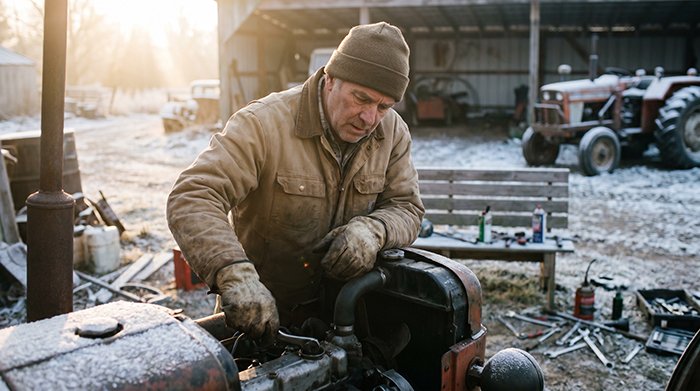
Winter doesn’t announce the damage it does to your diesel tractor — it works quietly, invisibly, and expensively while the machine sits idle in your barn or field.
By the time spring arrives and the engine refuses to turn over, the real harm was done months earlier. Understanding how to winterize a diesel tractor isn’t just about preventing a frustrating morning in March — it’s about protecting a capital asset that can represent $50,000 to $150,000 or more in fleet value.
The most costly damage is often the one you don’t anticipate.
Cold temperatures affect diesel equipment in various ways. Engine blocks can develop hairline cracks when coolant protection is inadequate and water expands as it freezes — a failure mode that doesn’t always announce itself immediately but quietly compromises structural integrity over successive freeze-thaw cycles. As Penn State Extension notes, “The most important winter maintenance task is ensuring the cooling system is protected to the lowest expected temperature in your region.” Fuel systems face their own silent assault, with moisture infiltrating tanks through condensation and contaminants settling into injectors during long dormancy periods.
For fleet managers, the financial calculus is straightforward. A $30 bottle of coolant additive and an afternoon of proper shutdown procedures can prevent a $4,000 engine block repair or a seized injection pump replacement. Winterization is ROI preservation, not optional maintenance.
What makes this particularly insidious is what industry professionals call invisible degradation — the cumulative deterioration of seals, gaskets, fuel quality, and battery charge that happens with no warning signals whatsoever. The tractor looks fine sitting in storage. It isn’t.
One of the most underappreciated threats falls squarely on the fuel system — and that’s where diesel gelling becomes the hidden enemy of every spring startup.
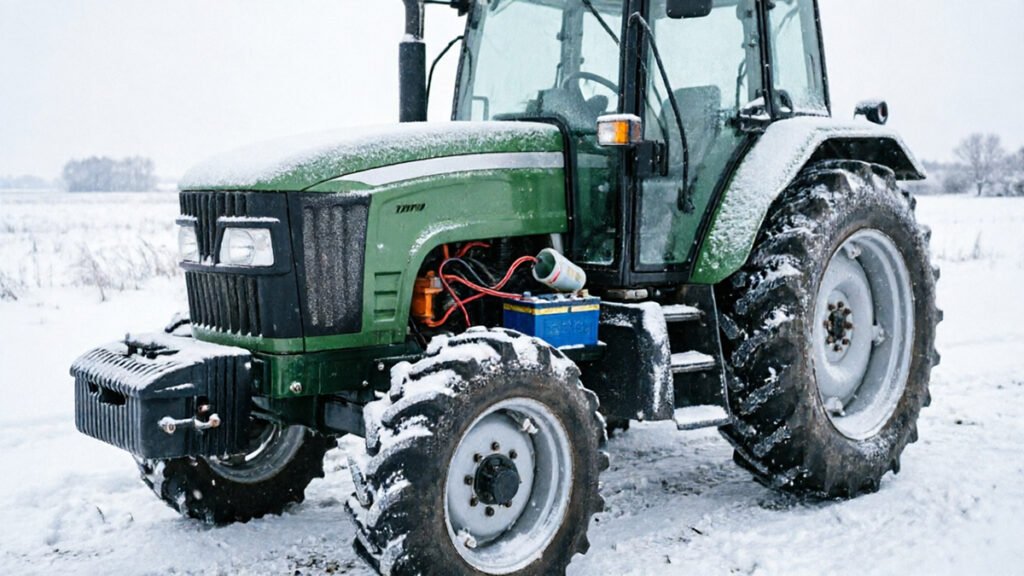
Diesel fuel chemistry is one of the most overlooked factors in tractor winter maintenance — and it’s responsible for more spring no-start failures than most operators realize.
The Cold Filter Plugging Point (CFPP) is the temperature at which wax crystals in diesel fuel become large enough to block a fuel filter. Every diesel blend has one, and standard No. 2 diesel — the workhorse fuel used throughout the warmer months — has a CFPP that sits dangerously close to common winter temperatures. According to Mobil’s Diesel Technical Bulletin, diesel fuel can begin to gel or wax at temperatures as high as 32°F (0°C), clogging fuel filters and preventing engine ignition entirely.
What physically happens is this: as temperatures drop, paraffin wax naturally present in No. 2 diesel begins to crystallize. Those crystals accumulate on the fuel filter media, restricting flow until the engine starves for fuel. The tractor cranks, but nothing fires.
The fix involves several practical strategies:
⚠ Warning: Adding anti-gel after the fuel has already waxed won’t dissolve existing crystals. Treatment must happen before temperatures drop — not after a failed start attempt.
Ensuring your fuel is protected against gelling is only part of the winter-readiness equation. The system responsible for keeping internal engine temperatures stable presents its own set of cold-weather vulnerabilities — starting with what happens when coolant isn’t mixed to match your climate.
Frozen coolant can expand with enough force to crack an engine block — and getting the antifreeze ratio wrong is one of the most preventable causes of catastrophic spring damage.
The physics are unforgiving. When water freezes, it expands by approximately 9% in volume. Inside the confined passages of a cast-iron or aluminum engine block, that expansion generates thousands of pounds of pressure per square inch — more than enough to split the metal. Unlike diesel fuel gelling, which typically leaves you stranded without starting, a cracked block leaves you with a repair bill that can exceed the tractor’s resale value.
Mixing ratios are where many operators cut corners. According to Penn State Extension, a 50/50 water-to-antifreeze ratio is the standard recommendation, but that baseline only protects to around -34°F. In more demanding conditions, a different approach is warranted:
| Climate Severity | Recommended Ratio (Antifreeze/Water) | Protection Level |
|---|---|---|
| Mild (above 0°F) | 50/50 | Down to -34°F |
| Moderate (-20°F range) | 60/40 | Down to -54°F |
| Extreme (below -20°F) | 70/30 | Down to -84°F |
Note: exceeding a 70/30 antifreeze-to-water ratio actually reduces freeze protection — more antifreeze is not always better.
Testing existing coolant is a step many skip entirely. A simple inexpensive hydrometer, available at any auto parts store, draws a coolant sample and shows the freeze point on a float scale. Test before temperatures drop — not after the first hard freeze.
Bold callout: Test your coolant strength every fall, not every spring. By spring, the damage is already done.
With your cooling system secured and fuel chemistry addressed, there’s one more threat hiding inside your tractor’s cab and engine compartment — and it has nothing to do with temperature.
Rodents are one of the most underestimated threats in tractor storage, capable of destroying a complete wiring harness over a single winter — silently and without warning.
The problem has grown significantly worse in recent years. Many modern tractor manufacturers now use soy-based wire insulation as an eco-friendly alternative to petroleum-derived plastics. In practice, this means the wiring in your 35HP–90HP tractor smells like food to mice, squirrels, and rats. They don’t chew wiring by accident — they’re actively attracted to it. According to the University of Minnesota Extension, rodent damage to electrical wiring is a leading cause of non-mechanical failure during long-term winter storage.
Common nesting zones in mid-range tractors include:
Once you know where they nest, deterrence becomes straightforward. One practical approach is to combine multiple low-cost methods rather than relying on a single solution:
🌿 Peppermint oil on cotton balls placed near entry points creates a scent barrier rodents strongly avoid — refresh every 3–4 weeks during storage.
🔩 Steel wool packed into gaps around the firewall, floor openings, and air intake passages physically blocks entry without trapping moisture or chemicals.
🪤 Snap traps positioned around the exterior perimeter catch scouts before they establish a nest inside the machine.
Ignoring this threat can be costly. A replacement wiring harness for a mid-range utility tractor can run $800–$2,500 in parts alone, not counting diagnostic labor. Complex cab-equipped models often cost more.
With your electrical systems defended, it’s worth turning attention to another winter storage vulnerability that operates on a slower timeline — what cold temperatures do to your tires while the machine sits idle.
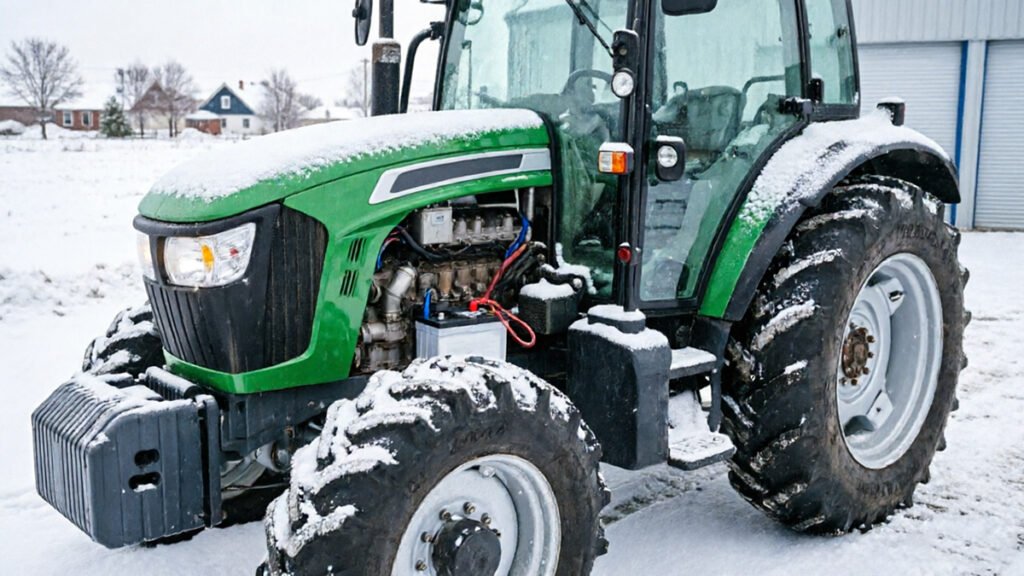
Tires are one of the most overlooked components in heavy machinery winterization — and a single season of improper storage can permanently distort a carcass that costs hundreds of dollars to replace.
Flat-spotting occurs when cold rubber loses its elasticity and conforms to the contact patch resting against a hard surface. Unlike a warm-season flat spot that rounds out after a few miles of driving, a winter flat spot set over months can become a permanent deformation — producing vibration, uneven wear, and compromised load stability when spring arrives.
Follow these steps to protect tire integrity during storage:
Bold callout: A tire inflated correctly and lifted off concrete loses virtually nothing to flat-spotting — the same cannot be said for one left deflated on a cold slab for four months.
With tire integrity addressed, the next critical concern shifts to the component that actually initiates every start cycle — and cold temperatures hit it harder than almost any other part of the machine.
A dead battery is the single most common reason a tractor refuses to start after winter storage — and cold temperatures are the primary culprit behind that failure.
Cold weather is a battery killer. When temperatures drop, the chemical reactions inside a lead-acid battery slow significantly, reducing available cranking amps at exactly the moment you need maximum power to turn a cold, viscous engine. A battery that tested at full capacity in October may deliver only 60–70% of its rated output on a freezing January morning.
Removing the battery to a climate-controlled garage or shop is one of the most practical steps in factory-direct tractor maintenance during the off-season. A stable environment above freezing slows self-discharge and prevents the freezing of a partially discharged battery — which can crack the casing entirely and render it unrecoverable.
Trickle chargers and battery tenders are the preferred tool for keeping a stored battery healthy. Unlike a standard charger, a smart battery tender monitors charge state and cycles on and off automatically, maintaining an optimal voltage without overcharging. This approach extends battery life measurably across multiple seasons.
Parasitic loads are an often-overlooked threat. Even with the ignition off, modern tractors with digital displays, GPS modules, or aftermarket accessories can draw a small but continuous current. Over weeks of storage, that slow drain can fully discharge a battery. Before storing, consider:
Addressing the battery now means it won’t be the weak link when spring work begins — and it’s just one piece of a broader storage process that’s worth approaching systematically, step by step.
A systematic winterization checklist is the single most reliable way to prevent spring no-start headaches before cold weather ever arrives. Work through each phase in order — skipping steps is where most problems begin.
Phase 1: Clean
Phase 2: Fluids and Filters
Phase 3: Lubricate
Phase 4: Seal
With these four phases complete, your machine is positioned for a reliable restart — but choosing the right fluids and fuel additives for your specific climate is what truly ties the entire winterization strategy together.
Preventing a spring no-start comes down to four non-negotiable habits: fuel treatment, coolant ratios, rodent protection, and tire management.
The checklist and battery guidance covered in earlier sections form the backbone of a solid winterization routine — but these four essentials sharpen that foundation into a complete defense against cold-weather failure.
Expert Tip: Proper diagnosis before storage catches small issues before they compound into expensive spring repairs — address every item on this list while the weather is still manageable.
The quality of the tractor’s components themselves plays a significant role in how well it tolerates these stresses — which is exactly what the next section addresses.
The best maintenance routine in the world can’t fully compensate for machinery that wasn’t built to handle extreme cold in the first place. All the fuel stabilizer, fresh coolant, and rodent deterrents covered in previous sections work hardest when the underlying seals, gaskets, and components are manufactured to tight tolerances from the start.
CE-certified manufacturing sets a meaningful baseline here. CE certification requires consistent quality controls across materials and production processes — meaning seals resist cracking under thermal stress, fuel system components maintain their integrity when temperatures swing dramatically overnight, and electrical connectors don’t corrode after a single harsh season. That engineering discipline is what separates tractors that respond on the first cold crank from those that become spring diagnostic projects.
OEM/ODM customization takes that foundation further. Operators in high-altitude regions, northern plains states, or coastal climates face conditions that differ sharply from one another. Custom-configured cold-start aids, climate-rated hydraulic seals, and region-specific glow plug specifications aren’t luxuries — they’re practical investments that reduce downtime and repair costs over a machine’s lifetime.
One practical approach is to treat maintenance as a partnership with your manufacturer rather than a solo effort. Seekmach, operating from a 50,000 m² production facility and supplying equipment to over 50 countries, builds with that global range of climates in mind. Their engineering teams understand that durability data from one continent informs better design for another.
Watch this quick cold-start troubleshooting walkthrough for more context on the benefits of good factory engineering:
If spring no-starts have cost your operation time and money, the smarter move is upgrading the foundation. Browse the Seekmach product catalog to explore CE-certified tractors and attachments built for the conditions your fleet actually faces.